Monday, September 23, 2013

Mauritius 4 - last month

In a week we will be gone from Mauritius, taking with us some wonderful memories…
 
An old Dutch fort lies under these French military ruins at Old Grand Port, Mahebourg
The Dutch first landed here about 1638 (calling the island after Prins Maurits van Nassaueiland). But the Old Port at Mahebourg proved disastrous, being on the SE side of the island which is exposed to the worst weather and their time here was characterised by hardship and failure. 
And the extinction of the large, flightless one-egg-per-year endemic Dodo bird.
And the destruction of most of the Ebony forests.
 
Looking eastwards to sea: a bad location for the port, as this area suffers heavy weather
The Dutch cleared huge swathes of Ebony forests but made some positive contribution by bringing in sugar cane plants from Java before they abandoned the island, leaving also macaque monkeys, java deer and fugitive slaves.

They had found, on the other side of the island, “Rade des Tortues” - “Harbour of the Tortoises”. 
 
The endemic Mauritius Giant Saddle-Back Tortoise became extinct but numbers of other large tortoises are now nurtured in parks
The French colonised this abandoned island in 1715, naming it Isle de France, and used “Rade des Tortues” (now known as Port Louis) as the main port, using mainly slaves to develop the island. The French influence has remained dominant, despite the British ousting them about 1810 and governing the territory until its independence in 1968.

We visited Le Morne peninsular, which is dominated by 556m Brabant mountain (in the distance on the left, seen from a Black River Gorge area viewpoint) - a basalt rock peak and UNESCO World Heritage Site.
 
Le Morne (“Mournful One”) Brabant mountain: site of slave tragedies
The craggy mountain is dotted with caves and overhangs and was a refuge for runaway slaves - and the site of tragedy. The British abolished slavery early in 1835 and a police expedition travelled there to inform the slaves that they had been freed; but the slaves misunderstood the reason for the policemen’s approach and leapt to their deaths rather than endure re-capture. The day is remembered by Mauritian Creoles in an Annual Commemoration of the Abolition of Slavery.

On the other side of the mountain, Le Morne lagoon is a windy playground - a stunning kite boarding spot!
Brilliant colours of grounded kites waiting their turn
We saw about 30 kite-boarders out simultaneously in a small area: an amazing sight!
 Discovering these areas with friends and family was a treat. We also enjoyed sharing some lovely areas of Port Louis with them… even if they sometimes complained about long walks!
 
Their smiles lie - Rolf and Carmen growled at me all the way up to the top of the Citadel!
But the view from the top was superb
After slavery was abolished, the British had to satisfy their subsequent need for cheap labour; they began a system of bringing in indentured labourers (a form of debt-bondage) particularly from India but also from China, Malaysia, Africa and Madagascar. This (often brutal) system ended in 1920, and has resulted in a mosaic of cultures living on the island. 

There are attractive reminders of Mauritian history and culture around every corner….


1736 windmill alongside harbour

 Lovely street lights on Place Nelson Mandela circle, at Port Louis Theatre
 Welcome to Chinatown
Small shrine on the water’s edge
Office of the Prime Minister of Mauritius
Many of the old Mauritian walls are built of beautiful black volcanic rock, as in the Prime Minister’s Office building, and any walk along the coast will take you clambering over these tumbled rocks.
 
Strolling around Grand Baie: sometimes white beach, sometimes black volcanic rock
Pretty beaches, beautiful sea, vibrant streets and colourful displays: lots to see here!


Magnificent fresh fish for sale in Grand Baie
Driving fish towards their nets in Merville Bay
 This is how you do it if you are a tourist – but YOU don’t keep the fish you catch! 
The boats each came in with about 6 magnificent Dorado
Colourful Dodo?
One wonders why the Natural History Museum in Port Louis shows them like this…
and behind it an artillery piece!
Our 4 month visit here will soon be over - we leave Mauritius on 30 September.
As we leave the harbour, we will pass a sight that has become familiar in our numerous entries and exits: this fire-damaged ship, the Brandenberg, was brought in by local tugs months ago.
The owners of the containers on board must have been frustrated…
but they were eventually offloaded and trans-shipped
 
Hopefully the overhaul and repaint has now begun
Au Revoir, Mauritius!


We will stop for a few days in Reunion then, when the weather prediction looks good for at least the first 5 days, we will set off for Richards Bay.
To see where we are on that voyage, go here….

Tuesday, September 3, 2013

Mauritius: magic month 3

Imagine a beach house leading from patio to shady grass to white beach to turquoise sea.

Imagine living on a yacht anchored a short distance from the beach, with your family in the beach house.

Imagine what a great place this would be for a family reunion... well, it really was!

Soft, balmy sunsets

Babies practiced "walking" (sorry sideways...!)
Grandparents got stronger!


The dinghy was always on standby, to act as transport and often climbing frame for beach children!

The yacht was a great place for celebrations...

... and also provided winches, ropes, anchor chains, fenders and other interesting play-items: a strangely different, wonderful new home to explore.
A window that looks down on people!
There was a successful day-trip to an island: even 90-year olds, if determined and plucky, can get from beach to dinghy to boat safely - what a celebration!


We ventured out for a car trip to a waterfall in the Black River (Riviere Noire) area: beautiful even in the dry season.

One of the most famous sights in Mauritius is the Seven Coloured Earth (s), a striking geological formation nearby, in the Chamarel plain. These sand dunes have seven distinct colours (approximately red, brown, violet, green, blue, purple, yellow); he differently coloured soil components settle in different layers, giving the dunes a beautiful patterned appearance.

Then followed a drive along the scenic south coast to the Gris-Gris headlands of Souillac, a rugged area very exposed to the SE Trade winds.


Back to the beach-house - at the end of the holiday, left-overs and toys were ferried back to Ketoro at the end of the holiday.
Mauritius had been a magical place for a family reunion!

These little ones inspired us to take another look at our journeys and experiences on Ketoro, and tell them in a way that would keep us close to them. So we have set up a blog for them:
At this stage it shares our animals with them - and all other children who may be interested!

Thursday, August 1, 2013

Mauritius exploring: month 2

It is easy to relax and have fun in Mauritius. Beyond the beaches and resorts (enough of those for a small island), a few car trips inland took us to other lovely and interesting places.

A dormant volcano, Trou aux Cerfs  (about 600m high, 80m deep and 300m diameter) with a well-defined cone and crater actually had Rolf walking around the lovely crater rim! No doubt he would have called it off as a high-risk activity if he had known it “could become active at any time within the next thousand years” (Wikipedia)!?
                            
Another reason to get up here is the spectacular views.


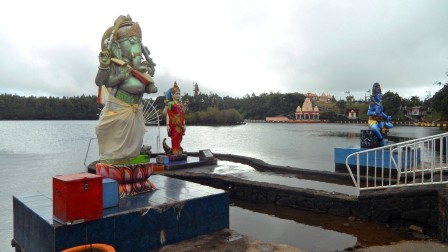
Also in the high central areas of Mauritius is Grande Bassin (Ganga Talao), a crater lake about 1800 feet above sea level and very chilly in winter!


This is the most sacred Hindu place in Mauritius and it must be astounding to be here during the annual pilgrimage.


Driving through the Black River Gorges National Park (where we debated hiking, but one of us suggested deferring this fun to another day), we looked down at the sight below, and decided we should take Ketoro to that small island, Ile aux Benitiers, inside the reef.


So to get closer to that goal, first Black River lagoon (Grande Riviere Noire) saw us dropping anchor a while later, and the calm and quiet with the backdrop of the Black River Mountains was a very pleasing contrast from Grand Baie and Port Louis.
 
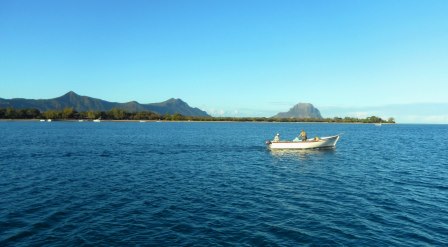
Going fishing
It is not only the local fishermen going fishing: this is the main base for big game fishing and marlin boats go out daily.

So now we had to get Ketoro from Black River to Ile aux Benitiers, as we had promised ourselves! 
After a reconnaissance trip with GPS, fish finder, iPad, beer (this is becoming routine with us!!) we found that there is a deep channel going in, and it was easy to get near to the island if we followed our iPad track carefully.
Safely in the channel but very aware that the chart detail is about to end abruptly
  
Blue dot in the channel is us
View south from Ile aux Benitiers anchorage
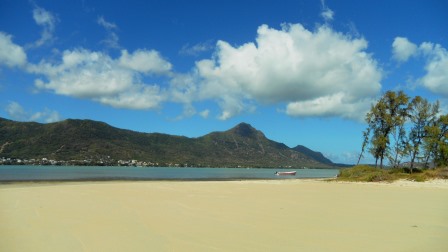
 Ile aux Benitiers island is flat and low and dry, but a good break from the boat.
We were captive in this anchorage for many hours, however, as gales came up and we did not dare take on the narrow, winding channel with the forces of wind and waves waiting to make mischief.

Leaving there finally, we sailed north up the west coast towards Port Louis and Grand Baie again - beautiful, distant views of emerald sugar cane fields at the base of the mountains.

Up close on land, the sugar cane was flowering…
After harvesting, the remaining plant material is evidently burned at the power station and great clouds of black ash sweep over the island…. settling mainly on all the white boats!!

Patrick and Sandy came to the boat for 5 days and experienced rather grumpy, windy, thundery weather. But friends will always have fun together, and happily they know us and the boat and the folly of fixed plans when sailing.

So it was that one day, trying at least to fulfil our promise of a trip to a nearby island, we experienced, in this order and in the space of 40 minutes of leaving the Grand Baie anchorage: the water-maker died; the predicted 16knot winds were actually a 35knot gale; the port engine overheated in a cacophony of engine alarms as we approached the rocky island.  We battled to hold course against wind and current on one engine, but when it was quite obvious that the cliffs to leeward had joined the conspiracy and were moving towards us, we were too close to try to sail out of trouble and had to abuse the starboard engine in hard astern for several long minutes to keep Ketoro off the rocks (or start up and really cook the overheated port engine).

In the subsequent discussion on whether to press on (after repairing the port engine) our friends understandably voted for drinks back in Grand Baie, where we remained to contemplate the bloody water maker while sending them off on the dinghy to explore ashore.

It was clearly not a turquoise-water day, and they just managed to scramble into a restaurant to sit out the rain-squall before returning “home”!
Much of our entertainment comes from watching the fun activities of tourists to the island. It is actually very easy to spy on others when their activities are water-based and whizzing around our boat. 

So we watch the water skiers: the expert ones (very few) confidently slalom and jump the wake with panache; the learners (frowning with fierce concentration, arse out, shoulders forward) try not to fall. The learners fall. The learners flip, tumble and shriek. The learners hit the decks.

And we watch the windsurfers: they all seem to be expert here, and the colours are brilliant.
And we watch the parasailors overheard. They generally shriek initially and then become speechless – unfortunately we are too far to see their expressions; awestruck, dumbstruck or rigid with fear? Sometimes they too are novices and the winds are strong; this is a bad combination, but handled well by the speedboat drivers: they go slowly. Sometimes the winds are very strong and the boats go…. Well, slowly: backwards.

And the dinghy sailors usually get great and challenging winds here, and this lot raced us into the bay…

And when the wind dies, they contemplate the horizon and wait for the breeze!

Then also, we watch the odd assortment of inflatable stuff being dragged behind speedboats: bananas, armchairs, boards… always with lots of shrieking.

Grande Riviere Noire provided a new twist: tiny jet-engined rigid inflatable boats for hire… they move as a fleet with their own lead / security boat. Watching from Ketoro: the powerful security boat goes out, stops ahead of us, and with a variety of energetic hand signals tries to communicate to testosterone-laden jet-boat drivers to spread out and remain behind him. Time passes as we watch the drivers with their nonchalant lack of co-operation barge around in their new-found toys. Eventually order is restored, the hapless passengers’ white knuckle grips relax, and they race off to nowhere and back after about 30 minutes.
Heading into Ile aux Benitiers channel, they appeared like a line of skirmishers!

Now that Sandy and Patrick have gone, what are we up to?
Preparing for more fun.
How?
Irene finds prehensile toes are a boon working with baby netting in the wind!
Baby net!

So this is what sunset looks like from behind the safety net. Beautiful!