Sunday, December 20, 2009

Looking back and forward: what is normal?

Well, we are two weeks into the Seychelles and it has been an interesting experience again: learning about procedures, how the new places operate, what they have to offer to whom and where.

While every time we get to a new port of entry we learn more about what we are supposed to do to clear in, it is very different in each place and so, mostly, we don’t know what to do… i.e. what to give to whom and where (the when is basically as soon as you come in, assuming it is not a weekend, public holiday or lunch time!) You may have read about our last experience….. dealing with the officials in our pj’s over cereal in the boat! But it is not just official procedures. Where do we shop for what and what is the benchmark price? How do we get around? Which beaches/islands can we visit and put down anchor and what do they offer? Where can we afford to eat, if we choose to eat out?

More importantly… how will we deal with our new circumstances, when will we adjust and when will new circumstances seem normal to us? In an e-mail I told a friend that things were settling down to normal, then followed up by telling her I took advantage of a good rain to put my cossie on and go outside to clean the whole boat down and thereby use the fresh-water rinse on offer. Well, this apparently caused my friend much mirth and exclamations of “Normal!!??” Well, it seemed normal to me…. Am I going “bossies” …?!

With this in mind we set to and developed a list of our new “normal”.

To help you visualise our current circumstances, to which we have grown fairly accustomed but cannot say we love them all, here is what we deal with daily: wet feet and wet floors (humidity), wet bums and pants (dinghy travel… and Rolf’s race-car driving!), being permanently sodden and streaming (no lovely “glow” in this heat and humidity!); always acknowledging the elements to be in control (sun… there is not enough suncream in the world, wind… which decides on how we will get there, water(sea state) … dictates the ease and comfort of the ride and the sleep); sleeping with no bed sheet deliberately so that we feel the rain as it falls through the hatch onto our legs (and then we know it is raining…. and can leap up and run around and close all the hatches, which were kept open for air); sore, tired muscles from doing work at odd angles, lots of walking to get anywhere, and getting chores done in an environment of stairs, constant movement, limited space, pull starting the outboard motor instead of turning an ignition key - everything is transported by dinghy which involves lots of multiple handling on unstable surfaces; endlessly monitoring our use of resources (when last did you check or limit your water consumption during a shower/gas consumption whilst cooking/fuel consumption while driving/battery condition when using lights/plastic bag consumption for garbage disposal?); regular inconvenience of accessing stuff (either you cannot remember which locker it is in or it is at the back/bottom of the locker); changing our land view even when not travelling – while swinging at anchor or on a mooring (very disorientating at night and when trying to figure out if the anchor is holding); sailing and its attendant sail work and on arrival evaluating options and then executing a mooring or berthing or anchoring – generally resulting in even shorter or broken finger nails. These are not complaints, merely observations of how different and physical our life has become.

Then there are the different standards in presenting oneself (well, for starters, if we are both happy with the other as hair stylist, our standards must have changed…!); different expectations of yourself (if there is a problem… Just fix it!) and of your day (it will be unpredictable: Murphy is a demon operator on boats) and of your life (deal with what comes your way and don’t expect to have much control… A funny one: the tall red postbox outside the café at Inhambane received Laura’s postcards and we happily moved on having completed a little task. Wrong! Walking past the BACK of same postbox the next day revealed it to be a dustbin… silly us to assume all was exactly what it seemed. Happily the postcards, on top of the pile of rubbish, were fine and able to be posted again… at the post office this time.)

So, that is the current “norm” about us. What is the norm in the Seychelles and how does this early days perspective differ from Madagascar?

The Seychellois: friendly, helpful, with a strong environmental consciousness. They have strict rules regarding litter and use of resources, including who may use their islands and beaches. Madagascans, also friendly and helpful but more naive, appear less environmentally-aware; they have no facility for dealing with litter, for example: the backs of their villages are liberally strewn with debris and if a helpful boat-man in a harbour offers to take your rubbish packet, you will return to find it strewn over the dock or in the water (however he will have scanned it for useful things like bottles, a precious commodity). When looking over Madagascar you will see telltale smoke from at least one fire at any time; the belief is that burning forests will help to enrich the soil with its coal/ash. A consequence? Only about 15% of their forests remain and land is not becoming enriched. Only Sakatia Island has a ‘no-burning’ policy, due to strong ex-pat influence, and it is regarded as the richest island for the communities.

However, the Madagascan attitude assists yachties in that we are allowed access virtually anywhere: cruising is an absolute dream with freedom of access to the beaches and islands (unless a luxury lodge frowns at you for blocking their view). In the Seychelles we are disappointingly restricted: many of the islands are privately owned or fall under National Parks, the latter resulting in a daily fee of approximately R150.00 (SA Rand) per person, and another R200 for the yacht (and no facilities for this except access). In fact, here is another normal for our life as we live it in the Seychelles….COST!!!! My first cappuccino since Cape Town was bought by a kind Rolf at a cost of almost R50 (last cappuccino!); we paid R80 for a (large) pineapple the other day…. a bit ripped off as they are normally R60; soft tomatoes from R6 to R8 each and I passed on the Walker’s Christmas mince pies at about R15 per pie. However, some of the Creole cooking takeaways from the street vendors are tasty and cheap at about R20 – R30; but then need to be washed down with beer (local) at R20 and up to R45 in restaurants.
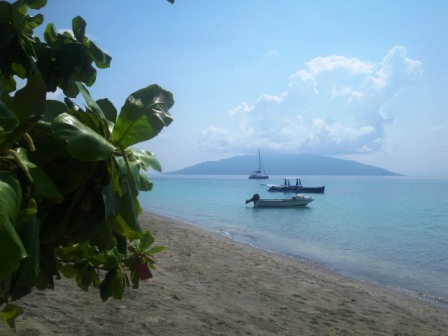
Nonetheless, the Seychelles islands are beautiful. Victoria (on Mahe) is one of the tiniest capitals in the world and has lots of charm – similar to Pietermaritzburg 40 years ago, but is busy and vibrant during the season; Mahe Island has some lovely spots but plays second fiddle to Praslin and La Digue, the main tourist islands… and the other 102 islands! The photo shows Chauve Souris, a private island off Praslin.

We look forward to visiting about 10 of them in our stay before we leave for Chagos and the Maldives at the end of Feb: many islands to the SW of Mahe will be avoided since they are privately owned, many are declared National Parks (and we will not often pay their fees) and many thanks to the pirates (although we have already seen two US Navy warships in Port Victoria… pirate patrol),.

The Seychellois are a colourful people (those on the smaller islands often adopting a Bob Marley-way, complete with accent) and are a range of colour themselves. To paraphrase a local guide book… in the Seychelles, “marriage is not a restrictive institution”! In Madagascar, meanwhile, a young French artist who had worked there for three years told me he was approached by a village chief to please spread his seed and increase the local gene pool (a problem in the small villages).

Rolf is presently drinking a toast (with his cheap Madagascan beer at a mere R12) and paying tribute to one of his favourite items of equipment – a 3 metre scaffold plank that found its way aboard in Richards Bay and has adorned our stern ever since. It has served as a gangplank; a fish cutting board; a coconut chopping platform; a workbench; a fender board; a fixture to secure additional diesel jerry cans on the trip from Madagascar; a washboard (to prevent big following seas from breaking directly into the cockpit); as a lever and as a jacking base to lift the starboard engine, weighing in at a couple of hundred kgs, back onto its mounting bolts (from which it had jumped at some time after a securing nut had unthreaded itself – your engine has not done this after a couple of months use?); and most recently as a scaffold plank to reach an otherwise unreachable light fitting in the cockpit roof (in order to drain the water from the fitting – see above for the new “normal”)


This second photo (also displaying the beauty of the plank)shows an example of interesting mooring practice undertaken by a couple in the charter yacht on the left… gave us a few moments of tension as we watched from the bank!

Today was boat cleaning day and putting up the canvas cockpit screens to enclose the large cockpit and effectively add an additional living space – useful when it rains, which it does a lot of in the current rainy season here! Particularly valuable because our children arrive in the next two days to fill the boat, share Christmas, New Year, interesting experiences, beautiful beaches, a lovely sea and a new look on our world.

Tuesday, December 8, 2009

Friends visit, playing survivor and surviving a passage

Ok, so this is a long one. Bear with our stories but a lot has happened…. If you want to take it in shifts, we have broken this entry into two coffee-break pieces: You too can have fun with us (the visiting friends part) and You too can survive a passage with us.

You too can have fun with us
We had guests for a week! Alice and Noel were the first of our friends to be brave enough to trust our sailing so they spent a week with us in Madagascar… a week that was wonderful, enjoyed by all, and provided interesting challenges…!

At the start, getting from your plane to your holiday accommodation is a different process when you are joining friends on their boat: arriving at night, the Shaws were picked up at the airport by a stranger, subjected to a long and rough taxi drive to a beach in the dark and then met by a small speedboat which would take them across a to another island where our boat was anchored. We were at Chanty Beach to meet them so they would not feel abandoned (or abducted) and as we walked in the dark over the rough eroded ground and then the beach to board the little transfer boat, Noel’s comment was that it felt like they were in a show of Survivor.

Waking on the first morning in paradise (a bay on Nosy Sakatia), they snorkeled off the boat and enjoyed coconut, mango, banana and papaya smoothies. During the course of the week we showed them all our favourite islands, beaches and snorkeling spots. Before continuing, a clarification… Alice says that reading that we “snorkel from the boat” simply does not convey the experiences we (and now they) have had: the snorkeling from the boat has, on many occasions, been on par with many previous scuba diving experiences. It is truly wonderful.

We played survivor on a tiny lovely beach in Russian Bay, dragging firewood around and making a great fire for a sunset braai. Never have beer, red wine and pork chops gone down better… and it seems the hermit crabs who tried to make beer cans their new homes, and those that FEASTED on the bones, felt the same. (Note that we are very environmentally conscious and feed the locals before removing our mess!)

Speaking of beer…. part of Noel’s survivor training was getting his stomach used to the local beer, which comes in quart bottles and spends days standing in the sun while in tortuous transit from Tana; after an initial wobbly however, he mastered the skill! At all times Alice and Noel were great “crew”: Alice proved a dab hand on the helm, Noel was fisherman and they both cleaned and tidied endlessly!

We did the tourist thing with the craft market at Nosy Komba and shared with them enchanting lemur experiences (Moms with babies wrapped tightly round them, both eating off your hand) then anchored off Lokobe National Park and sent them for a walk along the river in the wild.
Their eyes were big on their return, with tales of being chased out of the forest by the MIGHTIEST roar (“Didn’t you hear it on the boat?”). Chats to a local later revealed this terrifying roar to be made by the tiniest lemur in Madagascar…! That night we were subject to our rolliest sea; to our chagrin (or rather, read into that some fear and anxiety) Madagascar was hit by its first cyclone and we were on the outskirts of it, happily feeling only the impact on the water. Of course, you only know after the event that you will only experience the outskirts of the cyclone, while for days having a gnawing worry that you may have to survive its coming over you… it did not. Alice and Noel had to survive a hot, enervating day in Hell-Ville, but they found it easy by retreating to the local watering-holes and waiting for us as we completed official country exiting procedures and food and fuel provisioning.
Now to the real “survivor” experience… wherever we went, between boat and other activity, we used our trusty intrepid dinghy. It has a small “bailing bucket” in it and we joked as we left on day 1 of their visit (for the first time 4-up in the dinghy) that Noel was to be chief bailer. All went well in the morning but our return saw post-lunch revellers in choppier water with light swell and not paying heed to their weight distribution. It all happened so quickly: Irene saw turtle fin coming out the water and exclaimed; all turned to regard said turtle; water came over the front of the dinghy in a great torrent; all looked stunned momentarily as the second wave came over and submerged the nose of the dinghy as Noel simultaneously BAILED!! – off the boat! By doing so he began the start of our recovery, which continued with Rolf ensuring he kept the motor going to prevent stalling and the three-men-in-a-boat fiercely bailing out water. This word bailing implies method and control: the reality is that the boat was 7/8 full of water and sinking, the bail-bucket (half plastic coke bottle) was lost somewhere amongst 8 floating fins, 8 f-ing walking shoes, 8 f-ing fin booties, 4 f-ing masks and snorkels, clothing, suncream etc… we scooped MADLY with whatever we could: hands, shoes, feet (!) while Rolf used only one hand to scoop and kept the dinghy going in circles with the other. That was the other time Noel played survivor: only he knows how many times Rolf nearly rode over him. Then, when there was some evidence that we may be winning the war on water, Rolf noticed one of his crocs floating off in the distance. So we abandoned Noel and went to fetch it…. leaving Noel to play survivor! Summarised list of casualties: two ladies tops (used for snorkelling), one pair sunglasses, one camera (didn’t like the bailing), four people’s dignity. Summary of the event: we were never in any danger, but the motor would have been, and the post-mortems were hysterically funny!

Summary of the visit: WHAT FUN!!! You too can have fun with us… when are you coming?? Don’t be scared… we are more cautious on the dinghy now, and can sail the yacht really well, having just undertaken a passage completely on our own…

You too can survive a passage with us
Turns out spending a month cruising between islands and anchoring in generally calm waters spoils you and makes you forget that this is not really sailing. So, preparing for passage to the Seychelles, we had to get our minds and hearts back into the idea of sailing through the nights, constant movement under-foot, galley issues, real weather issues with few hide-away spots… and in this case, the added worry of piracy.

The day after the Shaws left, we got underway, having ascertained that the cyclone had gone and weather was good with only a low-pressure system building far in the east and no new cyclone threats. Wake-up call: the sea was horribly disturbed, wind on the nose, could not sail decently but had to power into it… and we both elected to have sea-sick tablets (probably partly induced by nerves). We had two days before leaving the northern tip of Madagascar and on both nights settled into fair anchorages to get some sleep.

Two issues: one… the northern tip (Cap St Andre) is notorious for funneling the seas and winds around it at great speed from the SE so one needs to steer clear and have conservative sail settings, attempting it only when weather conditions are appropriate. We had these conditions. Second issue: of course, both the UK and Dubai-based Maritime Safety Organisations had advised against sailing to the Seychelles (“why not sail in the Caribbean rather?”) as they had to do, with a couple recently being taken by pirates near the Amirantes (one of the Seychelles outer island groups, SW of the main island). We called the Seychelles Coast Guard and advised of our plan to avoid that area by sailing via the Farquhar islands to Coetivy Island, well to the east of the Amirantes. They approved of this plan, and all we spoke to said “head east as soon and fast as possible”.

So we left Madagascar behind us and to our dismay found, firstly, that we simply could not sail east immediately because, although the weather was good, the wind and current were still strong enough to make that virtually impossible and we had no option but to go north…. and, secondly, that we had no more money in our satellite phone account, could make no calls and were about to be cut off completely. (Aside… we had initiated the process of getting more money into the account with our provider but a series of events occurred so this was not completed…. Panic!) Fortunately an sms to Mark was received by him, he called us back and got the show going and the next day we were back on track.

Clearly, we got here safely (the Google Earth site linked to the blog shows our route, updated after we got here to foil the pirates!) and the trip was good, interesting, challenging, tense and simultaneously peaceful! The Indian Ocean north of Madagascar is fascinating: nearer the equator it can be like glass, reflecting the clouds around the rim of this apparent blue dinner-plate (Irene wanted to subscribe to the flat-earth society) but within twenty minutes can turn into a broiling, rolling, confused mess as storms on various sides all make themselves felt on the surface.
We were sometimes covered with gentle showers which moved over quickly and did not change the sailing at all but once after two days of the utmost calm and almost no sailing-wind we were assaulted from all sides and had to survive about 12 hours of heavy weather.

Watches were shared equally between us in 4-hour shifts, with Irene always given the 4 to 8am watch: a real treat, as testified to by the photos. For the first few days we were guarded by a full moon that turned the sea to silver and one morning the rising sun turned a cloud gold, bathing the whole area in magnificent soft golden light.

We were accompanied by birds en route: two hitched rides on the boat as they rested and many others used us to assist them feed…. dozens of flying fish would be disturbed from the water as we passed them and the birds would swoop down on them, capilitalising on the ungainly flight of these odd fish.
Some watches were delightfully peaceful while others required hard work and management of sails and route. All watches were tense as we scanned the horizon for fast-approaching dhows, in the knowledge that we would be able to do nothing in that situation but pick up our contingency “pirate bag” and spend Christmas in Somalia. This may seem overly dramatic but it was the reality and brought about the decision not to stop at any islands en route but to make way as fast as possible to our destination and avoid all exposure: hence no night lights (not even navigation) and no radar - just very sharp eyes. Also hence a conflict between joy at the brilliance of full-moon nights but tension that it made us more visible.

We were of course pleased to arrive here at Mahe Island late on Sunday afternoon but were too exhausted to really celebrate. We had to anchor outside the harbour with the yellow Q flag (standard practice to inform authorities you have not yet cleared in) and wait for them to come out to the boat on Monday morning. We were in bed at 7:30pm…. and embarrassingly slept through the arrival of the 6 Ports, Customs, Immigration, Health, Coastguard and Police guys on their launch at 7:00 on monday morning so that they had to return at about 9 and found us eating breakfast!

We have discovered normal life… a calm night at Seychelles Yacht Club, people across all sectors with a good service ethic, a little town with recognizable supermarkets and a movie house!! (But still no rooibos, provitas, bran or non-chocolate muesli!) Note: please don’t visualize Seychelles Yacht Club as the Royal Cape…. We are on a mooring buoy, no water or power provided by the club, tuna factory and noisy streets alongside. But the food is good and cheap…. Especially by Seychelles standards! After a few days of settling in here we will check out the neighbouring islands and prepare for the arrival of our next sets of visitors…. Mark and Livi, Barry and Kay are coming to join us for Christmas in the Seychelles!

Friday, November 20, 2009

Cruising into it in Madagascar

So, looking over our last two blog entries I saw things about which I am happy to say we have moved on… for example previously I said of the edibles on offer: “different eating patterns here… we went for the fruit!” Well, we are learning (but will NEVER get to turtles, which we see almost daily cruising around us): we eat the most odd-looking veg and fruit (sometimes to our regret) and have used all parts of the fish except the tail! We have not yet got to making Malagasy fish biltong like this:

Further evidence of our moving on: we are learning to collect useful bits of old carpet, bottles, etc (we have delicious pouring wild honey in a Sunlight Liquid bottle: have you ever thought of a better use for said bottle?); we have sat at the same anchorage in Madagascar for three nights before moving on (…but that “week-in-the-same-place” scenario is still looking unlikely); we have each started a second book; we are not impervious to the pleas of “Donner un cadeau” (gift please) and have been known to return to the boat to fetch the clothing or cigarettes (the latter specially bought for this purpose: Rolf has not started smoking again) and bring back to the happy recipient on the beach.

In contrast to a previous off-hand and boastful comment, we have learned that fish do not just throw themselves at you and ask to be eaten: in fact, they even make their escape after gaffing and on the boat (which meant beans for supper). Nonetheless, despite some bad fishing experiences – ones that got away - we have a freezer full of fish and eat it almost daily (although Irene is trying to get over her problem of the short time between the poor dude’s happy swim in the water and eating him).

Another challenge provided by the fishing experience from which we have learned a big lesson: if you do not reel in your lines before the boat anchoring process, the lines will immediately get themselves wound around your rudder (starboard side) and prop (port side). The consequence was mild in this case: relaxing over sundowners was replaced by about 2 hours with scuba tank under water trying to pick off/out as much of the line as possible…. and fortunately it seems enough was pulled from the prop to avoid lasting damage.

We have anchored in water that is exceptionally translucent and had the good fortune to snorkel or dive right off the boat. The quality of these waters and extent of the marine life is amazing and cannot be adequately described in words.

We have experienced wonderful nights at quiet, calm anchorages where it felt like we were in a (normal, foundations-in-soil) house again. However, we have also been on the receiving end of horrible stormy, rolly seas, with waves slamming fiercely into our bridge deck …. and this while at anchor!! On such nights your eyes feel like they are rolling around in your head and you cannot read or do anything constructive; basically, you exist and wait for it to pass, as it will undoubtedly do. The only positive thing is that sometimes these rolly seas are due to a rain storm…. and the boat gets a fresh-water wash!

(Below: … speaking of washing……!)

The appearance of storm clouds precipitates (besides butterflies in the tummy) a rapid battening-down-of-the-hatches and gathering of all electronic goodies (computers, VHFs, GPSs, sat phone, cell phones, digital barometers etc) to place them in the microwave or oven for protection from lightning strikes (it would be nice to have something electronic left usable if that calamity should befall us…. And these steel cabinets act as a Faraday cage). Lately, we have seen storm clouds gathering in the east every night … and we worry, as we hear the first cyclone has hit the east coast of the Madagascar main island. However, we have been assured that cyclones do not get to this western part of the island (which has its own micro-climate) until late December, so we will make sure to miss that appointment!

Local knowledge like this is invaluable and one of our challenges is how to access it. Apart from weather advice, it is enormously useful for us to hear about recommended anchorages (the bad, rolly ones we found ourselves in are sneered at by those in the know… we hear after the event!) and good dive spots (we try to see where others are going, but sometimes we are in remote areas where there are no others to follow). Rolf describes us as behaving like Ricochet Rabbit: bouncing around from place to place trying to find the right spots, instead of taking the time to discover these in due course; or alternatively having advance knowledge to get to the best places immediately.

We have explored many of the smaller islands around Nosy Be (Nosy: island; Be meaning big).

Nosy Tani-kely, Nosy Tsara-bajina and Nosy Komba have been wonderful finds: the first two for their exceptional white beaches, turquoise waters and marine life and the latter (despite being touristy) for its local village, crafts, cheap on-shore dinner (2 prawn kebabs and sautéed veg for R40) and nature park where we had lemurs on our shoulders (so gentle, light and soft, quietly eating their bananas next to our ears), followed by a boa constrictor (different adjectives here….) and examined the chameleons and range of tortoises. Irene’s “instinctive-Mum” tendency to assist the almost-falling banana into the tortoise’s mouth resulted in an inadvertent clamp-down on her finger… those beaks are STRONG!! Nosy Mitsio is a U-shaped island that provided a great restful anchorage in the centre of the U… while the Madagascan Zebus on the beach took us home to South Africa’s Transkei Nguni cattle.

We often return to Nosy Sakatia, where one of the anchorages tends to act as a base to many yachties who gather at the hotel lodge there for sundowners. Here, we have met many people (frequently South Africans) with varied stories to share … some of which are necessary to hear, but one hopes not to go through similar experiences! Some of them (the Lalamanzi’s, Ballyhoo’s and Gambit’s: people are referred to by their boat name here) have been sailing for a few years and have just started their trips home to SA; they were dismayed at the front coming up the coast, but one learns to read the weather and duck away from it where possible. Others are on their way up to the Seychelles and still others on their way to Tanzania.

Rolf still has not stopped looking at every boat he comes across. He is particularly impressed with the dhows and pirogues: such old technology, yet so efficient on their narrow hulls. However, now that Rolf is (learning to) become a fisherman he also spends time assessing fishing techniques and equipment. The crayfish trap below is of particular interest to engineers, it seems, but note the buoy: do not dismiss floating water bottles as being inconsequential to your voyage…. They could prove hazardous!

Of course, after jaunting around the islands it always comes back to replenishing the stores and for this we must go to Hell-ville. The town is apparently named after French Admiral DeHell; they have fortunately renamed the main road which used to be called Cours de Hell (Highway to Hell) and ended at the Catholic Church!

The old buildings indicate that Hell-Ville had a grand past and they stand beautiful in their avenues of stunning mango trees. However the rest of the town is typically run-down, if colourful.

The market at Hell-ville is really great, (although photos of baskets of huge moving muddy crabs, fly-infested meat and general spittoon channels on the floor have been omitted). We are trying the local spices and Madagascan green peppercorns, fresh vanilla pods and cinnamon sticks; we regard the ants falling from the latter during grating as a bonus but Rolf is less than happy to be sharing his Coco Pops with them. Rolf is also manfully trying the cheap Madagascan rum!

It is at times excruciatingly hot here and shopping day is a time to grit your teeth, trudge between the market and various stores with your bags and taxi driver in tow, get it all (3 big boxes - which all proved to be frail - 10 bursting packets and 1 jerry can of petrol for the outboard) to the harbour, fight your way through the hundreds of people and Zebu being offloaded from the giant ferry and convey it per dinghy (2 loads) to the boat.

At the boat, transfer from dinghy to boat, unpack it, re-pack it appropriately, wash all the veg in Milton, dry and vacuum-pack … then treat yourself by getting back to the internet café (and a beer) and spending a few hours in written conversation with your family and friends! We look forward to friends arriving to stay with us in the next day or so, then leave for the Seychelles.

Thursday, November 5, 2009

On our way to figuring out how to do this….

In our last blog we said we had no idea how to be “cruiser yachties”… well, from our observations of others and what we end up doing from day to day, the picture is starting to become clarified. And yes, we KNOW we have been posting pics of paradise and so you think we just sail happily and problem-free from one idyllic spot to another, but there is more: there are also the in-between times….!

Firstly, our observations…. other cruisers get to a place and sit. And sit (sometimes not even getting off the boat to snorkel or walk/dinghy about). For days and weeks… in the same place!! Think we won’t manage that one (did we mention in the last entry the fact that we were driven personalities…!?), but we will each try hard to at least start a book…!

Another observation: the cruising boats seem to be either (in fact, mostly) old monohulls or relatively recent cats (read: with modern technological indulgences on board like ours (in the minority)). We have met some of the sailors of these old monohulls and this is how it goes for them…. Many do not even have a country they call home as they have been sailing for so long (e.g. Jean-Claude 17 years) and their life is unbelievably basic: take jerry can to the river (for a real treat: fresh water for bathing); stand “kaal-gat” on your deck and wash down; when it is time to go, flex your muscles as everything is manual (no electric winch for that heavy anchor or mainsail…). Let us say that these boats are not pretty as, over 17 years of sailing, things weather badly and you collect SUCH dreadful stuff that must be stowed (like useful bits of old carpet, bottles, etc), so it is best to do it on decks which are ringed by a mesh net to keep it (and you) on board… although there is little space for you! We are sure they scoff at us (“plastic fantastic” Rolf calls us!)

So, apart from making observations of others, what have we been up to in between the paradise photos? Well, we clean and tidy a lot (boats are really small and get dirty VERY quickly), sometimes on a quiet sea and often on a rolly one. (PS Good tummy, arm and leg exercises: stand on a step, knees flexed, and lean forward from the waist till your hands are below the level of your feet, in the tub…. Now WASH those smelly clothes, girl! Scrub and rinse and wring them out then carry the bucket on board and hang them all over the guard rails… remember up to 11 pegs per item, some holding the sides together, depending on how the wind is blowing.) (PPS We are not buying salt any more… whenever we need for cooking, we run our fingers along any surface and within a few seconds have gathered a teaspoon. Sometimes we can pick up whole big crystals, even on surfaces washed 4 days ago.)

We look for things a lot; things that we need, and know we have, but are unsure of where we put them. We deliberately keep calm and wryly pass comment on senility.

We rearrange a lot, perfecting the fine art of “how to store things efficiently and economically and systematically so they may be found again”. We update our storage spreadsheets a lot.

We fix things a lot: yesterday Rolf sorted out a blockage in the port heads (paradise is…)

We snorkel where we can (lovely), walk and sometimes meet the locals, like Ahmed who had made this really great catamaran.

We are learning to be sanguine about the fact that you are expected to give gifts a lot. (Madagascans like to shake hands and chat, then share the fact that we are now family and they need something to remember us by… the best thing to do is have nothing on you except sweets, balloons or pens for kids.)

Lately, Irene has been worrying about fresh food a lot. Until a few days ago, we had some sweet potatoes sprouting happily (trying to turn themselves into highly-prized green veg), a butternut, some carrots and old gems… and some mangoes and a banana from the boat-trader. Now, we are rich in fresh! Our sprouter (no, not the sweet potatoes, but the plastic one) is working overtime on its beans, lentils and chickpeas… and we went on a coconut raid!! Whilst in Russian Bay we found a beach (a long dinghy-ride away) which had about twenty recently-raided coconut trees on it. The adjective serves to describe to you the placement of the nuts on the trees. Nothing daunted, Rolf made a plan (he is tired of sprouts…) with rope, his trusty axe and some fallen logs… and we are now proudly housing 8 green (drinking) coconuts!

Then, on our sail back from Russian Bay to here (Sakatia island again) Rolf (under threat of just potato and sprouts for supper) caught 3 fish. Well, let me qualify that… the first pulled all of the line off the rod, Rolf reeled all 600m back in (with difficulty: the fish was mighty heavy, and Irene did not slow the boat down fast enough…) but the fish bit through the line about 100m from Rolf landing it and stole the lure. The second (seen to be “long but thin”), Rolf fought, but it did not bite with sufficient determination and escaped. The third was delicious…. with potato, a sprout and carrot salad, and followed by a mango, banana and coconut-juice smoothie. Fresh heaven!

Today has been fun-and-games-in-the-engine-bay day, with David of Admiral up to his elbows in grease, alongside Rolf, the fishing-coconut picking-plumbing and engine-mechanic.

Tomorrow, hopefully, we will challenge the Hell-Ville market… and hopefully find an internet café with decent connection speed so I can post this and write to you…

Friday, October 30, 2009

Madagascar

Well, we are here at our (first) destination at last! We have cleared in to Madagascar and are formally allowed to stay for a month, after which time we will be heading up to the Seychelles. We have been in Madagascar for about 4 days as our clear-in destination was Nosy Be, on the NW tip of the country, so we enjoyed some of the islands and river anchorages on the way up. “Paradise” about sums it up …!

Anyway, we can summarise our life since 15 September as: 2822 nautical miles from CT to Madagascar, extended sojourn in Richard’s Bay (whoopee!! and twice, due to our aborted first departure…), stops at Inhambane (Moz) and Bassas da India (atoll in the middle of the Moz channel) and safe arrival at our first major “destination”.
However, this trip is not about the destinations but rather about the journey; the latter has provided a great wealth of opportunities to learn, experience and see the watery side of our planet. We have learned about sailing (fortunately… but I am still very nervous of storms and we still need much more experience, although they say if you have sailed up from Cape Town you are no longer novices!) and the amazing marine world (we stopped to swim in the middle of the channel on a very still day then while eating lunch saw birds diving nearby…. they soon came calling and wheeling over us and our boat was surrounded by jumping fish and prowling sharks!). We have also learned about fishing (huge fish just attach themselves to your two lines simultaneously as it turns out, causing you to learn how to gut and fillet them and store them in an already-full tiny freezer) … while in Irene’s case, learning has included cutting Rolf’s hair!
The pictures and memories we have in our heads are just astounding, from incredible and (REALLY) awesome whale interactions (one blew alongside us as we were sitting on the trampoline at twilight, so close it went under our bowsprit, while another resulted in Shane hopping into the dinghy to rescue us from our scuba dive … a whale was coming alarmingly close) to exhausting (and sometimes scary, particularly when associated with sleep-deprived hallucinations…) watch-keeping to the beauty of night skies with no ambient light but with incredible phosphorescence in the water below.

We have seen SUCH beautiful areas: Bassas da India, an atoll surrounded by hundreds of miles of sea and only above the water a few hours a day which provided incredible snorkeling and diving from the boat (beautiful reef fish shaded themselves from the sun under us); Nosy Iranje (turtle island) and Sakatia, two very different Madagascan islands (the former with white beaches and turquoise seas; the latter with forested headlands and sheltered coves).
The local people are friendly and interested in us (and tolerant of Irene’s French fumblings) and we have been approached on the boat by fishermen (or their children sometimes) and traders selling fruit, octopus, the HUGEST crabs and a turtle (different eating patterns here… we went for the fruit!)
We are so privileged to be able to have these opportunities, but it comes at a cost… that being, of course, missing our friends and family and simply sitting over a meal or a drink with them and sharing in the stories of their lives too. But the time for that will come again…. maybe here with us!
Shane and Laura (the crew who came with us from R Bay) left us yesterday; they were great to have on board, helped a lot on the exhausting passage and we all got on well together. We now have a month in Madagascar, sharing part of that time with friends coming to spend a week with us later in November.
I have no idea how we will run this month of exploring the area… being two fairly driven, busy personalities it will be interesting to see if we can slip into the role of being “cruiser yachties”… whatever that might mean. But we will certainly get all we can out of it, and take our home (and intrepid dinghy) around to as many places as possible!

Tuesday, October 13, 2009

Richards Bay to Moz

A week ago we were sitting in Richard’s Bay for the second round of repairs etc. Now we are anchored in the Inhambane harbour, with their dhows and ferries, big and small, working their way around this unusual sight of a yacht in harbour. This is Mocambique: hot, flat, humid, endless beaches, brilliant white diamond reflections dancing off the water, coconut palms, mostly-derelict buildings, friendly people who try happily to communicate with us (and sign language just does not always work, does it!?).

In RB, after finding the source of (some of) the problems to be water in the fuel, Rolf found the source of THAT to be the yacht builder’s innovative way of draining water from the runnels around the deck lockers via a pipe that met up with the overflow pipes from the fuel and water tanks. On paper, this looked fine, since on paper the yacht is always horizontal and thus the pipes all drained down and out. Reality check: yachts rock and roll in the sea and steep seas mean water over the top, into the runnels, into the overflow pipes… and back into the water and fuel tanks! AAARGH!! So we had slightly salty water to drink and engines refusing to do their work. Of course, this summary takes 2 minutes to read, giving no hint of the time and thinking effort that went into the final identification of this problem! So we dumped a whole tank-load of diesel and Rolf concocted his own special way of dealing with the deck water run-off (disconnect the offending pipes and make them drain into the lockers, which drain out anyway!) and plugged the overflow hoses so they stopped getting a sip of sea water every time the sea hit their outlet. We still have (other) problems in the port engine, which did not go away, so Rolf is yet again in discussion with the suppliers… and SO TIRED of all this admin, particularly as communicating with them is so difficult (from the point of view of signal… Vodacom went on the blink for days and the sat phone is imperfect … and the supplier’s attitude!)


On departure from RB, we must have amused the onlookers, with an extra motor and diesel jerry cans strapped on the back (being delivered for others), fenders tied on where we could and a stalk of bananas swinging on the davits over the dinghy (which caught the ripe crop well). Note: Bananas ripen rapidly when swinging freely on big seas, basted with sea water and warmed in the sun. Bananas go down well whole / in fruit salad / on toasted sandwiches with bacon as well as with tomato and cheese. We loved our bananas but if you have any other banana-based ideas, please send them to us…!


The trip up was uneventful in terms of the sailing: fairly good weather conditions, no illness, able to prepare reasonable meals / shower / sleep but nonetheless we all became exhausted by the constant physically tiring motion and rotating watch system, which also had to be overlapped with other boat duties, particularly in Rolf’s case.


Fortunately the entry into Inhambane was also uneventful, considering the fact that the 10mile stretch on the charts, reference books and chart plotter all show buoyage (about 7 buoys were supposedly there to guide us to and through the few deep-ish channels in this flat, shallow expanse) … and there was not a single one in place!! This also had impact on our anchoring: tried to pull up anchor to find a massive chain over it (that we had dragged into) attached to a concrete bock; no doubt the chain also used to have a buoy at the top of it…. Anyway, during anchoring we also pulled up a thick barnacle-encrusted rope, so have been dredging the harbour for them.


A wait in the Inhambane area for their weekend and public holiday time-off before we checked through port procedures and immigration and did the shopping gave us a great time to rest and relax. The ferries in this part of the world are most interesting (Rolf getting into one in the photo)… are you surprised that the engine of this one cut out and we ended up being towed to land by another one, just as derelict!!??


We also anchored off Linga Linga, a pretty peninsula jutting into the channel to Inhambane. Linga Linga particularly is isolated and rustic, fairly abundant with dhows with their amazing centuries-old sail structures and small fish traps in the water. We took the dinghy into the shallows and up little estuaries and walked inland, glimpsing the lives of those in this poor, primitive area of the country.

We were absolutely delighted by the marine life on the way up. We stopped counting the whales but never tired of them: swimming alongside us, breaching with water streaming off their massive bodies and falling back with almighty crashes, waving at us (say, 10m from the boat…) on their backs with fins in the air, calling over the top of the sea with deep, hollow, melodious calls… a sound we had never heard, being more familiar with their normal call heard underwater (and in our cabins). Then, of course, the sunsets and sunrises. Always beautiful… and always enhanced by their reflection on the water.


We really enjoy getting your news, telling of your lives, joys, frustrations …. I recently told a friend that our reasons for not sleeping are so different from yours.... bad seas/engines playing up/sat phone sms system not working/typical African admin hassles when clearing in and out of new country/worries about power, food, water management on the boat/worries about family and friends and so limited in our ability to talk with them.... but nonetheless this life provides so much learning and so many ways of seeing the world through new eyes, so we will stick with it for a while!

We plan to spend another day or so anchored as in the photo (previous!) in the Inhambane area (depending on weather and final preparations), hopefully fit in a dive then head off for the big push: Nosy Be (Madagascar) with little stopping en route except for a possible anchorage at Bassas or Europa to sleep. However, sleep is not easy at anchor: our first night at anchor in the exposed Inhambane Bay proved enlightening in that the motion was totally new to us: forward and back rock and roll combined with sideways swinging and many a jitter on the water made us feel highly odd and disorientated, although fortunately not ill. The best thing to do was go to bed! Anchorages in sheltered bays are sought if we need to sleep and really rest… so hope we find some in the next few weeks…

Monday, October 5, 2009

As we were...!

AAAARRRGH!!


After leaving Richard's Bay with great enthusiasm yesterday (late in the day as the winds were due to be on the nose but then diminishing around midnight) we met the seas on the nose quite happily and proceeded to settle down into a routine when... engine trouble on the port side reared its head; some anxiety and uncertainty followed but we decided since cats have two engines we would proceed cautiously and attempt to fix this one.


In terms of the fixing: for "we" read newly-experienced diesel mechanic Rolf! In fact, he got the port engine up to pace again but within 5 hours of departure the port engine was out completely and starboard was showing signs of trouble. So we turned through 180 and set off "home"!


Happily we were able to get in some good sailing for a while, and the quiet swooshing sounds accompanied by full moon reflections dancing on the water were wonderfully rewarding. Sadly the weather guys were right... the wind DID die down! So now we were left wallowing a bit, being carried at a bit over 2 knots by the current alone. Happily Diesel Rolf managed to get the S/B engine going so we were able to motor onto our previous wall berth and 2:45 am.... very weary souls.

So today is fixing day; hopefully all will be sorted so that we can leave again tomorrow or wednesday. Watch this space...!