Saturday, November 30, 2013

Flying the home flag

Well, Ketoro has been flying her home flag in Richards Bay, but we have not been there to see it, as we have almost permanently been elsewhere!

Ketoro (far left) at Zululand (Richards Bay) Yacht Club marina
But from the moment we landed, we had a great welcoming by lots of family -
Grand-dads take grandsons for walks to the hard stand – an outing both enjoy! 
Family visit: Livi (the day's chef) and Irene with Ingi and Caz 
What a difference there is between the first month after landing in a new country and the first month after landing in your home country.
The former sees frenetic activity as you try to cover all the bases (seeing the sights, observing the people, learning the customs, exploring the countryside/town/shopping options) while the latter sees (equally? MORE?) frenetic activity as you rapidly resume the "I'm home" strategies (visiting with friends and family; seeking work: Rolf went to Johannesburg; doing necessary medical procedures: Irene went to Cape Town; topping up the storage lockers with familiar foodstuff: we all went to Pick ‘n Pay and Woollies!).
Never far from the sea - here Cape Town 
Leaving the boat in the RBYC marina, we are happily resuming life in SA and seeing home with different eyes, having been away for over 4 years and now looking at our country as our cruiser friends would.
Cruising has put us in touch with wonderful people from all over the world, who are interested and extract from us information on South Africa – forcing us to gather our thoughts into coherent information. We now enjoy hearing from them about their actual experiences as many have now sailed here and travelled ashore.

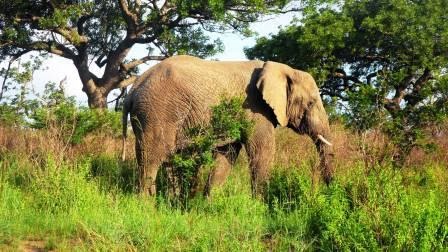
The item generally on top of a foreigners list is to go "on safari" - South Africans are spoilt for choice with game parks but people the world over get very excited at the thought of seeing elephant, rhino and lion in their natural environment. Well, to be honest, after a break of more than six years since our last game park visit, we were excited too, and a trip to Hluhluwe-Umfolozi was a priority.
A typical KZN rural scene en route to the park – we look at it with new eyes! 
The bush was looking magnificent in its (southern hemisphere) post-rains spring green, and baby animals were everywhere - a lovely time to visit. One of the best things about a game park visit is that it forces you to slow down and relax (although we suspect that many of our foreign friends are not doing this enough, in order to tick that big 5 box in their limited available time!)

Sometimes, however, you have no choice but to stop:
Game drive on hold for a magnificent rhino pair 
Then baby came out and dad’s look became a warning. This was a narrow road.
After a half hour impasse we turned around and decided on another drive route! 
We have become tree-huggers! (A dearth of those at sea) 
Sometimes a tree’s silhouette is enhanced – this time by giraffe,
animals with a great silhouette themselves! 
Elephant “land mines” were prolific –
and carefully avoided in order to save any dung beetles busy in them
 
Dung beetle in traditional pose – head-down, pushing its ball of dung up a slope 

A collection of comments in connection with game parks…
First, the reception room always has a mapped magnet-board for placing your latest sightings; well, there are no longer magnets for rhinos here – an effort to limit communication to poachers. We are reminded of the stir we caused in China in 2012 when a SA R10 note fell out of a bag onto the table: we were astonished by the state of excitement of the locals who gathered round the table when they saw it.

We now also have a new breed of poacher: one sourcing vulture heads for traditional medicines that are expected to provide “clairvoyant powers, foresight and increased intelligence”… apparently particularly to suit the demand for greater gambling and lotto success. The weekend we were at Hluhluwe, 37 white-backed vultures died from eating a poisoned elephant carcass. Vultures have been killed in their hundreds in Africa recently – 400 in a single poisoning case in Namibia in early 2013.

Now on a much lighter note: the BIG 5, little 5, ugly 5… and “plant 5”.

The Big 5 of course are elephant, buffalo, leopard, lion and rhino. But these guys have inspired the creation of other groupings, to make game or bush drives more fun and focussed (more boxes to tick!?)...

Another Big 5 beast; we did not see the cats this trip, but of course everyone else saw lion! 
The Little 5? Elephant shrew (with a long nose), buffalo weaver bird, leopard tortoise, ant lion and rhinoceros beetle (which looks a lot like a miniature rhino).

The Ugly 5 are evidently (fondly!?) considered to be the hyena, wildebeest, vulture, warthog (Irene's favourite beast!) and marabou stork.

Finally: the Plant 5 are indigenous plants with Big 5 animal names - the leopard orchid, buffalo thorn bush (of which giraffes are very fond), rhino coffee shrub, lion’s tail (wild dagga/marijuana) and elephant food (spekboom).
“At least we had a decent aggressive thorn named after us. I would have hated an orchid”
The best part of being home is the chance to spend time with family and good friends again - here to celebrate Oma's (Rolf’s Mom) 88th birthday with her.

Now back on the boat, we watch for a weather window to set sail for Cape Town, and wonder if we will be driven to take refuge from the storm fronts en route.... Maybe not such a bad thing after all, giving us a chance to see the country differently from our previous visits, and now as our yachtie friends would!
Looking beyond the yachts to the tanker entering the channel which we will exit tomorrow
We think we will leave on Sunday 1 December: follow us on the google earth link on the right… and hope for fair winds and seas, please!

Tuesday, October 22, 2013

Passage-making: Reunion to South Africa

Weather, weather, weather.

That is all yachties talk and think about before they set off across the ocean. You plan your trip as best you can (wish-list: gentle long-period rollers, no adverse current, maybe a little current in our favour, please?; winds from a consistent direction, consistent strength… maybe 20knots just forward of the beam, please?) and set off on the day most likely to give you a good start…

Hahahaha!!

We left Reunion in the knowledge that this passage around the southern tip of Madagascar was potentially a tough one. The weather and seas deliver absolutely nothing from the wish-lists, as the weather coming up from the Cape consists of a succession of weather front systems, all moving inexorably north and east and over any vessels en route - and when you approach the African coast, the notorious interaction between the SW storm winds and the Agulhas current adds a further dimension.

But our departure was timed for the end of the southern winter and thus the promise of fewer bad weather fronts, so off we set, Rolf and Brian (our nephew) securing the dinghy while underway and Reunion island still in the background…
Wake-up call! See that great flat sea? That was in the lee of the island… we were shocked a few hours later as we churned our way through and over huge swells (4-5m), were pushed by 25-32 knot winds, and had a most uncomfortable start as the waves were all on the beam, lifting us side-on. Then there were some rogues: water over the top of the cockpit roof, water over the stern and pouring forward over the cockpit floor; water over the dinghy as we slewed around and we came the closest ever to sliding down a wave sideways.
From the shelter of the saloon… they end up slamming down on top of the decks
Everything went flying in the galley and saloon (well, come on! We are a catamaran and should experience no more than a tinkling of the ice cubes in the cocktails!) some hatches capitulated and showed leaks when assaulted by solid water at that angle and with that force; a main sail reef line chafed and parted within the first two days, spilling the mainsail and requiring installation of the spare line on a bucking cockpit roof, other smaller bits flew apart and required attention up front and some damage was taken by bodies in the process: the boat demands its daily quota of bloodletting!
Setting up spare reef line
Foul weather yachtsman’s gear… and fluffy slippers!
Welcome to ocean crossings (not usually the fluffy slippers!! Just when you need a little TLC on the toes…!).

The following day (day 3) was calm and beautiful, gentle sailing under the screecher sail … and a rest period while we awaited an approaching front. Nonetheless, not all on the wish list was supplied: the current was horrible! 2 knots against us meant that while our speed through water felt great at 6+ knots, we were doing little more than 4 knots over ground in our effort to whittle down those 1500 miles to Richards Bay. This was truly frustrating and in fact we ended up suffering adverse current for almost the whole journey.
What to do on a calm day… getting away from everything in the world!
What to do on a calm day… transfer fuel from jerry cans. Are we having fun yet!?
Of course, the frontal system then hit us – barometer plummeted, winds came in and the log reflects the passage of the system as winds changed from NE to N to NW to SW to S: every wind-shift required attention to the sail plan, whilst we bounced on the sea made lumpy by the changing winds, sometimes having to helm when the autopilot did not cope, squalls passed over us… and the starboard engine died, requiring that Rolf go head-down under the bunk to investigate. The problem was terminal and that engine was off-duty for the remainder of the passage.
Engine oil contaminated with?? discarded into empty jerry cans 
24h Barometer pic tells a tale:
a massive pressure drop shows the low system we went through (12-6h prior); pressure rose as the high system moved in; stable means GOOD!
We have passed through the squall line and leave bad weather behind us: temporarily!

Getting weather downloads with satellite phone: the only place we could connect necessitated making a “table” for the computer.
‘Pile of Cushions’ tables in bucking boats are a challenge - something is going to go!
The high system came over us and again we had a period of calm (day 6) with lovely sailing… and dolphins, the beautiful sight of the setting sun and rising moon simultaneously and finally: the green flash as the sun’s last sliver disappeared. Treat!
Sun sets with moon sliver up high
Day 7 was auspicious for us (!!) as we passed the southern tip of Madagascar: the under-sea Madagascar ridge has huge impact on the waters miles above it, and we suddenly found current in our favour as we crossed this ridge. Hurrah!

But we knew we were getting closer to sea expanses that were more troublesome, with strong currents. Typically, if a strong wind blows over a fast-flowing current in the opposite direction, it produces large steep waves – and the Agulhas current, which flows generally towards the S/SW, is notorious for building up huge seas when a SW wind blows against it.

Our course coincided with the shipping route between the Cape (and SA ports) and the East and we encountered dozens of large ships.

The AIS info on the chartplotter was very helpful, as we could see their course and closest point of approach, and adjust our course.

An intimidating situation: 3 ships approach triangles), closest coming less than a mile away
Sometimes the AIS info entertains:
This ship’s name (Iolcos Confidence) reflects the reason for its confident approach …
with ‘Armed Guards On Board’!
And after Madagascar, there were still two further weather front systems to endure before landfall.
Nevertheless, we finally made it… (adverse current is merely annoying and 6m breaking waves are just babies, really)… and then there was South Africa!
Necessarily sailing into Richards Bay harbour (no SB engine)
Our home flag is now also the courtesy flag of the visited country: first time in 4+ years!
We, and Ketoro, are at home for a bit!

Friday, October 4, 2013

Take a quick look at Reunion

Sailed out of one harbour (Mauritius), sailed into another country (Reunion) a day later, and took a couple of days to see Reunion island before setting off again.

Our heads are whirling: it has been amazing.

Picturing Port Louis harbour from our boat before departure…
In the foreground is a small cargo boat: yes, it is afloat, but barely, and must be shipping water!

Behind that is a line of rafted Chinese fishing trawlers – apparently fishing season down here has started, and the Chinese trawlers are permitted to moor in Port Louis but must stay out of Mauritian waters when fishing. This was a line of 18 trawlers attached to a single mooring buoy!

Behind that some more trawlers and then the fire-damaged cargo ship ‘Brandenburg’ awaiting its tow to somewhere for repairs. Beyond that: silos. A busy harbour, this.
Leaving Mauritius and its moored Chinese trawlers behind us
The sail was wonderful and easy with light winds and we were treated to an indigo blue sea which offered up two magnificent Dorado (freezer and tummies all full!) and showed us whales wallowing and blowing nearby. Heaven!

Then there was Reunion in the distance.

We got into Le Port and tied up on the fishing harbour wall. Here are our neighbours…
Our front neighbour rests and works on his boat in his tiny jocks (an all-day treat!)
Back neighbours: lucky to have a ladder, as low tide provides challenges getting off the boat. 
We have no ladder and Irene no longer has dignity!
Reunion is a beautiful island, with unique features and huge contrasts – white sandy beaches… and also black volcanic sand beaches.
The island is volcanic and in its centre are ancient collapsed calderas, called the Cirques: three unique “amphitheatres” that were once covered by a single huge dome which collapsed. Each cirque is isolated by steep mountains, and each is unique due to differences in rainfall and accessibility.

We went up to Maido, an overlook into the Cirque de Mafate.
Driving up to Maido viewpoint
Above the clouds, looking down on the cirque
This is the most isolated cirque with no road access into it. There are communities living down there: the cirque was originally inhabited by slaves who escaped into the rough terrain to hide and their offspring remain. They have to carry everything in or have it dropped by helicopter.

A trip to another of the cirques, Cilaos, showed huge mountains with sheer sides and rivers winding along the bottom of ravines.
One of the three villages seen on the plateau within Cirque de Cilaos
Getting to Cilaos village requires driving along exceptionally windy roads - the road to Cilaos famously has over 400 twists and turns, plus tunnels and sections of one-way traffic.
Switch-backs and hairpin bends...
Driving on these roads, in the “wrong” lane, in a car steered from the “wrong” side (left hand drive country), on bends where it is impossible not to encroach on the oncoming lane to achieve the turn, and with the locals speeding past no matter the road circumstances… hair-raising!
Two lanes but only when the oncoming truck agrees!
Nowhere for the road to turn, so it had to be taken back under itself
… in the space of about 200m
An impasse in pass!
Cilaos Village… lovely but touristy
One of the most active volcanoes in the world is on Reunion - Piton de la Fournaise last erupted in 2007, for the third time since 2000!

We drove the coast road (the “Lava Road”) and in the south-east saw where the latest lava eruptions flowed down to the sea.
It is startling to be surrounded by acres of black lava, and see its stream from mountain to sea
Notre Dame-des-Laves is a church that was in the path of the lava in 2007.
It was spared: the lava flow stopped three feet from the building on three sides. Extraordinary
All this driving required refreshment stops and there are many opportunities for this. Reunion is very French: French cars (note our trusty Citroen above), signage, streets… and if you have many Euros you can enjoy your baguettes and coffee frequently. But be polite…
If you say please (s’il vous plait) here, you get a discount on your coffee!
What a marvellous visit! Reunion deserves so much more time than this, but we are grateful to have had a short stop-over and tomorrow we leave to sail to South Africa.