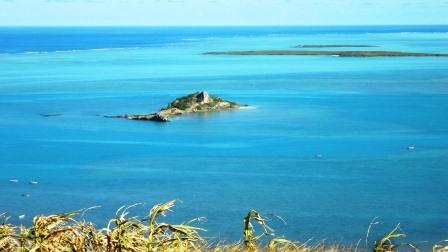
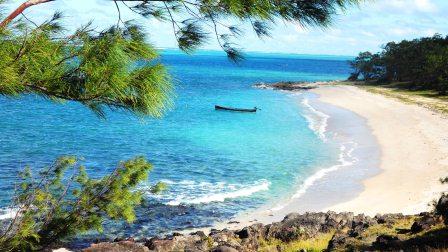
After a couple of weeks in enjoyable, rustic Rodrigues, we
moved on to Mauritius Island - Mauritius controls the islands of Rodrigues,
Agalega and St Brandon.
Port Louis harbour, the only port of entry and one of two Mauritian
harbours, looked like this as we entered. Beautiful mountains and waterfront
area, busy harbour: much of interest.
When the ship in front of us had finished its manoeuvres we
headed deep into the harbour to the customs and coast guard area to check in.
On the right are masts in the “marina” where we ended up after that was done.
The “marina” is really a small area at the Caudan Waterfront
that has facility to tie boats onto the concrete walls, and supplies power and
water (GREAT!). Unfortunately the wall was not designed to berth yachts, it
would seem: it has a concrete overhang that causes huge damage to berthed
yachts that move in the tides and swells and wakes from passing traffic.
However, with enough fenders and planks and tyres and ropes, a measure of
ingenuity, and constant watchfulness and adjustment the boat was left dirty but
unscathed!
The area is tiny, so boats need to raft up alongside one
other: here we are, tied to the wall, with a big catamaran tied onto us.
The problem with this situation (where the inside boat acts
as a large buffer between the outer one and the wall) is that the boats move
differently, straining the mooring ropes and cleats, and the people on the
outer boat need to clamber across the inner one every time they want to go
ashore. Also: every day, the rope tying our plank outside the fenders
(protecting the fenders from the rough concrete wall) was chafed through and
the plank was left hanging by one side only – imagine if the fenders or boat
had taken that beating!
However, we happily passed the time in Port Louis. Le Caudan
Waterfront feels a lot like (a tiny version of) Cape Town’s V&A Waterfront:
a working harbour, mountains, shopping and eating-places. It is only a short
walk from town, we made regular trips there: what contrasting experiences are
provided in this small city!
The main street is flanked by many bank buildings, some very
lovely (Mauritius is a busy financial centre) on the palm-lined route to the
old colonial parliament buildings where Queen Victoria’s statue stands.
Leave these neat, posh areas and the scene changes
dramatically: north of this is Chinatown and the old market area – mostly areas
of uncontrolled hawking and general bedlam!
 |
| Hawkers under “Hawking Not Allowed” sign |
However, the inside of the market is a real treat: a vast
old building with central columns rising high, the three levels cover fresh
produce, then local crafts then clothing at the top.
 |
| The market interior from the craft level upstairs |
It is the ground floor that provides a massive sensory
experience: the large floor holds many stalls, all heaped with superb fresh produce;
stall-holders take great care to arrange and present their products beautifully
(no jumbles here: all in neat symmetrical piles); smells of incense and spices,
the general hubbub of noise punctuated by a cacophony of sellers shouting out
prices and advertising their wares (all in French or Creole). Wonderful place
to shop!
 |
Rougaille is a Creole sauce: tasty, rich, tomato-based –
hence the plentiful ripe-tomato supplies! |
Elsewhere in the city are interesting sights:
 |
| Lovely Company Gardens with restful shade and piped music |
 |
A typical street scene outside the CBD has fruit sellers, peanut roasters
and all manner of retail |
Back to Le Caudan Waterfront Marina: our timing here could
not have been better: three Dutch Tall Ships (‘Tecla’, barque ‘Europa’ and ‘Oosterschelde’) are sailing around the
world, following historical old trade routes, and Mauritius was en route so
they tied up along the wall outside the marina.
 |
| Oosterschelde and Europa tied alongside Le Caudan wall |
Wow. These ships are
truly beautiful, and it was fascinating to go on board and see how they feel
and are put together. They have a small, permanent crew and take on paying novice
sailors for all their passages – as a working holiday this must be a great
experience!
 |
Looking towards the city over perfectly flaked sails
– we watched them: its takes ages! |
Friends from Phuket – Jay Jay, Melisa, Megan and Hayley,
joined us at the marina for a week’s stay on Ketoro. After seeing the fun
sights of Port Louis including the low wall alongside Ketoro’s berth which
appeared to be the favoured spot for uninhibited young locals to make out with
passionate kissing and cuddling, it was time to move on.
We headed for Grand Baie. Exploring Mauritius’ shores by
boat is a challenge, as with so many Indian Ocean Islands. Mauritius is
surrounded by fringing reef that provides few channels to the shore and then,
once through the reef few areas that are deep enough to actually accommodate a
boat with a draft of more than a metre. What is worse, there is no pilotage
information available: you get your info wherever you can, and go slowly!
However, Grand Baie in fact has an easy entry channel and as
a result is a favourite for the Mauritius boat-world. It is not a picturesque
bay, but it has other attractions: notably, it is calm and gentle (hardly even
rocks you to sleep!), and a great place to shop for provisions and eat out
(although, being touristy, expensive). We found particularly delicious local
food at La Rougaille Creole Restaurant, with spiced fruity rum made by the
owner… we took that bottle home!
Speaking of calm and gentle: what was I thinking!? This is
true for the nights… during the day, skiers, speedboats and day-trip catamarans
are always on the move and about once each day a speedboat driven by alcohol,
testosterone and an over-age adolescent almost careens into us. The local mosques
encourage wakefulness from 4am, while roosters and dogs are plentiful and are
set off by the call to prayer!
This is also a base for diving, and Megan (10) has her PADI
Junior ticket: so off we went!
From here we set off to an island a few miles to the north.
We had been told that it is deep around Gunner’s Quoin Island (Coin de Mire)
and that there were mooring buoys on which to tie up: there are many rocky
outcrops so anchoring is difficult.
 |
| Gunner’s Quoin Island (A quoin is a wedge used to elevate a cannon) |
What beauty and solitude! The change from busy Port Louis
and Grand Baie was remarkable – birds and fish were our only companions, and
the only noise was waves crashing on the rocks.
The mooring buoys are fairly heart-stoppingly close to these
rocks; in fact one has a good view of them and even nesting birds! As we swung
on the mooring our view changed and we were never bored of the scene.
 |
| Looking across the boat to nearby rock-face |
However, the hearts were challenged by an adrenaline rush
one morning when the view changed at an alarmingly rate - Ketoro had suddenly
spun around. We had come free of our mooring and were drifting onto the rocks.
Engines were on in a trice and we drove to secure another mooring, had a
soothing beer and contemplated the new situation.
We had dived down the line of the first mooring as deep as
we could and it had looked okay – but could not get deep enough to get a close
look at the rope to chain junction at the base. So after the beer Rolf secured
us to our new base using a few additional lines, fitted two of our guests with
scuba gear and dispatched them to check the entire mooring. Only at this stage
could he smile as he regarded the Mauritian line, which had chafed through.
So we settled back again to drink in the local beverage (the
local Phoenix is actually most drinkable!) and the scenery and splendour,
enjoying our second day of quiet.
Then the world descended on us in a flotilla of boats!
Evidently this island is a good stop-over for craft returning from their day
trips to the other islands up north, on their way home. Afternoons here are not
quiet!
Speedboats (four, with noisy beer-swilling passengers)
arrived to snorkel, climb the rocks, and, um, drink and party. Catamarans (two,
with noisy beer-swilling passengers and excellent / loud sound systems) did the
same. There were not enough moorings available. No worries: some tied onto the
other moorings, some tied onto Ketoro!
So it was that our new mooring held Ketoro, a speedboat
hanging from our stern, and another party catamaran rafted onto us.
 |
| Enjoying the music from day-cat alongside, while another one departs |
The mooring held, and we partied. The crew on these boats
know how to cater to their guests…. and, it seems, neighbouring boats: they saw
our flag and dug out their Afrikaans music!
Eventually they left, the speedboats left, and we were left
to enjoy the bay on our own again.
Our guests have now gone, and we are relaxing into Mauritius
and trying to figure out how to get places. Particularly, we need to know how
to get Ketoro to an anchorage (if indeed there is an anchorage) off Merville
Beach, where the family will be staying in August.
Initial research by dinghy was conducted using a portable fish
finder (to measure depth), GPS, iPad (with Google earth map), writing
implements and Phoenix beer.
We think we have now mapped out a route through the reef. It
all looks good – and we hope it is not just the beer talking!
More of Mauritius explorations and other friends’ visits
next time…


 The main street is flanked by many bank buildings, some very
lovely (Mauritius is a busy financial centre) on the palm-lined route to the
old colonial parliament buildings where Queen Victoria’s statue stands.
The main street is flanked by many bank buildings, some very
lovely (Mauritius is a busy financial centre) on the palm-lined route to the
old colonial parliament buildings where Queen Victoria’s statue stands.