Saturday, June 16, 2012

Leaving Thailand again

Siam has many (hi)stories that offer enough intrigue and interest to be potentially good material for fascinating movies. Unfortunately, the King of Thailand (Siam) has frequently said no to any film-making done on location, and thus films on or about Thailand’s past were not filmed in Thailand. Two examples are ‘The Bridge on the River Kwai’ and ‘Anna and the King of Siam’.

When recently in Bangkok, we decided to visit the spot ABOUT WHICH the first of these films was made, i.e. the spot where it was NOT made! So we took a two-hour trip to Kanchanaburi and the Bridge over the River Kwai…

During 1942 and 1943 (World War II) the Japanese used Allied prisoners of war and civilian labour to build a 415km railway line between Burma and Siam (now known respectively as Myanmar and Thailand). This line became known as Death Railway as it cost the lives of over 15000 POWs and over 100000 Thai and Burmese civilians as a result of sickness, malnutrition, exhaustion and maltreatment.

The poignant but beautiful and immaculately maintained Allied War Cemetery for 7000 POWs stands near the site of the former Kanburi POW base camp.

Kanchanaburi was the site of notorious internment camps for the Allied troops; the history is really well presented at the Thai-Burmese Railway Centre (museum) and the JEATH War Museum, constructed by the Chief Abbot (and in the grounds of) Wat Chaichumpol, a Buddhist Temple. The bamboo museum’s construction resembles that of an Allied POW camp.

JEATH is an acronym for the nations that participated in the war effort here, as indicated by the flags: Japan, England, Australia, Thailand, Holland.

Just north of Kanchanaburi is The Bridge on the River Kwai.

This bridge was part of the Death Railway line, actually built to span the Mae Klong River. In the 1957 film The Bridge on the River Kwai, filmed in Sri Lanka (then Ceylon), the river is incorrectly identified. However, the extreme popularity of the film brought about an influx of tourists to Thailand, looking for the “Bridge on the River Kwai”, so in the 1960s the name of the river was pragmatically changed from Mae Klong to Kwae Yai! (The tourist buck clearly has power, as also seen by the number of towns now named Shangri-La after the book, one example being Zhongdian… now Shangri-La… the lovely city we visited in China).
Tourist train on "Bridge on the River Kwai"
The original POW timber bridge was bombed several times (with varying degrees of success) by the Allied forces; this is long gone and what we see today is the steel bridge that was built a few months later and a couple of hundred metres upstream and that has also been repaired after a successful bomb attack near the end of the war: the round truss spans are the originals and the angular replacements (see in pic above) were supplied by Japan as war reparations.
Kanchanaburi, the town, is actually a fun place to be, despite being surrounded by a tragic past, and three days spent enjoying the historical sites, eating and having massages is a wonderful way to spend time while waiting for a UK visa in Bangkok!

There is also a beautiful 7-tiered waterfall, Erewan Falls, that has a Thai twist;
... here, at stage three, you share the pool with cleaner fish… you know the little ones they have in glass boxes for “fish massage” at Thai tourist towns? Well, their huge grandparents are here in this pool, looking for your skin cells!
The return to Bangkok took us down typical Thai streets with evocative street-light decorations … and a reminder that the King is always around!
After Bangkok it was back to Ketoro in Phuket, where we had to acclimatise to days of more than 34 deg. C temperature and 95% humidity again. But we needed to get to Langkawi, Malaysia: a visa run for the two of us and the boat. After having had a fairly long break from sailing we were happy to get into it again, so cleared out of Thailand and set off with good winds which allowed the sails to work (for a change) but the uncomfortable rolly sea from many days of wind challenged our stomachs and reminded us that our sea legs needed exercise!

Three days later it became “interesting”! We were due to go first to an anchorage at Telaga (in Langkawi, Malaysia) which is shallow and has a bad reputation for providing poor holding for anchors, particularly with winds from the SW. Heading across there on the uncomfortable sea, the winds picked up from the SW and we decided to try to find an alternative place to anchor. We therefore turned back into Thai waters and spotted a number of fishing boats holed up on the south east side of Tarutao Island. The locals know what they are doing so that is where we anchored…
Staying two nights in the company of more than 35 fishing boats and a tug and barge, all taking refuge from the weather, we watched a moving world as Ketoro danced and slewed about in the winds (happily limited to 25 knots) that bulleted across us from different directions. The fishing boats gave us considerable swinging room and half the bay, while these heavy boats took up the other half of the bay, rafted together in lines of three to seven boats, and close to each other.
Fishing boats rafting up

There are 18 fishing boats in this small area
The shallow waters of the bay were churned up by erratic swells, and one morning we were treated to the sight of pink-marked dolphins enjoying their feed around us.

The decision not go to Telaga was fortuitous: we heard that there was chaos in the anchorage, with huge gusts of wind (50 to 60 knots) and some boats dragging anchor and crashing into each other. (In discussion with other yachties, we are quiet about the fact that our worst loss was Irene’s vodka and orange which was tossed everywhere when a big cushion was blown off the sunbed onto the table!) Our refuge off Tarutao (albeit with little sleep on the first night) had provided interest and also beauty from surprising sources.

We are now in a marina on Rebak Island, near Langkawi (Malaysia) and the notorious Telaga anchorage… which has the crumbling film-set of that other film on Siam.

A falling-apart old house on the beach at Telaga is all that remains of the Summer Palace of King Rama IV of Siam, as filmed for Anna and the King. When the real, current King of Thailand said “no”, that film was shot in Malaysia (in Langkawi, Penang and Ipoh); later, the Thai authorities did not allow the film’s distribution in Thailand as some scenes were construed to be disrespectful towards the King. The Summer Palace now provides a lovely backdrop for the wedding photos of this gorgeous Malay couple, a sight we were delighted to come upon some time ago.
Current status? Ketoro is to be left in this marina, safe from storms, until mid September while its crew travel to the UK and then SA to meet their two new grandchildren!

Sunday, May 27, 2012

China 4: China in a month.

China in a month. Or rather, a month in China; it would take over a year to explore this huge country!

But we had a one month visa, so we set the itinerary to get the best/most we could get out of "China in a month". A fair amount of this is covered in our first three blogs, and this last one is a photo-summary of each stop on the awesome journey, from start to finish… our trip from east to NE to centre to SW gave us some fascinating glimpses of what this country of great diversity offers.

Hangzhou

This 1000 year old core city of the Yangtze River delta was our entry point to China. Hangzhou’s West Lake is renowned for viewing the culture and adjacent historical pagodas, cultural sites etc. but we had only one jet-lagged day… so we spent it enjoying our first Chinese park area.
What a treat! Sights and sounds as you would expect and hope for: green grass-fringed walkways winding along the sides of the lake and through beautifully planted and maintained gardens with bridges and pagodas as points of focus; rolling hills around the lake which was dotted with rowboats and small radio-controlled sailing boats.

Then the people using the park: individuals doing tai-chi routines;
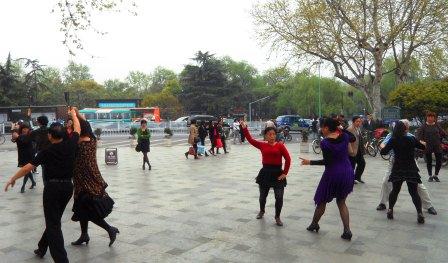
small groups having lessons: here ballroom dancing, there aerobics;
a dozen ladies singing for passers-by just for fun; kids and adults flying kites;
throngs of people there to enjoy the fresh air and the entertainment provided (intentionally or not) by the others. The Chinese create the most beautiful and richly textured parks and then make such good and healthy use of them.

The hotel, eventually found by the taxi driver, at $45 was twice the cost of our usual budget and even then we were grateful for our Vietnam-purchased silk sleeping bags! Then it was off by train to…

Suzhou

Canals, stone bridges, pagodas, gardens.
Renowned as “Venice of the east” and “heaven on earth”, Suzhou is famous for its unique, elegant gardens; we saw that Chinese gardens focus as much on the architecture of the many structures and buildings as the botanical aspects. The city is traversed by a network of rivers and canals that make for pleasant trips on poled wooden boats through the Moon Gates.
In downtown Suzhou, not the old town section, morning groups of old residents danced and exercised in a square adjacent to a construction site. The older Chinese appear to be very conscious of exercise; outdoor exercise apparatus is often to be found simply alongside a street.
Some areas and shops are very upmarket; our hotel was not in one of them and we were serenaded by ferociously bad karaoke from across the road. Crossing roads is a challenge due to the hundreds of silent electric scooters /motorbikes.... Actually, walking on the sidewalks is even more hazardous as they drive on these and you just don't hear them coming!

Having discovered this peril in Suzhou, we were prepared for it at our next stop, Beijing, which we reached at speed and luxury in an incredible express train.

Beijing

It is the size of things in China that took us by surprise. We have seen the pictures but they in no way prepare you for the enormity and scale of places, the architecture and decoration, how costly (in resources and manpower… and men’s lives) the old projects were: and how big an ego must have conceived of the plans and contrived to put these enormous projects together. Beijing is an excellent base to start exploring examples of these sites…
The Great Wall. Built to keep the northern barbarians out of the Middle Kingdom, it is a real wonder: on average an 8m high and 7m wide earth, brick and stone structure with endless watchtowers, it rolls across 6400 km of peaks, ravines and deserts. Begun in the 5th century BC, the first Chinese emperor worked on it around 220BC, then a 100-year rebuilding project was undertaken in the Ming Dynasty (1500s).

We saw the wall at Mutianya (here, with reflections from cable car windows), a section less touristy than others and an excellent place to observe the outstanding feat and imagine the millions of conscripted labourers in this immense and grand project.

In the centre of Beijing, the third biggest square in the world, Tiananmen Square, is a 109 acre area fronting the Gate of Heavenly Peace (Tianenmen Gate) which is the entry to the Forbidden City. This massive, sprawling complex of 980 buildings was the Imperial Palace (the emperor’s city) for 5 centuries from 1400 and required a million workers to build.
Picture the scene: a procession of 1000 eunuchs, courtiers and ministers leaving the Imperial Palace at the Forbidden City and going to the Temple of Heaven nearby. Well, twice a year the emperor and this retinue made this short trip, to stay for a time of fasting and praying for good harvests.
This 270 hectare park has wonderful Ming – dynasty architectural complexes, and is another park well-used by local people playing musical instruments and exercising.
Of course, the Emperor also required a Summer Palace, another huge site that also provided us with hours of walking and gaping! Eventually you need to sit down… so the two best ways to do this in Beijing is to sit in a restaurant that specialises in “Peking Duck” and get to the famous Beijing Acrobat Show, which was nothing short of jaw-dropping and spectacular.

Imagine yourself, for example, driving a motorbike in a spherical ball big enough to fit on a biggish stage. Now another motorbike enters with you. Then another…. and another… until there are six other bikes in there with you. It will probably make you more comfortable rather to imagine you are watching this, although even that was accompanied by enormous tension. Now the theatre lights go off, and there is just the roar of seven motorbikes and the flashes of headlights as they criss-cross amazingly inside this “ball of death”. An astounding, death-defying feat, that is just one act in an incredible show of strength, balance, gymnastics and talent.

We stayed in an original courtyard home (turned into a hotel) in one of Beijing’s hutong areas. Most of the way of life of the old city can be seen in these hutongs: old alleyways winding between a tangle of houses and courtyards which are hidden behind gates decorated with characters to bring good fortune to the owners.
Our hutong is still a local residential area and a great place to see hole-in-the-wall noodle shops and gambling dens, wander the streets and observe life in the old areas. Many of the hutongs are being razed to make way for newer accommodation with better plumbing and electricity for local residents. In the tourist hutongs, many of the homes are now small shops.
We left Beijing by train, in an eventful trip (described in blog 2) to…

Datong

This is a dirty, dusty, polluted coal-mining city, but a base for two major sites: the Yungang Grottoes and Hanging Temples.

In the 5th century BC work started on carving Buddha statues in shallow caves in sandstone cliffs; before the project ended in 525AD there were 252 of these Yungang Grottoes displaying over 50,000 carved images and statues of Buddhas and bodhisattvas, ranging from a few centimeters to 15 meters tall.
Preservation and repair work was done on the caves in the 11th and 17th centuries and the number, quality and beauty of the caves and artworks is striking.
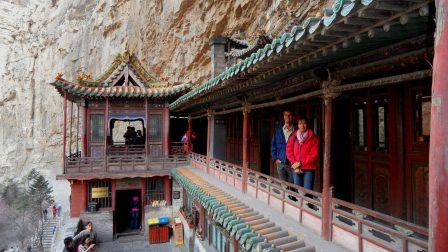
The 1500 year old Hanging Temple of Hengshan Mountain is a temple that clings to a sheer precipice, 75m above the ground, held in place by oak cantilever beams fitted into holes chiselled into the cliff.
The Hanging Temple was apparently built by a monk around 400-500 AD, then rebuilt / restored after being damaged by the Red Guard during the Cultural Revolution. It is an incredible architectural and engineering achievement with 40 chambers and a network of narrow passageways; it is also notable as it has a “Triple Religion Hall” containing Confucian, Taoist and Buddhist statues: all are welcome to worship here.
In Beijing we had seen, in various places, tall screen walls and were unsure of their function. We learned that here: spirit screens or spirit walls are used to shield entrance gates; they thus protect the home / temple / city from evil spirits, which are believed can only move in straight lines and cannot get around corners.
This 45m long, 8m high and 2m wide Nine-Dragon Wall, in front of the mansion of the 13th son of the first Ming dynasty Emperor must have contributed greatly to his peace of mind!

Our MMM (Most memorable Meal: see blog 1) in which we searched the sheep’s head for meat (while entertaining the local customers) was followed by a comfortable train trip to…

Pingyao

This wonderfully preserved 2700 year old town was previously a financial hub of China but since this function was moved elsewhere, Pingyao was saved from development and has preserved its character: Ming-dynasty walls of clay, brick and stone – we walked on the wall to see the modern city outside the moat, and the views of life in the old town inside the walls.

There are about 4000 preserved traditional Ming and Qing buildings, interesting ancient financial institutions and commercial buildings inside the ancient city.
In the main streets, every little shop-house sells curios and trinkets aimed at us wandering tourists, but local residents also pass the time alongside their stores playing games… entertaining themselves as well as us!
While all the curio shops are very interesting to see, it is good to wander the back streets to explore some “real” life.

You are also welcomed into the ancient Taoist Temple and its graphic depiction of the brutality that awaits the unlucky ones that are consigned to hell.
After a couple of day trips from Pingyao, we had our last train trip: to…

Xi'An

Picture this: in 221BC Emperor Qin Shi Huangdi founded the first unified China, and the first imperial dynasty. But he is described as a ruthless megalomaniac and had a great mausoleum built for himself. What an ego: he then surrounded his tomb with thousands of life-sized statues of his personal army (each with unique facial features) to protect him when he died. The project apparently involved 700 000 workers over 36 years, and thousands of them are purported to be buried here.
This army of Terracotta Warriors just outside Xi’An is an incredible sight that was only discovered in 1974. Excavation work is on-going; the site is a huge archaeological dig.
What we saw: an enormous terracotta army in an underground tomb of 3 large underground vaults housing over 8000 life-size warriors, horses and chariots; this is believed to be only a tiny fraction of the whole and to excavate it fully, 12 villages would have to be relocated! What also becomes obvious is the incredible size of the job for archaeologists: to take countless shards and put them together to re-construct this army is a job of immense magnitude and patience.
Xi’An was once (10th century) the biggest city in the world and was China’s capital for 1000 years: the destination of Silk Road traders. It is now a huge, bustling, congested city with the old part encircled by its ancient wall.

Cycling on the 13m wide wall of the ancient city of Xi'An (much restored), 12m above the ground, you can't help but be awed that most of this structure was laid down in the Ming dynasty, 1100. An inspiring 11km cycle shows the old city inside (temple in the corner), huge new city (with about 50 tower cranes at work when we were there) outside the moat and gardens, and giant gates ushering the heavy traffic through.


We left Xi'an after many other visits to historical sites, museum, Great Mosque (lovely Muslim mosque with no dome: Chinese architecture) and fun Muslim street, saying goodbye to Sonja and Delwin as we flew to Yunnan Province.

This is sometimes called the rebellious province because it is home to most of the minority groups who have traditionally rebelled against the ruling Han Chinese. The attraction for us was the different beauty of the province (mountains, huge rivers and tumbling falls) and an interest in seeing the minority groups, of whom a large proportion still wear their traditional garments and live as they have for centuries.

Lijiang

Since the booking site had the wrong number for our guest house, we got to know the pretty, narrow, winding cobblestone roads and waterways of Lijiang Old Town quite well in our first few hours there!
This 6000 years old city was an important hub in the Tea and Horse Caravan road, and is now a quaint place to stroll along, sample the foods of the local ethnic groups (mostly Naxi people) and browse the hundreds of tiny shops selling their craft.
With Jade Dragon Snow Mountain in the background, it is a beautiful city, but very full of tourists: domestic tourism in China is huge, and it is best to try not to be at the popular spots over the weekends, if you wish to be able to move freely!
Sorry this did not load upright: bend your neck, ok!?
After a fun and busy two day stay we were ready to go up to the Tibetan plateau and observe Tibetan culture in…

Zhongdian

There is a book called Shangri-La, written in 1933 by James Hilton. He described a paradise on earth but was not specific about its location; thus there are now many towns that have claimed to be this fabled place called Shangri-La… in Nepal, Pakistan, Bhutan and China.
China officially changed the name of Zhongdian to Shangri-La in 2001, but it is still locally known as Zhongdian (or, in Tibetan, Gyeltang). The move probably helped to boost tourism, but there are far fewer Chinese tourists here than in Lijiang or Dali and mostly western tourists venture here. This is a wonderful place to observe Tibetan culture, as a special permit is required to visit Tibet itself and the permit is difficult to get. In the photo above we are looking past the prayer flags over the town to the snow-covered mountains.
We loved our visit here: the Tibetans stand out from the Han Chinese in appearance, and most people have not changed their traditional garb; their architecture of square, three-storey homes with bright scrollwork is very different from the rest of China; yaks in the farms (and in the towns, here with the owner’s possessions protected from the rain); yak meat, yak bells and yak tails hanging in the shops!
Also in the shops: fake tiger furs and genuine local crafts, interesting foods, lots of incense and great Tibetan daggers. Meanwhile, ladies daily set out their handcrafts and provide food in the square.
Prayer flags made cold, drab, winter scenes very cheery and imparted a lovely ambience; locals walk clockwise around the prayer wheels, worrying their beads and sending their dreams and prayers upwards.
Trips on local buses, which we undertook fairly often to see “modern” Shangri-La, were always fascinating with a range of customers sharing the trip with us, all wearing the garments of their minority group or in other ways vitally different from us.

Songzanlin Lamasery is a huge, golden, multi-storied sprawling Monastery complex accommodating 700 Tibetan Buddhist lamas (spiritual leaders) and monks … and currently undergoing extensive repair (and reconstruction?)
From Shangri-La we took a day trip to Tiger Leaping Gorge: a beautiful, extremely deep and dramatic river canyon (in places under steep 2000m cliffs); terraced and farmed part way up the sides where less steep, and worth a hike (assisted in the odd place by vertical long ladders) down to the raging Jinsha (Golden Sands) River at the base, a primary tributary of the Upper Yangtze. Legend has it that a tiger jumped across the 25m narrowest section to escape a hunter: this long jump champion gave rise to the demand for fake tiger furs in the shops…!

We froze in Shangri-La! The city was surrounded by snow-topped mountains, we did not have the right clothes, and the guest house only switched on the heating after 8pm! Added to the fact that we were at about 3500m, and thundering up and down mountains… some of that imprudent behaviour contributed to Rolfs suffering high fevers on the night before we left, and the 9-hour bus trip (a fascinating trip, see blog 2) was embraced because every minute we were decreasing altitude. Our sea-level-accustomed lungs did not appreciate the higher altitude, much as we appreciated the city we had visited.

Dali

Dali Old Town is beautifully situated in the middle of the Cangshan Mountains to the west and Erhai Lake to the east, and is another old city with preserved ancient walls and gates.
Arriving late after the lovely (and long) bus trip, a long walk into the old city and struggle to find the guest house (the address provided by the booking site was again not very useful), ill Rolf was put to bed and Irene set off to find food. Turns out we were at the wrong end of town for buying food that was in any way recognisable and certain of not containing MSG (allergy), so all that could be rounded up in a 90 minute search was this…
The hard old cake went down well with the fresh milk, and Snickers are always cheering (and, Rolf thinks, a wholesome and balanced food). Later, we found many places with wonderful food... so we got our real wholesome food!
Dali is the cradle of civilization of another ethnic minority, the Bai people, who originally acted as middlemen between tea growers from Xishuangbanna and horse traders from Tibet. Bai ladies are renowned for their beautiful embroidered items, but unfortunately when you are backpacking there is absolutely no space for holiday mementoes.
Another long-haul bus was the chosen transport to get (health improving) Rolf and (health deteriorating) Irene to…

Kunming

This was the last town in our awesome China trip. Although Kunming does have to-do-and-see things to offer tourists, we were completely unable to do it justice; being ill (and, really, exhausted!) we used it as a fly-out venue. The hotel was close to the airport and far from any tourist opportunities: and this proved more interesting to us than being in another street-of-curio-shops, knowing that we had seen the very best of this province in the previous three cities.

Looking out from the hotel window on arrival, Irene panicked, convinced she would fall the 24 floors,

But when good health was restored she enjoyed hanging out of the window to assess her environment. A highlight was watching the specks moving in formation on the square below, which proved to be children in the school yard doing their daily exercise routines before break time!
And so the holiday ended. When we left China we felt as though every sense and memory bank was exploding from the enormity of the inputs and exceptional experience of our trip, despite the fact that we had merely scratched the surface of the country. We are awed by a history and a culture that stretches back centuries, with exceptional artefacts and structures still evident, and our hearts were taken by the people and land of Yunnan province.