Thursday, May 26, 2011

The UK and Singapore


How odd to juxtapose these two parts of the world, but that’s the way we did it… (with Kuala Lumpur jammed into the chronological sandwich).

England and Scotland

Sitting on a stifling boat just over one degree north of the equator (in Johor Bahru, Malaysia about 500 metres across the straits from Singapore), we packed for spring in the UK. All the cold clothes we possess on the boat went in… most of them having been purchased in haste and dire need in Hanoi recently. How wonderfully surprising it was therefore, to be in Scotland and England during their “hottest” April in recent memory; the whole delightful experience of being with our family enhanced by swathes of daffodils, bluebells, pink blossomed- or freshly greened trees, and emerald green fields speckled with new-born lambs!
Rolf and Irene spent the first week “doing” London (daily programme dictated by Barry’s spread sheet); and no, you cannot get tired of that city!  

We loved it all: the feel of this cosmopolitan city, which is surprisingly ‘small’ and unintimidating; the amazing works and displays in the museums and galleries; the contrasting atmospheres in different areas (Regent Street above, Camden below, Notting Hill, Hampstead, Richmond, kids’ home turf of Clapham); the ease of getting around on public transport.

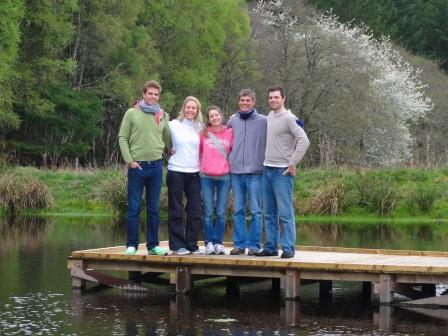
And then the six of us met and flew to Inverness in Scotland for the start of our road trip. A tribute to our children: they are gracious when squeezed into a vehicle adequate for six smaller people and no luggage, tolerant of the more-aged’s regular needs to stop the car (life does have this way of turning the tables!), patient with burble and commentary from the back seat and the need to speak louder!

This is how it goes on such a road trip: the driver (of the Vauxhall Zafira) has space and comfort which he trades for enduring disparaging family back-seat-driving chirps; the passenger seat occupant is navigator (blue blob on iMaps helps) and dispenser of snacks (cookies and fruit from the B&B or chocolates endlessly purchased by Rolf); the 3 in row 2 are up-close and personal, so a shared activity is best (good example: crossword; bad example: reading a newspaper); the lone soul in row 3 zones out and props up most of the luggage. And sometimes calls the shots for stops…. and the need to change for a forward berth, depending on the queasiness level…

What an amazing holiday: Scotland saw us at Loch Ness (some swam: it was freezing; we walked in atmospheric woods and searched for Easter Eggs in same), Fort Augusta, Oban whisky distillery (of course!) and Edinburgh.
 We saw Scotland’s best face in the wonderfully gentle weather, allowing us to enjoy the ruggedness of high rural areas and lowland lakes with Highland cattle peering through their fringes alongside flocks of sheep in dire need of shearing.
 To visit Edinburgh has long been a dream and it lived up to all expectations: from the underground galleries of the ‘bridge’ and the narrow alleys of the ancient city to the modern high-end shops and accommodations, with that beautiful park at the base of the huge castle.
 So many faces to the cities of London and Edinburgh make them such desirable places to visit. The pubs were great, particularly the one in Edinburgh that had to tolerate a raucous family tradition: our own version of Balderdash, which requires reading out loud individual contributions to word definitions, this to be done above the general pub hubbub and particularly above the squeals and peals of laughter greeting each new definition.
We drove down to the Lake District, with quaint towns and glittering lakes in the sunshine. Walks, sheep dotting the fields delineated by endless miles of dry stone walls, narrow country lanes, lakeside wandering, swans... how typically English and wonderfully enjoyable!

That gave way (on the day of THE wedding… were there more loo stops that day, to catch up on the “I do” ceremony on Sky TV??) to a drive to Lynton in Devon overlooking the sea and gazing up to the Welsh coast. All the Lynton inhabitants appeared to be enjoying a “Right Royal Knees-Up” party at the town hall to celebrate the wedding. A few days were spent here, with a walk on the cliff paths and forays to the town of Lynmouth (directly below Lynton on the hill) best made by an ancient gravity train!
 Finally, we were off to the lovely city of Bath for a couple of days. In our case all get-togethers require the presence of a ball or two: in this case tennis balls from Malaysia and London and football from SA. No walk, whether in the woods, country roads or busy streets went without ball-tossing/kicking, and if the resources at hand included a body of water over which to skim the ball, so much the better!
 This exercise did not occur without its rescues: from rivers / balanced precariously on the edges of cliffs / claimed from the centres of busy roads (the tolerance of local drivers for “those bloody tourists” being tested!). 

Back to London via moody (and now chilly…. the weather was changing) Stonehenge… and home. It was a real treat to enjoy so much of the UK in such a short time, to appreciate its diversity, beauty and history, and especially to experience all of this together with family. Plans are afoot for the next family holiday…!

Back to Asia: Kuala Lumpur 

Hop-on, hop-off buses. That’s the way to do it. Well, let’s qualify this: if time is short and / or you are jet-lagged and / or you arrive in a city too early to find anything open, these buses are the greatest way to get a brief history and guided tour of the highlights of a city and a sense of its functioning.
 With all of the above applicable in our case (London flight landed at 0530) and only one night allowed to ourselves in KL, we locked the bags away in a bus station locker and hopped onto one of these buses with a small shared bag of clothing. The ‘hop offs’ alternated with an occasional on-board nod-off but we enjoyed what we saw of this relatively small, modern city, particularly the Islamic buildings with beautiful domes, arches and delicate intricate decoration contrasting to adjacent modern high-rises and small, well preserved historical buildings amongst the towering modern structures.
 A Malaysian thing: street lights are all decorative, and appear to have themes along streets.
  Guided by Lonely Planet’s advice of a central area to stay cheaply, we hopped off, found the closest back-road Chinese walk-up hotel above a busy food court and checked in, getting this view of real life.
 From this base the bus and main shopping / walking streets were easily accessible, so the day became full, fun and busy: enough time for us to see and do what we had set ourselves in the city, including seeking repairs for an iPhone. This took us to one of many huge shopping malls where the repairs were done quickly and cheaply …. we declined the widely advertised offers of “cell phone accessories and unlocking”, which is a euphemism for “we do anything on any phone, including jailbreak programmes and pirated apps fully installed and optimised”. 

The next day, a 4-hour bus trip took us through lush green rolling countryside(however, great tracts of indigenous forests have also been decimated and replaced by oil palm plantations) to Johor Bahru, back to a very dirty boat, its recently-buffed and polished topsides and decks having been exposed for a month to fine black dust courtesy of construction alongside the marina and extensive aircraft exhaust from nearby airports (and the dust ground into the sides permanently by rubbing up against the fenders). All else was well and we were grateful for a home that was otherwise in good shape, so … soon after meeting our fellow Sail Malaysia Rally yachties … we briefly departed from the rally programme and sailed to Singapore for a 4-day visit: a city not to be missed when the opportunity to visit it relatively cheaply was at hand.

Singapore

Maybe we are just easy to please. But we loved being in Singapore too! Having said that, we did not love it in the way we enjoyed Bangkok and London and Edinburgh.  The cultural diversity in Singapore is great: it is a melting-pot of Malay, Chinese, Indian and Arab cultures (although harmony between different groups does not necessarily indicate embracing each other’s ways), but the strict rules governing society and the single minded pursuit of profit gives a less vibrant feel - and the city feels somewhat soulless.
 It is also very, very expensive! But public transport works pretty well and our penchant for exploring cities by ‘hop on, hop off’ tour bus again served us well.  As in KL, the building developers and their architects extended themselves and the result is a city full of really interesting buildings and bridges.
 It is so refreshing to see that cost effective commercial buildings do not need to be the boring and ugly rectangles that dominate the CBD of so many modern cities. 

Then there is the interest provided by the juxtaposition of huge modern structures against the original China Town, Little India and the Arab area.

 No end of things to do here (fortunately we are not shoppers, for we would have spent too much time and money on Orchard Road, home of ALL the major brand names) …
 We spent hours in the Asian Civilisations Museum, which has incredible ancient Asian artefacts, amongst which this magnificent centuries old copy of the Qu’ran

… and this duck!
 … and also spent a great evening at Fort Canning Park, having a picnic with friends and watching MacBeth, a production done really well.

So we set off from Singapore, down the Singapore Straits again and dodging the heavy shipping traffic in this area. We are the little black boat in the pic; the rest are the AIS (Automatic Identification System) signals of big ships, and the ones closest are outlined in flashing red as the alarm rings to tell you to beware!
 Hmmm… like you cannot see them….! But it is very helpful at night… and the ships (big and small) without AIS are the real problems.
 Now it is back to the islands, on the Rally route in the South China Sea that will take us up the east coast of peninsular Malaysia and then across to Borneo and the Malaysian states along the west and north coasts of Borneo. We are relishing being back in clear seas again with healthy coral and great marine life … more about that later.

Wednesday, April 13, 2011

Passage down Malacca Straits

Wow, what a fascinating, awesome (sometimes tiring, sometimes anxious) journey! There was no end to the learning we had in this 11 day adventure…

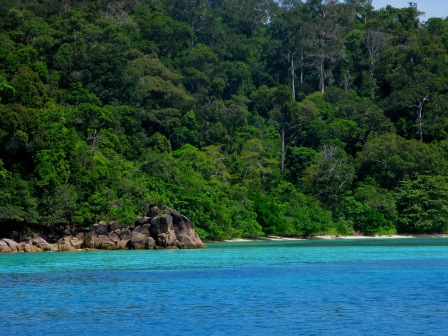
Langkawi was our point of departure, from where we had a short hop to Pulau (which is Malay for Island; abbreviated to P) Daya Bunting: our previous most-southerly stop in Malaysia. A calm overnight anchorage at a beautiful spot looking onto these steep slopes, heavily-treed with a rich diversity of foliage, rested us for an early start to our full-day sail to P. Penang.
Let it be said that the word “sail” did not really come into it much for the whole way to Singapore; apart from some squalls that brought strong but fleeting winds and rain (see later), there was not much wind for sailing, and the engines worked overtime. However, Rolf remarks (when Irene gets really frustrated) that the QE2 also “sets sail”; however, her engines were deep in the bowels of the ship and hence QE2 purred… Ketoro does NOT purr when motoring: she rattles and roars, compared with the sublime sounds of sea and wind when actually sailing!

Georgetown, Penang: what a wonderful place to stay for 2 nights!

Tying up at the marina in the heart of the old city, we needed only walk a few hundred metres before finding China Town, Little India, the extensive old colonial areas, the Chinese clan jetties…

The history

But first, a short history of the west coast of Peninsular Malaysia, because these areas boast the most fascinating cities and exhibit the (apparently) peaceful co-existence of so many cultures, which originate from centuries of changes of influence and power. The Malays on the peninsula came under the control of various SE Asian empires for many centuries, then in 1403 a Sumatran Hindu Prince (read: pirate in hiding) settled in the fishing village of Melaka (Malay spelling) and established it as a strategic port and city-state of great importance which drew traders from east and west, using it also as a place to wait for the change in monsoon seasons (to time their passages back home under the right wind conditions).

When Siam became threatening, the Chinese arrived, promised the protection of the Ming Emperor and thereby got their foot in the door, thus also extending Melaka’s influence through the rest of the peninsula. Interestingly, this gave rise to the fascinating culture of the Peranakan people, or Baba-Nyonya: born through the marriage of a man from the Chinese mainland (Baba) to a local Malay woman (Nyonya).

The population of Melaka became predominantly Chinese, followed in numbers by Indians then Malay. With Melaka becoming so wealthy and powerful, a glitter appeared in the eyes of the Europeans: first came the Portuguese (1511) whose ships defeated the local defenders and their war elephants, sending the Sultan fleeing south to Johor: thus Johor became the Malay centre and Melaka became a centre of European power. The Dutch threw the Portuguese out in the next century, and the British took their turn the following. Melaka however, poorly managed and developed by its colonial masters, declined in importance when the British made Penang their naval and trading base. Melaka was parcelled up and passed back to the Dutch from the British East India Company, then back to the British Straits Settlements portfolio…. and so on!

The Japanese took control in WWII...( a travel guide describes their “lightning dash” down the peninsula, while picture displays in the really great Penang Museum state “Two modern (Malay) warships rushed to Singapore with their canons facing South but the Japanese came from the North by bicycle”, giving this photo…)

The Chinese resisted Japanese domination fiercely, the Malays less so, bringing about polarisation of the communities and a troubled population when the British got Malaya back at the end of the war. Ultimately, Malaya got its independence in 1957 and the Federation of Malaysia was formed in 1963, with Singapore departing in 1965.

Penang

Now back to Georgetown… the fascination of the city lies in the contrasts between the different areas in which the different cultures live and work. The architecture, decoration, sounds, lighting, smells of each area are food for the senses and simply walking the streets and peering into small shops, workshops and restaurants and seeing how the inhabitants run their days is stimulating. Turn a corner and you will see the beautiful grand imposing colonial buildings and at the end, a street of tiny Chinese shop-houses, introducing yet another area.

Walk into elaborate, highly ornate and decorated colourful Buddhist temples (China town) and Hindu temples (Little India) to observe places of worship that are active and vibrant, with no animosity towards onlookers who fortunately keep their distance (and do not intrude their cameras, although photographs are generally allowed). Some of the joss-sticks (called Dragon Joss Sticks here) are huge, as seen below!

Come from the street into pristine, simple, cool tiled, beautiful mosques and you will be given a robe and encouraged to walk around the courtyard and outer passages, frequently while prayers take place inside. In unfortunate contrast St George’s Anglican Church was locked when we arrived.
The city has a plethora of local food houses and we did our best to sample it all: Malay, Indian, Nyonya, Chinese... here with traditional presentation of an Indian curry meal on banana leaf.
Rolf’s presentation of his “No MSG” card, in local language, is generally successful as they will find something for him to eat; except at “The Green Oasis” which said cheers, they could give us no ‘MSG free’ food at all! The city also has outdoor cafes to appeal to all tourists and it was easy to get around with hop on-off bus and trishaws.

Our rather frail trishaw driver was very happy to oblige every time we wanted to stop, so he could mop his brow and catch his breath; he was very informative and a bonus to have as guide, taking us through the Clan Jetties. An important part of the old Georgetown waterfront, there are seven jetties, each belonging to a Chinese clan. No longer able to get enough fish to sustain themselves, the homes on the jetties are now used as bases for shops or trades, but the clans still maintain their coherence.

Leaving Penang, we passed under Penang Bridge, with an air draft of 28m. Even though you know that it allows plenty of space for your yacht to pass safely, you still hold your breath and look upwards with trepidation while passing underneath.... it all looks so close! Rolf gives the thumbs-up here…
Thus commenced three days and two nights of sailing before our next break: a trip that passed well, with one interesting incident... in no hurry as we did not want to reach the channel entering busy Port Klang until dawn, we drifted slowly in the black night. Pitch dark, silent, slowly moving forward, we became aware of the small lights (one red, one green) of two small boats stationary to starboard, just off the main shipping channel. It took us 30 minutes to near them, at which time the green light moved off into the lane silently, slowly, but made no effort to proceed, while the small red flashing light remained dark and still in position; when we were a fair distance further down, the green light returned in stealth and discussion / negotiation was clearly resumed... the deal settled, the lights went their separate ways. Trying to make sense of things in a black night on a black sea, when the only reference points you have for interpretation are pinprick lights moving silently around… stimulates the imagination!

Port Dickson and Melaka

Admiral Marina near Port Dickson was home for four nights and used as a base for the boat while we went the two hours overland to Melaka. Another treat!!

Staying in Hotel Puri, in Chinatown, again we were centrally placed to get everywhere in the lovely old town precincts. However, we capitulated on our normal price limit for our accommodation: the hotel was originally the home of one of the richest founding Peranakan gentlemen in the city so offered a picture of Chinese, Dutch, Portuguese influences in its architecture and furnishing - far more than “just the basics” we usually seek.... at twice the price! However we felt for only one night we would tolerate the $55 payment.

A trip to Melaka is essential in a visit to Malaysia, as is seeing Georgetown, so we are incredibly privileged to have enjoyed both cities. Melaka was similar in many ways to Georgetown, and a delight to walk, look, eat. Our only “local-eating” disaster came here, however: at a cute Nyonya food place they could only offer three dishes, and only one without MSG: Rolf’s plateful of tofu in some indefinable sauce was definitely not to his taste, and we resorted to a Snickers coffee in an over-priced western cafe to console him!
Melaka is perhaps more tourist focussed even than Georgetown, but the great buildings from the Dutch era and the long Chinese streets on the opposite bank of the Melaka River give a good picture of life-back-then, while the Baba-Nyonya heritage of the Straits Chinese is wonderful to explore. Tiny-fronted homes and shops (pay less tax, which is calculated on street frontage) stretch back sometimes a hundred metres; exploring the shelves of joss sticks, mah-jong and board games, antiques, crafts, kites, art works, dusty treasures reveals amazing and sometimes unexpected items, like the shelves of tiny shoes for bound ladies feet.

The trishaws that abound in the tourist area are basically bicycles with two-seater sidecars or two-seater ‘front of bike’. The owners evidently believe that these contraptions are a prop for their talents as decorators as they are completely over the top with every conceivable plastic flower, brightly coloured plastic bauble and car stereos.

Alongside the busy, noisy walking street (Jonker Street) is Harmony Street: a peaceful haven and wonderful to stroll along, from the Moorthi Temple, to the Mosque, to the Chinese Temple of Buddhism, Taoism and Confucianism. The Tao God of Seafarers here will hopefully be of help to Ketoro.
In Melaka, we met up with friends from SA! In an amazing coincidence, Peter and Tracy were with boys from Kearsney College School who were on a hockey tour, and we managed to time our trip down the Straits to overlap with their day in Melaka. The short time together had to take place in a shopping mall where the boys were shopping for groceries for a local orphanage, but it was a wonderful hour.

Returning to Admiral Marina near Port Dickson, we rested a day (i.e. do laundry, install lock-washers on the adjusting brackets for the engine water-pump drive belts, take on water, wash boat, check weather and mail, plan the passage including accounting for the strong tidal currents (2 knots) and ports / anchorages of refuge in emergency, etc) before setting off on the last leg down the Straits, spending another day and night on the water....

The sailing… Malacca Straits

The Malacca Straits carry an enormous volume of shipping – with Singapore and the East at the southern end and the Indian Ocean leading to Europe and the Med at the northern end. The bottom two hundred nautical miles of the Malacca Strait is narrow – only 20 to 30 miles in places; and the shipping is controlled within a formal Vessel Traffic Separation Scheme. This involves funnelling all the traffic into two lanes, each about 2 – 3 miles wide and separated by about a mile.
Our instruments include electronic chartplotter, autopilot, radar and AIS (a system whereby all large ships (should) continuously transmit their course and speed information to a receiver on your boat and which displays this on your radar and chart display). In fact our system also transmits our own course and speed data to these ships – and their ever alert and courteous crew. We also enjoy the redundancy of two engines in addition to the flappy bits. In good conditions driving a boat through this traffic is a little like playing a computer game where you simply keep the boat icon (you) on the chartplotter from crashing into any radar targets (pink on the screen) or AIS targets (triangles), or the sticky out bits of land! What can be seen here is that the bulk of the ships here were in the channel waiting to enter one of the smaller harbours.
In practice little plastic things like Ketoro in fact do not sail within the strict traffic lanes of the Vessel Traffic Separation zone. You tag along near the outside edge of the traffic lane trying to derive the benefit of the coherent traffic that exists within the lanes and hoping that the local fishing fleets and their bloody nets and traps do not encroach here. On the southbound passage to Singapore this means you skirt the edge of the northbound traffic because going alongside the south bound lane involves multiple crossing of these lanes and is too close to the dodgy Sumatra coast, where the fishing boats double as pirates in the off season. Crossing the VTS lanes is not smart as the controllers tend to shout at you over the radio and the traffic lanes are only a few miles wide and are literally teeming with behemoths, some over 350 metres long and 60 metres wide and weighing in at a couple of hundred thousand tons, going at 15 to 20 knots and up to three abreast – and wanting to overtake! Overtaking is usually accompanied by a polite radio request to the guy ahead to move over a little, but sometimes appears to involve a little gamesmanship and jostling; and this with monsters that take several miles to turn and a day to bring to a stop.
The fun part is therefore at night as you skirt the lane and its oncoming traffic of juggernauts; you try very hard not to cross the little lines on the chart – like colouring in when we were children!

The real fun part is of course that all the ships that do not qualify for passage within the Vessel Traffic Separation System are all in the same informal and congested “skirting area” trying for the same benefits. This traffic generally does not carry AIS equipment. In the case of the smugglers that cross to and from Sumatra, they are in fast wooden boats (no radar reflection from the wood) and without lights. They must have remarkable instincts, because you only see them when they materialise as dark shapes a couple of hundred metres away. Other ships that should carry AIS dodge the system by travelling in this same zone, as evidenced by a tanker that caused Irene a start when she looked behind and saw the red-and-green (meaning the ship was being seen bow-on) 2 miles behind us and bearing down on us at twice our speed; whereas that skipper should have altered course to overtake us the unwritten rule seems to be that the little guys must move, so after using spotlights in a vain attempt to get their attention / alert them to our presence, we changed course fairly radically.

The real, real fun is reserved for those occasions (day or night) when horizontal wind-driven rain obliterates all normal vision. Notwithstanding what you see in movies, commercial radar becomes completely useless during heavy rain as the adjustment necessary to turn out rain clutter also takes out the ship targets! You know that there is traffic out there as you saw it visually and on radar before the storm hit and you also know they do not carry AIS because they did not come up on that system. You now hope like hell that you might see their lights before you collide and that they do not start swerving around but simply open the gaps using basic collision avoidance rules. This of course is sheer folly because you know very well that most have not received any training and their observed antics in the past have proved that they have no knowledge of such collision avoidance regulations.

When this happened to us during a short squall of heavy rain, we had just identified the three steaming lights signifying an oncoming tug with an over 200m long tow line.
The tugs in this area tow vast barges of what appears to be sand or some such material – vast mountains of it; and stuff that does not reflect radar waves! Fortunately this ended well and a text book port-to-port passing in the night occurred, albeit a little closer than intended (even then, in the driving rain we only saw his lights when we were alongside each other). An entire day of such rain with zero visibility and no useful radar and such heavy traffic densities must be an absolute nightmare! (We think back to our crossing to the Maldives, where this nightmare presented itself near Sumatra, and we had no AIS...) Added to this is the very heavy lightning for which the Malacca Straits area is notorious and the ever present danger of a lightning strike taking out all your instruments – beyond nightmare.

Our rule is that after every anxious moment that is successfully negotiated, Rolf is allowed a celebratory Snickers chocolate bar. He has an insatiable appetite and vast capacity for chocolate but during those couple of hours of rain almost suffered a first ever chocolate headache!

The traffic density in the Malacca Straits is the stuff of legend and we regularly tracked more than 70 vessels at a time in the lanes (i.e. within the range of the VHF radio used by the AIS). However the screen looks like a rash when you approach Singapore with all the ships that are anchored in the roadstead around the two ports here – Singapore itself and Johor Bahru on the Malaysian side. We did not scroll the list of ships in range at the time but others who have, reported over 400 targets on the system. However this disciplined and regulated commercial traffic is not a problem as they are well equipped and generally appear reasonably crewed.
We timed our arrival to be after sunrise on the third day of passage and negotiating our way through the, mostly, anchored ships was easy and crossing the major channels leading into the port itself also not a problem once we worked out the rhythm of the traffic in the channel. We just exercised patience and allowed those deemed as “boss” to go ahead: this fellow (with his associated pilot boat) was waited on!
Then followed a short trip up Johor Straits, passing under the causeway bridge between Malaysia and Singapore.
Berthing at Puteri Harbour on Johor Bahru in Malaysia was a doddle and it was nice to be able to relax again. Which is what we are doing… until tomorrow, when we leave for the UK and a much-anticipated visit with children… yay!

Friday, April 8, 2011

Visa run stories

(On our way down the Malacca Straits, having left Thailand, we reminisce about sailing those "visa runs" in the last 8 months, below. We are currently taking a break in Port Dickson and will soon be at Puteri harbour, Johor State, Malaysia, when we will write about this latest awe-inspiring trip…)


A “well-trodden path” for yachties in SE Asia is the route between Phuket and Langkawi! At Phuket Customs, the register requiring you state where you came from has reams of replies: ‘Langkawi’, and vice versa in the Langkawi Customs record. Having done the trip ourselves about 8 times – between three and five days each way, we know the passage quite well but there are nevertheless a couple of optional routes to take, and on each route there are a number of optional island anchorages (often weather-dependant).

Sometimes we approached the task with determined set to the jaw, left at dawn daily and sailed / motored until the closest appropriate stop to sunset, always relaxing enough to eat and enjoy the sundown views at our new anchorage then collapse into bed to repeat the next day. (It is a really bad idea to do this coastal passage with overnight sailing because of the proliferation of fishing nets, fish traps and unlit fishing boats.) However, this strategy was most often avoided as being miserable and taxing, and replaced with a passage plan set up to cover sufficient miles in the day to allow more enjoyment of the “road trip”. Here, then, are some pictures of these road trips that occupied a good part of our last 8 months…

Our road is changeable. Often in this region the days are utterly windless and we motor along on oily calm seas: beautiful in their colour and showing the shoals of huge jellyfish to best advantage, but the heat can be oppressive and when there is no wind, unwilling crew (here Sandy and Ros…. and Irene) force the boat to stop and abandon ship!

At other times the winds were favourable, seas had only a pleasant roll and surge and we revelled in the sailing. Then also, there were times when big systems covered the area and we had to adopt an unplanned jaw-set and bear it (grinning generally did not come into the picture with the bearing part) as we bounced and rolled and rocked and slammed in horrible water for the whole day: the previous plan of reaching island X thrown out as we could not cover that distance in these seas or the wind was from the wrong direction, so think about another option and get on with it...!

Mother Nature is masterful at showing who is really in control… one day the weather report said 7 knot winds from the west; as we were heading east this was perfect for the code zero sail so up she went and out went two fishing lines (new ones: now with five lures on each line… even though we can only eat so much fish!!). The code zero, however, is a very large and fragile sail and needs to be taken down, stroked and gentled (takes some time and effort on the part of both Ketoro crew) at the slightest disruption of her environment. Picture one blissful hour and a suitable, pot-sized tuna, smiles all round as we seized the day. Picture the next 30 minutes, as they included the following… Irene on helm, two fishing trawlers approaching from port-side and on course to cross our path - ahead or astern or collide? (Which of these can only be determined when they are much closer as they appear to change their minds, course and speed quite often - but never to take the avoiding action!); storm moving up rapidly from astern so we must take the big code zero sail down; two fish strike, one on each line; storm goes over us and the trawlers, completely obliterating them from our vision and our radar picture… the day had seized us! We emerged from this interlude to have to deal with the subsequent grumpy and unsettled sea… but triumphantly bearing several fish!

Fishing boats: love them, hate them. They set up a glow along the horizon at night, and trail traps and nets for unlucky yachts during the day (well, they are for fish but many yachts have had ropes/nets wound round their propellers and rudders… as we admitted to in a previous blog). Here are 7 of them sharing 2 anchors… and our anchorage. That's when we hope the weather stays fair and anchors don't drag…!
Longtail fishermen: not so much the love them (flags and fishing nets aplenty, and they are fond of speeding across a yacht’s bow believing that the bad spirits on their boat will fly off onto the yacht) until you buy their wonderful fresh prawns for dinner!
A favourite stop-off is a marine reserve, Ko Rok Nok (in the background of the 7-fishing boat photo) where a French Survivor series was filmed. We tie up on mooring buoys set by the National Parks Authority (to ensure anchors are not dropped onto the reef) in the bay formed between the two islands, and enjoy a snorkel to check the mooring lines…. and the little ecosystem of fish that live around the lines. Mooring buoys are a real bonus but we have learnt not to take for granted that the Authorities have put the buoys at appropriately deep places: snorkelling one spot with a buoy to do reconnaissance for future use, Irene nearly bashed her head on high coral structures simply falling back into the water from the dinghy… a depth not suitable for yachts, clearly! This photo shows us attached to a mooring ball at Ko Racha Yai, the sun setting behind us and potential storm brewing… an occasion when we put our faith in the ball’s placement and hope that the lines are regularly checked and replaced!
The Butang Islands are west of Langkawi, a frequent stop for us as they provide lovely snorkelling, particularly around one area where we tied on for the night with Sandy and Ros on board and enjoyed the solitude, clear seas, beautiful islands and fish. We subsequently heard that this mooring was the site of a tragic story: a few years ago a couple were asleep on their boat here when Burmese escapees off a Thai fishing boat boarded and killed him; they left in the dinghy and she sailed the boat trying to get help, eventually sailing into one of the fishing boats before they would pay attention to her or assist her.

Recently at Rok Nok we set off in the dinghy for a snorkel, and saw a man waving for our attention on the smaller southern island (unoccupied); picking our way to him through the reef, he indicated to us that he needed a lift off the island: with “a friend”, indicated by a flick of his arm. So the dinghy wended its way parallel to the beach as he walked along; we saw the friend arising…. And then two more, teenagers, lifting their bodies from their burial places in the sand! They had clearly been abandoned on the island: difficulty in communicating prevents us from knowing why, but three of them were clearly drunk or drugged; however, the first fellow was relatively fine and cogent, explaining that they were from the fishing boats, and it was only when they were all on the dinghy (Irene remaining on the island to make space) that their “condition” became apparent. Oh well, Rolf (growling menacingly that they wash sand off their bodies first) dropped them off at the other island near the National Parks Authority Office… and we will never know how/if the they got back to their boat.

Sometimes the sailing day was not too long and we are able to visit beautiful spots before or after the 9 to 5 rush of day-trippers… here Wendy enjoys Maya Beach, Phi Phi Ley (where the movie “The Beach” was shot). Later in the day, there are at least 20 speedboats and longtails here at any time, disgorging their visitors onto this beach, which is merely a tiny strip at high tide, with the throngs rubbing sweaty shoulders with one another.
Sometimes the planned visit does not work, even though you are there at the right time…. As far as Wendy and Rolf are concerned, Emerald Cave (a beautiful hong) is in here somewhere but it was impossible to get the dinghy in due to the unsettled sea state and John and Irene swam in to verify its existence.
After anchoring (and snorkelling to check the anchor is set) we will often go on shore, if we are not tired (in which case a swim will suffice). At some islands this is a challenge: you can find idyllic beach landing spots… but you must choose your tide carefully, or you could be stranded!
Here, we had to leave the dinghy far out and wade in (hoping fervently that the dinghy anchor or rock-tying will hold) but we have also watched people dinghy in at high tide, leave the tender on the beach to enjoy shore facilities and later returned to a dinghy high and dry… with sea access denied by the sharpest, roughest rocks and corals.


Once a month these stops have a focus: Haircut time (for which we choose an appropriate beach at low tide) and then of course the trip ashore may have another focus: food and drink! Some of the beaches have really great bars (frequently Bob Marley type), and those on tourist islands have a wonderful evening atmosphere with seating at rough tables or dug into the sand, numerous candles, fire-shows and fireworks.
Some islands offer a chance for a walk, for example here on Ko Tarutao, a beautiful densely wooded island and former penal colony for political prisoners … this pier was a long walk keeping them safe from the crocodiles! The British Army was called in to help dismantle the prison in 1946 when the prisoners were discovered to be running their own anarchic society on the island, including some piracy forays from this island base.
The end of the day frequently comes with magnificent sunsets, often accompanied by sea eagles returning to their nests and cicadas starting their calls along with many birds settling down for the night, making the 6 to 10 days and nights of the Visa Run round trip something to look forward to.

Wednesday, March 30, 2011

Ketoro on the Hard… and Liquid Glow...

The heading of this entry tells you that there are two stories here…first, life on the hard-stand and the second: well, no doubt you assumed that to be yet another sundowners drinks on deck experience. Wrong! But we will start with the second, as it needs to be borne in mind constantly while you are trying to visualise the images for story number 1.

Liquid Glow

Society’s better circles refer only obliquely and then very discretely to bodily functions – we do not plumb the depths here but merely consider the innocuous process of perspiration. So on a particularly hot day ladies might refer to having a glow about them, as they wave their fans/retreat to shade/order iced tea. Thailand is an exceptionally hot and humid country; Phuket Island particularly so; and the hottest month is April (which is why Thai New Year in April, Songkrans, is celebrated by tossing bucket-loads of water over people…. in the streets, in their cars, wherever you come upon them… and the recipients are grateful). In March 2011 an early heat wave assaulted us and the accompanying discomfort and lack of dignity defies adequate description. You cannot move without glowing. Unfortunately this glow liquefies and simply streams and in the course of daily life gushes and pours, dripping off every appendage (nose, ears, fingers, chins, and even the bits hiding under clothes) and announces itself by transforming clothes into rumpled and sodden rags. Life in a sauna…

On the Hard: the boat

Now onto our story of Ketoro “on the hard”: this means that the boat was lifted out of the water (man with mask checks that the slings under water are placed accurately on reinforced areas and not damaging parts), rudders were removed,
        
Underwater flora and fauna dislodged using a high-pressure water jets,
And the boat was moved to a space on the Boat Lagoon hard-stand where she was chocked on supports to hold her up and steady for the duration.
The ‘out of water’ work commenced – full servicing of the engine drives, re-doing the antifoul paint (the contractors a mere eight months ago evidently neglected to deliver and apply some of the paint we had paid for) and replacing the rudders and rudder shaft bearings. In addition while we had her out – checking and tuning the mast and standing rigging, repairing some gelcoat cracks, servicing engines and genset and compressor and water maker, repairing sails and sail battens, fault finding on the battery invertor / charger, fault finding on the engine alternators / regulators, replacing the blown sea water pump on an engine and cleaning up the alternator that subsequently got sprayed with sea water (fortunately this blew the day before entering Boat Lagoon – and not the day after we left!); servicing the outboard motor, replacing cockpit speakers, repairing cockpit door, modify cockpit table, make up new anchor bridle and mooring ropes, end-for-end the main halyard and sheets, etc. All good clean fun!

Of course this necessarily involves sharp edges, tools, corroded fittings, narrow spaces and high temperatures and the yachting imperative for daily blood-letting is assured. While many tasks on this very long list were attacked by contractors, others were DIY. Visualise the image of Rolf: glowing as he hastens between contractors’ offices, checks on the boat progress, changes filters, becomes a sound specialist with cockpit speakers and plays with ropes… all done in Phuket heat and enclosed-in-boat intense hot stuffiness. Picture standing on the boat deck and roof, way above ground, intense heat and light reflected off the white (albeit very dirty) topsides and sun searing down as Irene (glowing) stitches the heavy canvas main sail cover.
The gusto, professionalism and efficacy of the contractors varied enormously and certainly did not meet standards dreamed of or suggested by their invoices, but in the end we were generally happy with what was launched back in the water 15 days later… however, this is a‘building industry’, and therefore there were issues, but these generally got resolved with tolerance and humour. The anti-foul guys discovered a bad section where there was separation between the balsa core and the fibreglass layers and this section was dug out and repaired.
There were also NEW issues that revealed themselves to us in the course of the boat-work tasks that we assigned ourselves to do… Rolf set about changing filters on the water-maker, which has two sections: for de-salinating sea water and also for fresh-water flushing / backwashing itself. Turns out the latter section was dry as a bone. Nope: has never functioned. We know the de-salinator works (after long previous unhappy history; but we are now gratefully drinking fresh water from it) and have always assumed the other section was doing what it was supposed to do. Investigation revealed that this area had not been plumbed into the whole system when put together in Cape Town. We distantly remember the builder wearing a (relatively) troubled expression during some aspects of this installation, so he obviously eliminated the problem area by by-passing it. Rolf became a (glowing) plumber and after many hours and parts purchases, our water-maker is able to give itself a fresh-water flush.

On the Hard: us

Some people choose to stay on their boats while they are on the hard. This choice involves a home with no plumbing (with workers underneath and people walking by, it appears a little antisocial to simply discharge your drain / sewage water onto the concrete beneath the boat!), huge quantities of dust and fibreglass powder, no space to move, a real clamber to get on and off the house (there are five on board in the pic below: count the shoes…)… and a permanent GLOW. While considerable time was spent clambering up and down and working on the boat, we did not sleep there and only cooked there occasionally (taking dirty dishes down to the nearest tap on the hard for washing; the photo shows Rolf in our “front garden” with new rudders in the foreground waiting to be placed).

Our choice therefore required renting a small apartment at the resort alongside the hardstand; only a small hotel room with bathroom (we were surprised at the patched sheets and stained towels, and suspect these are allocated to rooms rented at discount prices to long-stay yachties…), it nevertheless had the luxury of aircon, endless water in the shower, aircon, TV, servicing twice a week and … aircon! The days’ activities sometimes went as follows: on boat at 8:30, glow; spend some hours working there or running around supply stores, GLOW (go to apartment for cold shower), return and repeat (go to apartment for cold shower and aircon), return and repeat (turn aircon onto really cold setting).
The luxuries we enjoyed at the apartment also included being able to remain in touch with world news (CNN and BBC: gotta love them, although they do repeat and repeat…); access e-mail easily; get on top of admin; washing boat cushion covers (in a bucket, then hang over line in the searing heat in front of the aircon exhaust, tastefully placed on the small balcony, which does however boast this picturesque view) and best of all: watch DVDs on the computer while indulging in take-outs brought over by the local food stalls: rice, massaman curry and chicken and cashew nuts for the princely total of 120ThB (less than SAR30). Then there was the coffee shop with great cheap iced coffee and aircon… and wifi. Then there was the local supermarket: turns out a great place to stand in front of the refrigerators and pretend you are going to buy something…. and meet other yachties!!

There was a meal or two on the boat and as the sun set we were bathed by a glow of a different sort: the lights of the resort behind us and… the glow of the light from the men’s public toilet (seen here behind our boat braai). This highlighted an observation that we have made on many occasions in Thailand: men’s urinals are situated to be seen by all passing by.

We enjoyed several evenings with friends, one a genuine South African braai! Such meat…. such piles of food…. such super people…. such memories! Bittersweet memories were made as we took a last trip to see friends anchored off our Christmas beach, to say farewell. We said goodbye to many, hoping nonetheless to see them on the water somewhere, and were happy to make new acquaintances of some who will be participating in the up-coming rally with us.

The best thing about having Ketoro on the hard stand was that she was not in the water at Boat Lagoon. Well, that seems self-evident, but here is the reason why… Phuket Boat Lagoon Marina is situated in a dredged-out mangrove swamp: at high tide it all looks (and is) glorious but at low tide the boats are sitting in the mud. Flush the loo: draw black mud into the system; start any engine: ditto into the cooling system. The top photo was taken from a portlight (side hatch/window) of the boat at high tide on a previous stay; the next taken from the same place at low tide… glorious.
So Ketoro was placed back in the water at high tide (standing on the deck as the travel-lift drove us forward (pic below) it seemed impossible that she would fit, and indeed it is a tight squeeze: we cannot even put fenders down both sides) and, determined not to put our newly-refurbished boat into this cesspit we tied up to the fuel dock for a few hours of outstanding work on the battery charging system then off we went before the tide ebbed, heading for Ao Chalong and planning to clear out at customs / immigration / harbour master the next day.
Best-laid plans: the boat…

Toilets… An hour into the sail we realised we had no working toilets and the next morning we realised the charging systems not only had not been fixed…. they were worse than before and we could not charge batteries with our engines. However, everything else seemed to be functioning well…

So our evening arrival at Ao Chalong was followed by our (glowing) resident plumber turning his dab hand to the toilets; the problem was more than simply air in the system (they normally draw sea water) and several hours later Rolf managed to get some action into one toilet by pulling the deck wash hose through the hatch and blasting water through the supply pipe. The picture in your head should involve bilges open, bits and pieces exposed, plumbing fittings undone to gain access into the circuits, water liberally sprinkled across the hull and bilge alarms going… and the ubiquitous glow through the scowl.

However, the following morning’s dive to inspect the water intakes identified the real reason for the problem: the water inlets had been painted over with several layers of anti-foul paint by the over-zealous painters! We are happy with the apparent thickness of the paint, as judged by the thickness prised off the toilet and other water inlets…!

Electrics… Another day’s delay saw the electricians return to the boat, and this time they actually appeared to fix the problem with the battery charging… and we were able to get underway to Malaysia. (A day later, miles from anywhere, we discovered that the problem has not been resolved- and the ‘solution’ according to our resident handyman was to lay in a large stock of spare fuses at the first opportunity.

Bugs… A few days later, we have found another gift from Boat Lagoon: infestations of little flying beasties… flies, midges, some biting things… a range to keep an entomologist busy for days! It seems the previous generation of these insects had found glorious cover in our sails / lockers / canvases and laid eggs to guarantee perpetuation of the species: well, sorry, but when the eggs all hatched the offspring were Doomed on this boat!

Best-laid plans: where to?

Any distant thoughts of heading for the Med are even more distant, after recent news of US yachties shot by pirates and a Danish yacht with 4 adults and 3 teen children now held in Somalia. The rest of the Blue Water Rally yachts (of which both these boats had been participants but had headed off separately at the time they were attacked) have been placed on a ship to be carried as deck cargo to Turkey. But we have also heard of one such yacht-carrier being hijacked- and with the yachts on board distributed to fellow Somalians, no doubt. Apparently many yachts somewhere on passage to the Med have turned around to return to SE Asia, and possibly some will be with us on our next venture…

Our coming journey of about 2500 nautical miles will take us along the Malaysian coastline: down the west coast of peninsular Malaysia to Johor / Singapore at the southern tip, then up the east side to Kuala Terengganu, across to Kuching on Borneo and up that coast to end near Kota Kinabalu at the northern tip of Borneo, as participants of the Sail Malaysia Rally. Currently on our way, but only to Langkawi, we need plan the passages into new territories in more detail… and reminisce about all the previous visa-run trips we have made down here…. but that is for the next blog!