Friday, April 8, 2011

Visa run stories

(On our way down the Malacca Straits, having left Thailand, we reminisce about sailing those "visa runs" in the last 8 months, below. We are currently taking a break in Port Dickson and will soon be at Puteri harbour, Johor State, Malaysia, when we will write about this latest awe-inspiring trip…)


A “well-trodden path” for yachties in SE Asia is the route between Phuket and Langkawi! At Phuket Customs, the register requiring you state where you came from has reams of replies: ‘Langkawi’, and vice versa in the Langkawi Customs record. Having done the trip ourselves about 8 times – between three and five days each way, we know the passage quite well but there are nevertheless a couple of optional routes to take, and on each route there are a number of optional island anchorages (often weather-dependant).

Sometimes we approached the task with determined set to the jaw, left at dawn daily and sailed / motored until the closest appropriate stop to sunset, always relaxing enough to eat and enjoy the sundown views at our new anchorage then collapse into bed to repeat the next day. (It is a really bad idea to do this coastal passage with overnight sailing because of the proliferation of fishing nets, fish traps and unlit fishing boats.) However, this strategy was most often avoided as being miserable and taxing, and replaced with a passage plan set up to cover sufficient miles in the day to allow more enjoyment of the “road trip”. Here, then, are some pictures of these road trips that occupied a good part of our last 8 months…

Our road is changeable. Often in this region the days are utterly windless and we motor along on oily calm seas: beautiful in their colour and showing the shoals of huge jellyfish to best advantage, but the heat can be oppressive and when there is no wind, unwilling crew (here Sandy and Ros…. and Irene) force the boat to stop and abandon ship!

At other times the winds were favourable, seas had only a pleasant roll and surge and we revelled in the sailing. Then also, there were times when big systems covered the area and we had to adopt an unplanned jaw-set and bear it (grinning generally did not come into the picture with the bearing part) as we bounced and rolled and rocked and slammed in horrible water for the whole day: the previous plan of reaching island X thrown out as we could not cover that distance in these seas or the wind was from the wrong direction, so think about another option and get on with it...!

Mother Nature is masterful at showing who is really in control… one day the weather report said 7 knot winds from the west; as we were heading east this was perfect for the code zero sail so up she went and out went two fishing lines (new ones: now with five lures on each line… even though we can only eat so much fish!!). The code zero, however, is a very large and fragile sail and needs to be taken down, stroked and gentled (takes some time and effort on the part of both Ketoro crew) at the slightest disruption of her environment. Picture one blissful hour and a suitable, pot-sized tuna, smiles all round as we seized the day. Picture the next 30 minutes, as they included the following… Irene on helm, two fishing trawlers approaching from port-side and on course to cross our path - ahead or astern or collide? (Which of these can only be determined when they are much closer as they appear to change their minds, course and speed quite often - but never to take the avoiding action!); storm moving up rapidly from astern so we must take the big code zero sail down; two fish strike, one on each line; storm goes over us and the trawlers, completely obliterating them from our vision and our radar picture… the day had seized us! We emerged from this interlude to have to deal with the subsequent grumpy and unsettled sea… but triumphantly bearing several fish!

Fishing boats: love them, hate them. They set up a glow along the horizon at night, and trail traps and nets for unlucky yachts during the day (well, they are for fish but many yachts have had ropes/nets wound round their propellers and rudders… as we admitted to in a previous blog). Here are 7 of them sharing 2 anchors… and our anchorage. That's when we hope the weather stays fair and anchors don't drag…!
Longtail fishermen: not so much the love them (flags and fishing nets aplenty, and they are fond of speeding across a yacht’s bow believing that the bad spirits on their boat will fly off onto the yacht) until you buy their wonderful fresh prawns for dinner!
A favourite stop-off is a marine reserve, Ko Rok Nok (in the background of the 7-fishing boat photo) where a French Survivor series was filmed. We tie up on mooring buoys set by the National Parks Authority (to ensure anchors are not dropped onto the reef) in the bay formed between the two islands, and enjoy a snorkel to check the mooring lines…. and the little ecosystem of fish that live around the lines. Mooring buoys are a real bonus but we have learnt not to take for granted that the Authorities have put the buoys at appropriately deep places: snorkelling one spot with a buoy to do reconnaissance for future use, Irene nearly bashed her head on high coral structures simply falling back into the water from the dinghy… a depth not suitable for yachts, clearly! This photo shows us attached to a mooring ball at Ko Racha Yai, the sun setting behind us and potential storm brewing… an occasion when we put our faith in the ball’s placement and hope that the lines are regularly checked and replaced!
The Butang Islands are west of Langkawi, a frequent stop for us as they provide lovely snorkelling, particularly around one area where we tied on for the night with Sandy and Ros on board and enjoyed the solitude, clear seas, beautiful islands and fish. We subsequently heard that this mooring was the site of a tragic story: a few years ago a couple were asleep on their boat here when Burmese escapees off a Thai fishing boat boarded and killed him; they left in the dinghy and she sailed the boat trying to get help, eventually sailing into one of the fishing boats before they would pay attention to her or assist her.

Recently at Rok Nok we set off in the dinghy for a snorkel, and saw a man waving for our attention on the smaller southern island (unoccupied); picking our way to him through the reef, he indicated to us that he needed a lift off the island: with “a friend”, indicated by a flick of his arm. So the dinghy wended its way parallel to the beach as he walked along; we saw the friend arising…. And then two more, teenagers, lifting their bodies from their burial places in the sand! They had clearly been abandoned on the island: difficulty in communicating prevents us from knowing why, but three of them were clearly drunk or drugged; however, the first fellow was relatively fine and cogent, explaining that they were from the fishing boats, and it was only when they were all on the dinghy (Irene remaining on the island to make space) that their “condition” became apparent. Oh well, Rolf (growling menacingly that they wash sand off their bodies first) dropped them off at the other island near the National Parks Authority Office… and we will never know how/if the they got back to their boat.

Sometimes the sailing day was not too long and we are able to visit beautiful spots before or after the 9 to 5 rush of day-trippers… here Wendy enjoys Maya Beach, Phi Phi Ley (where the movie “The Beach” was shot). Later in the day, there are at least 20 speedboats and longtails here at any time, disgorging their visitors onto this beach, which is merely a tiny strip at high tide, with the throngs rubbing sweaty shoulders with one another.
Sometimes the planned visit does not work, even though you are there at the right time…. As far as Wendy and Rolf are concerned, Emerald Cave (a beautiful hong) is in here somewhere but it was impossible to get the dinghy in due to the unsettled sea state and John and Irene swam in to verify its existence.
After anchoring (and snorkelling to check the anchor is set) we will often go on shore, if we are not tired (in which case a swim will suffice). At some islands this is a challenge: you can find idyllic beach landing spots… but you must choose your tide carefully, or you could be stranded!
Here, we had to leave the dinghy far out and wade in (hoping fervently that the dinghy anchor or rock-tying will hold) but we have also watched people dinghy in at high tide, leave the tender on the beach to enjoy shore facilities and later returned to a dinghy high and dry… with sea access denied by the sharpest, roughest rocks and corals.


Once a month these stops have a focus: Haircut time (for which we choose an appropriate beach at low tide) and then of course the trip ashore may have another focus: food and drink! Some of the beaches have really great bars (frequently Bob Marley type), and those on tourist islands have a wonderful evening atmosphere with seating at rough tables or dug into the sand, numerous candles, fire-shows and fireworks.
Some islands offer a chance for a walk, for example here on Ko Tarutao, a beautiful densely wooded island and former penal colony for political prisoners … this pier was a long walk keeping them safe from the crocodiles! The British Army was called in to help dismantle the prison in 1946 when the prisoners were discovered to be running their own anarchic society on the island, including some piracy forays from this island base.
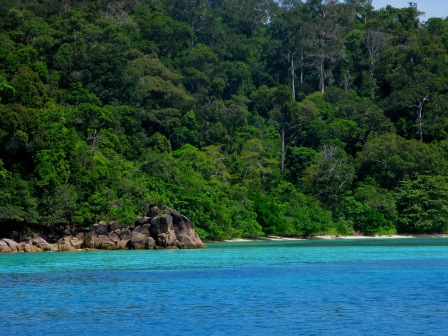
The end of the day frequently comes with magnificent sunsets, often accompanied by sea eagles returning to their nests and cicadas starting their calls along with many birds settling down for the night, making the 6 to 10 days and nights of the Visa Run round trip something to look forward to.

Wednesday, March 30, 2011

Ketoro on the Hard… and Liquid Glow...

The heading of this entry tells you that there are two stories here…first, life on the hard-stand and the second: well, no doubt you assumed that to be yet another sundowners drinks on deck experience. Wrong! But we will start with the second, as it needs to be borne in mind constantly while you are trying to visualise the images for story number 1.

Liquid Glow

Society’s better circles refer only obliquely and then very discretely to bodily functions – we do not plumb the depths here but merely consider the innocuous process of perspiration. So on a particularly hot day ladies might refer to having a glow about them, as they wave their fans/retreat to shade/order iced tea. Thailand is an exceptionally hot and humid country; Phuket Island particularly so; and the hottest month is April (which is why Thai New Year in April, Songkrans, is celebrated by tossing bucket-loads of water over people…. in the streets, in their cars, wherever you come upon them… and the recipients are grateful). In March 2011 an early heat wave assaulted us and the accompanying discomfort and lack of dignity defies adequate description. You cannot move without glowing. Unfortunately this glow liquefies and simply streams and in the course of daily life gushes and pours, dripping off every appendage (nose, ears, fingers, chins, and even the bits hiding under clothes) and announces itself by transforming clothes into rumpled and sodden rags. Life in a sauna…

On the Hard: the boat

Now onto our story of Ketoro “on the hard”: this means that the boat was lifted out of the water (man with mask checks that the slings under water are placed accurately on reinforced areas and not damaging parts), rudders were removed,
        
Underwater flora and fauna dislodged using a high-pressure water jets,
And the boat was moved to a space on the Boat Lagoon hard-stand where she was chocked on supports to hold her up and steady for the duration.
The ‘out of water’ work commenced – full servicing of the engine drives, re-doing the antifoul paint (the contractors a mere eight months ago evidently neglected to deliver and apply some of the paint we had paid for) and replacing the rudders and rudder shaft bearings. In addition while we had her out – checking and tuning the mast and standing rigging, repairing some gelcoat cracks, servicing engines and genset and compressor and water maker, repairing sails and sail battens, fault finding on the battery invertor / charger, fault finding on the engine alternators / regulators, replacing the blown sea water pump on an engine and cleaning up the alternator that subsequently got sprayed with sea water (fortunately this blew the day before entering Boat Lagoon – and not the day after we left!); servicing the outboard motor, replacing cockpit speakers, repairing cockpit door, modify cockpit table, make up new anchor bridle and mooring ropes, end-for-end the main halyard and sheets, etc. All good clean fun!

Of course this necessarily involves sharp edges, tools, corroded fittings, narrow spaces and high temperatures and the yachting imperative for daily blood-letting is assured. While many tasks on this very long list were attacked by contractors, others were DIY. Visualise the image of Rolf: glowing as he hastens between contractors’ offices, checks on the boat progress, changes filters, becomes a sound specialist with cockpit speakers and plays with ropes… all done in Phuket heat and enclosed-in-boat intense hot stuffiness. Picture standing on the boat deck and roof, way above ground, intense heat and light reflected off the white (albeit very dirty) topsides and sun searing down as Irene (glowing) stitches the heavy canvas main sail cover.
The gusto, professionalism and efficacy of the contractors varied enormously and certainly did not meet standards dreamed of or suggested by their invoices, but in the end we were generally happy with what was launched back in the water 15 days later… however, this is a‘building industry’, and therefore there were issues, but these generally got resolved with tolerance and humour. The anti-foul guys discovered a bad section where there was separation between the balsa core and the fibreglass layers and this section was dug out and repaired.
There were also NEW issues that revealed themselves to us in the course of the boat-work tasks that we assigned ourselves to do… Rolf set about changing filters on the water-maker, which has two sections: for de-salinating sea water and also for fresh-water flushing / backwashing itself. Turns out the latter section was dry as a bone. Nope: has never functioned. We know the de-salinator works (after long previous unhappy history; but we are now gratefully drinking fresh water from it) and have always assumed the other section was doing what it was supposed to do. Investigation revealed that this area had not been plumbed into the whole system when put together in Cape Town. We distantly remember the builder wearing a (relatively) troubled expression during some aspects of this installation, so he obviously eliminated the problem area by by-passing it. Rolf became a (glowing) plumber and after many hours and parts purchases, our water-maker is able to give itself a fresh-water flush.

On the Hard: us

Some people choose to stay on their boats while they are on the hard. This choice involves a home with no plumbing (with workers underneath and people walking by, it appears a little antisocial to simply discharge your drain / sewage water onto the concrete beneath the boat!), huge quantities of dust and fibreglass powder, no space to move, a real clamber to get on and off the house (there are five on board in the pic below: count the shoes…)… and a permanent GLOW. While considerable time was spent clambering up and down and working on the boat, we did not sleep there and only cooked there occasionally (taking dirty dishes down to the nearest tap on the hard for washing; the photo shows Rolf in our “front garden” with new rudders in the foreground waiting to be placed).

Our choice therefore required renting a small apartment at the resort alongside the hardstand; only a small hotel room with bathroom (we were surprised at the patched sheets and stained towels, and suspect these are allocated to rooms rented at discount prices to long-stay yachties…), it nevertheless had the luxury of aircon, endless water in the shower, aircon, TV, servicing twice a week and … aircon! The days’ activities sometimes went as follows: on boat at 8:30, glow; spend some hours working there or running around supply stores, GLOW (go to apartment for cold shower), return and repeat (go to apartment for cold shower and aircon), return and repeat (turn aircon onto really cold setting).
The luxuries we enjoyed at the apartment also included being able to remain in touch with world news (CNN and BBC: gotta love them, although they do repeat and repeat…); access e-mail easily; get on top of admin; washing boat cushion covers (in a bucket, then hang over line in the searing heat in front of the aircon exhaust, tastefully placed on the small balcony, which does however boast this picturesque view) and best of all: watch DVDs on the computer while indulging in take-outs brought over by the local food stalls: rice, massaman curry and chicken and cashew nuts for the princely total of 120ThB (less than SAR30). Then there was the coffee shop with great cheap iced coffee and aircon… and wifi. Then there was the local supermarket: turns out a great place to stand in front of the refrigerators and pretend you are going to buy something…. and meet other yachties!!

There was a meal or two on the boat and as the sun set we were bathed by a glow of a different sort: the lights of the resort behind us and… the glow of the light from the men’s public toilet (seen here behind our boat braai). This highlighted an observation that we have made on many occasions in Thailand: men’s urinals are situated to be seen by all passing by.

We enjoyed several evenings with friends, one a genuine South African braai! Such meat…. such piles of food…. such super people…. such memories! Bittersweet memories were made as we took a last trip to see friends anchored off our Christmas beach, to say farewell. We said goodbye to many, hoping nonetheless to see them on the water somewhere, and were happy to make new acquaintances of some who will be participating in the up-coming rally with us.

The best thing about having Ketoro on the hard stand was that she was not in the water at Boat Lagoon. Well, that seems self-evident, but here is the reason why… Phuket Boat Lagoon Marina is situated in a dredged-out mangrove swamp: at high tide it all looks (and is) glorious but at low tide the boats are sitting in the mud. Flush the loo: draw black mud into the system; start any engine: ditto into the cooling system. The top photo was taken from a portlight (side hatch/window) of the boat at high tide on a previous stay; the next taken from the same place at low tide… glorious.
So Ketoro was placed back in the water at high tide (standing on the deck as the travel-lift drove us forward (pic below) it seemed impossible that she would fit, and indeed it is a tight squeeze: we cannot even put fenders down both sides) and, determined not to put our newly-refurbished boat into this cesspit we tied up to the fuel dock for a few hours of outstanding work on the battery charging system then off we went before the tide ebbed, heading for Ao Chalong and planning to clear out at customs / immigration / harbour master the next day.
Best-laid plans: the boat…

Toilets… An hour into the sail we realised we had no working toilets and the next morning we realised the charging systems not only had not been fixed…. they were worse than before and we could not charge batteries with our engines. However, everything else seemed to be functioning well…

So our evening arrival at Ao Chalong was followed by our (glowing) resident plumber turning his dab hand to the toilets; the problem was more than simply air in the system (they normally draw sea water) and several hours later Rolf managed to get some action into one toilet by pulling the deck wash hose through the hatch and blasting water through the supply pipe. The picture in your head should involve bilges open, bits and pieces exposed, plumbing fittings undone to gain access into the circuits, water liberally sprinkled across the hull and bilge alarms going… and the ubiquitous glow through the scowl.

However, the following morning’s dive to inspect the water intakes identified the real reason for the problem: the water inlets had been painted over with several layers of anti-foul paint by the over-zealous painters! We are happy with the apparent thickness of the paint, as judged by the thickness prised off the toilet and other water inlets…!

Electrics… Another day’s delay saw the electricians return to the boat, and this time they actually appeared to fix the problem with the battery charging… and we were able to get underway to Malaysia. (A day later, miles from anywhere, we discovered that the problem has not been resolved- and the ‘solution’ according to our resident handyman was to lay in a large stock of spare fuses at the first opportunity.

Bugs… A few days later, we have found another gift from Boat Lagoon: infestations of little flying beasties… flies, midges, some biting things… a range to keep an entomologist busy for days! It seems the previous generation of these insects had found glorious cover in our sails / lockers / canvases and laid eggs to guarantee perpetuation of the species: well, sorry, but when the eggs all hatched the offspring were Doomed on this boat!

Best-laid plans: where to?

Any distant thoughts of heading for the Med are even more distant, after recent news of US yachties shot by pirates and a Danish yacht with 4 adults and 3 teen children now held in Somalia. The rest of the Blue Water Rally yachts (of which both these boats had been participants but had headed off separately at the time they were attacked) have been placed on a ship to be carried as deck cargo to Turkey. But we have also heard of one such yacht-carrier being hijacked- and with the yachts on board distributed to fellow Somalians, no doubt. Apparently many yachts somewhere on passage to the Med have turned around to return to SE Asia, and possibly some will be with us on our next venture…

Our coming journey of about 2500 nautical miles will take us along the Malaysian coastline: down the west coast of peninsular Malaysia to Johor / Singapore at the southern tip, then up the east side to Kuala Terengganu, across to Kuching on Borneo and up that coast to end near Kota Kinabalu at the northern tip of Borneo, as participants of the Sail Malaysia Rally. Currently on our way, but only to Langkawi, we need plan the passages into new territories in more detail… and reminisce about all the previous visa-run trips we have made down here…. but that is for the next blog!

Monday, March 14, 2011

Thailand’s Similan Islands and tourist Phuket

The Similan Islands: beaches of the softest, whitest sand; great boulders tumbling into the sea and beautiful vibrant green hillsides. We sailed here with Mark and Livi (an overnight sail from Phuket - not repeated on the return journey as we had by then learned how many floating fishing nets, fish traps and buoys there are out there, impossible to see at night, and that lurk there to wreck imprudent yachtsmen…) and enjoyed these islands enormously.
We snorkeled in the clear turquoise seas of the Similans; enjoyed the view from Sail Rock on Similan 8, enjoyed some great scuba dives and had sundowners on the beach with the family and other friends for Irene’s birthday. The islands boast probably the most beautiful clear waters in Thailand, with excellent snorkeling and diving… still; this comment comes as the Parks Department has recently shut down Similans 1 to 3 to protect them, and there is talk that the temperature of the Andaman sea has increased such that enormous coral bleaching has taken place.

Swimming around the boat became somewhat perilous, however, when Rolf came under attack…. from a young, energetic (hawksbill?) turtle!
One of the biggest killers of turtles at sea is plastic bags: turtles eat them, evidently mistaking them for their natural foodstuff viz. jellyfish. A section of Rolf’s swim fins are an opaque white and the rest of us first discovered the turtle when we heard screams and yells from the water: Rolf was “under attack”! He tried to fend off the turtle by flapping (how fast can a flap be: underwater…!?) his fins in its face… a strategy that got the turtle even more excited as it appeared convinced that the flappy white things were tasty jellyfish! However, turns out this fellow is just extremely curious… on other occasions he came disconcertingly close to investigate what we were. We are reminded of a certain incident in the Seychelles when Barry “came under attack” from a curious giant tortoise… the Ketoro crew appears hare-like in the tortoise race. The Ketoro men are also establishing a tradition of squealing like girls when confronted with such terrors!

The trip to the Similans was made after a few days in familiar territory to us, beautiful Phang Nga Bay, where the bright yellow croc canoe came in handy to explore the steep islands with their hidden-access hongs and caves.
These caves house their own isolated and wonderful ecosystems including dozens of small crabs each with one huge, over-developed claw. Some of us are fearless with animals (unlike the turtle / tortoise club) and Livi took a close look at these lovely crabs.
There are many other things to do on a boat holiday: fling yourself off the roof of the boat playing “fetch the ball”, have arm wrestling competitions, pat dinner-plate-sized jelly fish on the head … or, if a little more sedentary and cautious, play scrabble, swim or read!
Phuket is a tourist island. Although we have been in this area for about eight months, for most of that time we have been working or travelling elsewhere or enjoying the all-weather protection of the Phang Nga Bay area as the SW monsoon season has prevented us from sailing along the beaches on the west coast of Phuket, which is where it is all laid on for tourists. Well, this has now changed! With Mark and Livi, and then Ilana when Mark left us (Ilana being subjected to a crash course in boat-showers, sea baths, boat-loos, dinghy-work etc), we cruised up and down this picturesque coastline and enjoyed all it had to offer: beaches lined with loungers-under-umbrellas, interspersed with low-key, inexpensive but lovely local food restaurants and massage shops or platforms (for your en-masse massage in public); beaches with no road access that were therefore ours alone after the longtail boats left to take their day trippers home; and long beaches that house upmarket resorts and associated restaurants and bars.
All of these had their appeal and provided wonderful experiences, with the only drawback being the jet-skis on the more busy beaches. Jet-ski drivers appear to get bored five minutes into their 30-minute ride, so liven up their own experiences by seeing what yacht people are doing on board or making “doughnuts” around the boats as close as possible (creating an annoying wake). The best moment however came when two young guys on a jet ski, clearly impressed by the two young ladies on board, got really close and proceeded to show off their prowess: which was clearly deficient, as the jet ski spectacularly flipped over! They did not return…

One of the multi-resort beaches provides a huge draw card: two young elephant from the Phuket Fantasea show are walked on the beach twice daily, so we made sure to be anchored off Ban Tao to enjoy this sight ourselves. Lily and Lucky are only about 3 years old, but do all one would expect of show elephants including bow, dance, kiss the tourists and play a mouth organ; the best however was simply to watch them being ellies and giving themselves sand baths.
Of course, we made use of many opportunities to get off the boat and explore the beaches (on foot), the island, all its facilities, its Big Buddha and Temples using motorbikes or tuk tuk; here, Liv and Ilana are at the southern-most tip of Phuket, Phromthep Cape.
So, as one does on these holidays, we ate, we drank, we got massages, we trawled the retail opportunities …. and, as one does, one got tattoos!
The Ketoro arm wrestling champion challenged the rest of the crew to a final contest around a restaurant table, an activity that surprised the customers at nearby tables... but inspired the restaurant owner to take up the challenge too. The tiny but sprightly Thai gentleman however had age against him – and the champion of course – and we feel our champion remains supreme (despite graciously letting him win).
Eating out is always both an adventure and a culinary treat. The latter because Thai food has variety, is tasty and of consistently high standard wherever one eats: at a restaurant, a small cafĂ©, a food court, a market or a hawker’s trolley. The former because of the menus! Of course, at tiny food stalls there are no menus and only one or two dishes are prepared; at others the menus are only in Thai (sometimes helpfully accompanied by pictures, which seldom resemble reality… in one case, the original caption reflecting the internet source of the picture was still visible!). In many, however (particularly in tourist Phuket) the name (and a description) of the dish is given in English … that is the entertaining part! We have previously put up a picture of a menu where one could eat potato shit (chip); the following shows that when ordering fish you may have it fried, frued or even freed (to cater to vegetarians?). Many restaurants proudly offer Uropien dishes (not my spelling!) particularly Gordon Blue Chicken.
After our wonderful holiday it was again serious business for the regular Ketoro crew: we sailed the boat to Langkawi (Malaysia) and back (with dawn departures along with other yachts doing their visa runs, and full sailing days) to fetch our new rudders and then lift the yacht out onto the hard stand in Boat Lagoon (Phuket)… where she now sits, looking awfully forlorn and out of her element!
We are preparing for a four month, 2500 mile trip along the Malaysian coast… down the Malacca Straits on the west coast, round Singapore, around up the east coast of the peninsula and then across to the East Malaysian provinces on Borneo and finally up to the Phillipines. And then? No answers to that question yet….

Friday, February 25, 2011

The Kingdom of Cambodia

We first saw Cambodia from a boat on the Mekong River, stepping ashore at their Customs and Immigration which already looked remarkably different from all we had seen in Vietnam and Laos: distinctive pagoda-style entry to the customs / immigration building complex and the Khmer people who are bigger and lighter-skinned than their Vietnamese neighbours.

We are still entranced by travelling a country by boat, so enjoying sitting back and watching the world and its changing vistas sweep past. The river and countryside on the Cambodian side of the Vietnam border was quieter than in its neighbouring country where our boat trips had revealed busy floating markets and fishing as well as incredible industry on the river including commercial scale dredging of sand from the river bed – a highly prized (and priced) commodity used for construction in this low lying, silty / muddy delta area. In Cambodia we saw far less river traffic, fewer farmers, almost no industry immediately apparent; however, the agriculture appeared to be more extensive large-farm business, very different from the market-garden type businesses we had seen lower down the river.

This changes as you approach Phnom Penh and turn from the Mekong onto one of its tributaries, the Tonle Sap River: most of the river traffic in this part is carrying dredged building sand.... and why more of these sand carriers do not sink is a mystery! In the photo, the one at the back (laden) used to have a waterline as the one in the foreground…. And yes, it is moving! They are fully laden to the extent that the decks are awash and they constantly pump out the water that is flooding in. We saw one that was so overloaded that a second boat had tied on alongside to help with pumping out water simply to keep it afloat!! Clearly there are incentives to arrive with plenty of cargo....


Phnom Penh

Our first sighting of Phnom Penh was the ornate pagoda roofing of the Royal Palace from the river: exotic and beautiful! PP is a relatively young city and very modern in appearance, with an extensive waterfront (Sisowath Quay) adorned with flags from almost every country, and lawns providing space for jogging and martial arts exercises in front of the restaurants, bars and hotels. A great place for watching the sunset over the Royal Palace and Silver Pagoda (Erik’s pic below).

Two days in this young city (1800’s) was spent walking the streets (apart from the main streets, little attention is paid to street names; they are all simply given numbers: even numbers run one way and odd numbers the other), and visiting markets and Buddhist Pagodas (Cambodian Wats / temples).

Cambodia is recovering from decades of warfare and violence, including carpet-bombing by the Americans during the Vietnam / American war and then four years of rule by Pol Pot and his genocidal Khmer Rouge in their brutal ‘restructuring’ of Cambodian society to make it more Maoist and peasant-oriented. Everyone knows the history, but a visit to the Choeung Ek Memorial (at one of the “Killing Fields” which are described as “… ad hoc places for execution and dumping grounds for dead bodies during the Khmer Rouge regime 1975-1979”); and Tuol Sleng Genocide Museum (former S-21 prison) is sobering but, we felt, necessary to try to get a better understanding of what the people had endured.

We left PP on a north-bound bus for Siem Reap - a 350km journey; air-conditioned and sufficiently comfortable.... and costing only $6!!!! Generally the buses in SE Asia are very good…. not luxury but they work well, are clean, perfectly adequate seats (no, not reclining), comfortable for 6+ hours and very cheap. They always leave on time - but almost never arrive at the promised time!

The 6hour trip was fascinating: all homes are on stilts, with the space under the houses evidently shared by the animals (pigs, water buffalo, ducks, dogs….), children and adults as they eat, play, work or rest on their hammocks (blurry, taken-from-bus photo!). In this dry season the stilts appear unnecessary but Cambodia has, for half the year, the biggest fresh-water lake in SE Asia…. The Tonle Sap Lake. When the rains come the Mekong River pushes up into its Tonle Sap river tributary which then reverses direction and causes the lake to expand 10-fold. In a flat country the effect on the landscape and on the lives of the inhabitants is incredible.

Siem Reap and the Angkor Archaeological Park

Siem Reap, Angkor Wat, Banteay Srei…. For so much of my life I have savoured these exotic words in my head and tried to visualise what they represented. Well, it was all far bigger and more wondrous than my imagination could dare.

The millennium-old ruins of the Angkorian-era Khmer Empire, the Angkor Archaeological Park, is a UNESCO World Heritage Site and described as the largest religious monument ever constructed. Angkor literally means “Capital City” or “Holy City” and now refers to the capital city (cities, actually) of the Khmer Empire (900 to 1300 AD) and also to the Empire itself. The Angkor dominance once extended over all of Thailand, Laos, Vietnam and Kampuchea (Cambodia).

Obtaining a three-day pass, we went there by tuk-tuk: a wonderful way to see the transition from the busy Siem Reap town to rural sights amongst quiet villages and farming areas.

Entering the Angkor Park, we enjoyed avenues of trees surrounding large lakes, were surprised to see a few villages within the park itself, then exclaimed around each corner as we came upon many large and small ruins, all revealing something of ancient Khmer architecture, civilisation and art. We were taken aback by the huge expanse of land that is the Angkor Park (97 sq km), and the fact that this houses dozens of temples, mostly the remnants of a succession of Angkorian empires. At its peak, this area contained more than a million people and the Khmer kings built extensive waterworks and other infrastructure to service the temple structures.

A timeline of the Angkor area shows the successions of kings, dominance of religions (the shift from Hinduism to Shivaism, again Hinduism then Buddhism) and associated archaeological styles is useful; guidebooks help, as can guides; but much of the beauty of the place is in moving away from the throngs, finding a space and simply absorbing the magnitude and history of it all, trying to visualise the circumstances and people of the time and marvelling at the construction, architecture and artwork.

The sandstone and laterite crumbling stone reliefs, great towers, palaces, temples, passageways, magnificent carvings, jungle backgrounds, moats and high walls seen all around the park make this a fascinating and mysterious destination.

Angkor Wat (top photo; surrounded by a moat and high exterior wall) is legendary for its artistic and archaeological significance, with many of the walls covered with bas-reliefs and carvings depicting the story of the times, interwoven with legend;

the giant faces of Bayon (four carved faces on each of more than 30 towers, oriented towards the cardinal points) are spectacular, recognisable images;

at the Ta Prohm Temple enormous fig, banyan and silk-cotton trees have been allowed to encroach on the temple structure, giving it a creepy atmosphere (and providing the site of the movie Tomb Raider!). But there is incredible beauty and fascination in all of the sites… you need to give yourself time, wear a hat and lots of sunscreen, take litres of water, be patient outside the temple areas where a myriad vendors sell souvenirs and trinkets for a dollar, and – when you get “templed-out” – return to Siem Reap to recover for the next day’s trip!

Siem Reap is the town near the Angkor Park, and also a great place to visit for itself! The town is a cluster of villages that developed around individual pagodas, and these villages are now linked together. The colonial architecture, Old French Quarter and Old Market make it a fun place to hire a bicycle and roam the streets, stopping off for a cheap beer or coffee, or a massage (or even a fish-massage, see Rolf below...) for those aching limbs!

We found a great, cheap place to stay in the heart of the old town and at the entrance to the night market (at $15 per night our room was the most expensive in the place, but WE had private bathroom, hot shower and aircon! Hmm… this was, however, after two days of mishaps with accommodation…). The town, however, is bursting with tourists and offers an incredible range of hotels and guest houses, from very pricey to a dodgy $2 per night!


The range of bars and restaurants reflects tourist needs too, but we ate and drank wonderfully well, as usual. Generally throughout SE Asia our plates of food seldom went above $4 (Rolf once went big with a $6 main meal!) and we had some meals-with-drinks-for-4 that came to a princely $12 total. Generally "local is lekker" and we enjoy eating where and what the locals eat (above: a Cambodian BBQ at a food court… in front of their bar, clearly!), savouring the tastes and textures of local cuisine and coffee (strong... with a dash of condensed milk...) but occasionally the lure of the familiar (grilled meat, latte coffee) takes you to a westernised place where you pay the penalty (although that is never more than we would pay back in SA).
Siem Reap is a real tourist town, with its “Pub Street”, entertainers and vendors in abundance, but it is so easy to support the local vendors ($1 = 4000 riel, but dollars are used everywhere and the goods are extremely cheap), be entertained and enjoy the cheap pubs so a visit is memorable and repeat visits advised. The deep contrast of the light entertainment of the town with the exotic mystery of Angkor Park make for an irresistible destination.