Ok, fine, this is a long story! But Vietnam is a long, amazing, absorbing country and we could not do justice to our trip there without putting it all down for ourselves. Bear with us, read this (there are lots of photos to sweeten the pill...), then…. Go there on holiday!
Rolf and I came here to meet Erik and Diana after our trip to Laos (see previous blog….)
Hanoi
Oh my word.... what a shock!! From the peaceful city of Luang Prabang in Laos to the exceptionally busy, noisy streets of 1000-year-old Hanoi; from a city of about 100 000 to a city of about 8 million with its associated noise and traffic; from a city where the dominating colour was the orange of monks’ robes to one where the colour is the red and yellow of the thousands of flags and banners! The experience of Hanoi was almost unbelievable.
Hanoi is situated on the banks of the Red River but the river plays only a small role in the tourists' stay there. Much of the tourists’ enjoyment comes from the Old Town area, which is found to the north of Hoan Kiem Lake.
Old Town Hanoi has kept the original street layout and architecture: 36 streets, each one named according to the merchants specialising there.... hence Shoe Street, Jewellery Street, etc. A foray into old town is absolutely fascinating, revealing so much industry crammed into every available space… placed up against bare walls or squashed into exceptionally tiny stores of dilapidated structures or on the ground floor of beautiful (although often unkempt) classical Vietnamese and old French buildings; these are interspersed with occasional striking entrances to Chinese temples and alternate with a huge range of local eating houses and restaurants as well as several clubs and bars.
There is endless fascination in watching the local people going about their business, many of their old ways still very evident; classic pictures of tiny Vietnamese people in their conical hats abound, hawking their wares on bicycles or carried in two bamboo baskets at the ends of a pole over their shoulders (these are VERY heavy!)
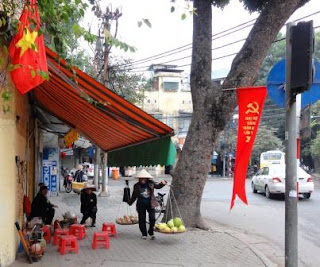
But the first thing that hits you (well, hopefully not literally!) is the traffic. There are apparently about 6 million motorbikes in Hanoi. It is not clear whether there are any road traffic regulations at all: they (probably) drive on the right hand side of the road, as most people seem to do this, most of the time, but there is a catch: when the huge multi-lane streets are totally congested the motorbikes also drive on the pavements / sidewalks.. en masse! The only clear rule seems to be: "hoot". Hoot all the time, everywhere. Let them know you are there; tell them you have seen them; tell them you are coming / turning /stopping.... do it all by hooting. It is a cacophony. The traffic is frenetic, noisy, chaotic, lawless.... but it is also pragmatic and allows others to get where they need to go too. Of course, together with the scooters are the many cars, cyclos (rickshaw-type bicycles) and trucks as well as hawkers plying their trade from their bicycles or shoulders. The bicycle-hawkers could sometimes not be seen for the amount of product carried on their bikes; sometimes the product itself is the point of interest… like a huge pink pig, suitably trussed and lying horizontally across the pillion seat.
The rule for you, the pedestrian needing to cross the road? Tally ho! Walk. Do not look at the driver about to land on top of you as he will then believe you have seen him and that you will therefore give way for him. So walk and stride confidently forward.... they will make way for you. Well, with heart in mouth, that is just what we did. It is not easy or fun or a happy experience. And we must confess to more dodging than the above rule would imply was necessary, but we succeeded.... and were always grateful (and laughing… a touch of hysteria!?) when reaching the other side.
We need to talk about the weather, a topic generally to be avoided. Unless it is remarkable. Well, we forayed into our travelling areas armed with the knowledge that the winter average high/low in Hanoi was supposed to be 19/14 degrees Centigrade. Hence we equipped ourselves with essentially warm weather clothes for the areas further south and a stock of warmer layers for the colder north... brought-from-the-boat-in-the-tropics thermal underwear, beenie and gloves. Ha! Hanoi was beset by “a cold snap” so…. Irene bought several jackets and scarves; Rolf bought gloves and appropriated Irene's scarves, then bought his own scarf (very dapper, our skipper is becoming….). Erik and Di bought jackets, scarves, gloves, beenies.... Hanoi's warm-clothes sellers, both at shops and the mobile street hawkers like below, had a bonus year with the tourists (and the locals) in January 2011!
Thus cocooned, we thoroughly enjoyed our Hanoi experience of street-walking and cyclo-touring along with visits to the Temple of Literature and Ho Chi Minh Mausoleum and Museum. Getting to grips with Vietnam’s history is challenging as only some parts are presented to you, depending where you are at the time. However, you come away with a sense of horror at what the populace has endured, an empathy with the Viet people and above all a deep respect and admiration for them now as being generally warm and friendly and not dwelling on the past. It is very evident, particularly in North Vietnam, how beloved Ho Chi Minh was, and still is, and his humanity and empathy with his people.
Not joining the hundreds of locals eating on tiny plastic chairs on the pavement around their small fires, squashed between the retail and the motorbikes, we ventured into smaller local café/ restaurants, an experience that is always interesting what with interpreting the menu (variations on a theme in the English translations always amusing, as also trying to understand WHAT the dish is) to deciding whether what was received actually reflects the order, to understanding the staff…. In one case, after a 30 minute wait, we were told in no uncertain terms that “there is problem, your food is not coming”; our puzzled expressions at this bit of news became even more puzzled as another staff member materialised behind the first, bearing beautifully plated food (...hope it was ours!)
Hanoi is a great place to visit, both for the huge sensory impact it offers and also as a base to set off for Sapa and to Halong Bay. So tourists get here and set about arranging trips to these destinations, often armed with the following bits of information:
1. Go to Sinh Café travel agent (we had heard this from others, and several Lonely Planet guides recommend it.)
2. Beware of being scammed by travel agents.
HA! Re point 1: There must be at least 50 Sinh Cafes travel agents in Hanoi, Old Town (tourist trawling route). There is a strategy amongst travel agents/tour offices and amongst restaurants in Hanoi: get the newest Lonely Planet / Frommers / Trip Advisor and see who they recommend. Immediately re-name your shop accordingly, and support this with a banner that proclaims “As recommended by …etc” or “This is the one GENUINELY recommended by….etc”. Refer to point 2 now… what chance do you have, really, in getting what you paid for!?
Happily, the hotel in which we were staying provided trip-arranging services and they never went wrong (although we were seldom given tickets, an alarming practice that caused some anxiety as we were dropped off in the dark at odd railway stations and found ourselves stumbling across the railway tracks wondering which ancient coach was ours and what sort of trip this next one was to be….!)
Sapa
From Hanoi, we set off on a local overnight sleeper train for Sapa; booked a “soft-berth, four-sleeper”... and were delighted to actually get it, as tales of people finding themselves in the “6-berth, hard bed” option abound. In the latter, you sleep on woven steel slats about a foot below your neighbour; our “luxury” option had narrow mattresses and 2 fewer bunks… However, it is still a train in a 3rd world country, where the definition of luxury would surprise many. But surrounded by our carry-on snacks and Laos rice wine we were fortified for the fun experience of shared close accommodations and rocking Asian train toilet facilities, some eminently avoidable even when at a station…!
Sapa is a magnificent mountainous area far north, near the China border, where we (almost froze to death in the 2 degrees and yet) enjoyed treks to the villages of the local Hmong ethnic communities. Many of the beautiful views of this area were hidden from us due to the heavy fog (or "frogs" as our Hmong lady guide described it) but as we trekked lower down we were able to see the incredible terraced rice fields at the sides of mountains sometimes so steep that the rice paddies were merely 2m wide.
We loved being amongst the ethnic villagers in their traditional clothing (regular daily wear, not just for tourists, it seems), learning from them of their way of life and observing old farming practices (grain crushing with rotating stones and water-powered hammers), seeing their interaction with their animals, with water buffaloes as domestic pets (Irene somewhat surprised on a narrow path on a steep hill as she felt an unexpected nudge from behind… she decided to be prudent and give the buffalo right-of-way); we were delighted that we had hired the recommended gum boots from the hotel (although unsure why, at the time) and enjoyed the strength and support of the tiny Hmong guide-women as we slipped our way down the incredibly steep slopes in the mud (sheer drop-offs protected by side-rails? Don’t be ridiculous!) … they deserved every dong they earned from us when we bought some of their crafts as souvenirs!
Nonetheless, one still engages in the bargaining game, negotiating upwards from 50% of their original offer. We have proved to be very bad at this game, and the goods are so cheap anyway…. At US$1 to 20 000 Vietnam Dong (VND) however, your brain is always on the go making conversions. Strangely, Rolf and I convert everything to Thai Baht these days! Home?
Halong Bay
The Sapa stay was followed by (a sleeper train return to Hanoi then bus trip to Halong and) an overnight cruise on a junk-type boat in Halong Bay, in what the Vietnamese call the East Sea and we knew as the South China Sea.
What a beautiful area! Similar to the geography of Phang-Nga Bay in Thailand, Halong Bay has a greater density of giant sheer limestone rock islands jutting up out of the sea (the Thais would describe as “same same… but different”) … and much greater density of tourist traffic on overnight boats of many sorts: but no private yachts as Vietnam is not geared to handling that type of tourism.
Two great days were spent enjoying the natural spectacle from the junk and kayaks (Erik and Irene skillfully and gracefully steering their vessel above…) and we were taken on trips to spectacular caves and fascinating floating fishing villages.
Tiny but exceptionally strong local ladies are very skilled at poling tourists around in their basket-type boats … and getting us out of the mud when the tide was too low. We were delighted not to be skipper and crew of the junk when it also got stuck in the mud and enjoyed the very robust approach taken by the skippers with their boats!
Hoi An
Arriving late in this town we wandered mostly empty streets trying to find a bite to eat, ending up in a tiny-plastic-chair-on-pavement scenario. The classic Vietnamese dish of noodle soup (Pho, pronounced her with an F!) from a mobile stall that had disappeared in the morning warmed us and the next morning our first stop was retail…. a trip to the tailors. They did good business with our little party… but we came away happy too!
Hoi An: an old-world town, UNESCO World Heritage Site of quaint buildings mostly beautifully restored, this was an important port trading mostly with China and Japan, and the influences on the buildings can be seen, along with those of the French occupation too. This is a small town, fun to walk and cycle, with interesting nooks and crannies in its many winding roads and alleys and a range of opportunity to meander the streets and eat, view the history and shop.
A chartered longtail (motorised sampan) ride down the Thu Bon River showed us life on the river, with many fishing boats with their painted eyes (a Buddhist practice) and took us to wood carving and boat building villages.
Across Vietnam huge (and small) marble carvings are seen and many originate from the village at the base of the Marble Mountains near Hoi An which are the source of the stone. The mountains are interlaced with fascinating ancient caves, some of which are Buddhist sanctuaries and contain beautiful shrines.
Never judge by appearances: an old lady (wizened, bowed, skinny, with betel-stained red teeth) firmly took over and indicated that we needed a guide and she would be it, notwithstanding the fact that we had no language in common. She scampered ahead of us up all the steep paths within the caves, demonstrated procedure at the shrines… and proved a capable photographer, determinedly arranging our positions appropriately for both their and the site’s best display!
We left this central area of Vietnam on a train, to travel south to Ho Chi Minh City, a trip that gave us an afternoon of sight-seeing and a night’s accommodation. Again on the “luxury” option, this time it was even more grimy and subserviced and less “luxurious” than before, but at least we did have something which might be called mattresses, and there were only the four of us in our cabin. We were glad of the silk sleeping bags bought in Hanoi in preparation for just such circumstances. A young Dane next door, convinced that he had been scammed and that this could not possibly be the “soft-berth, four-sleeper” option he had paid for, was surprised to hear our assurances of the integrity of his tour agent.
What a wonderful way to travel! A fascinating countryside passed by our window: small villages or clusters of homes alternating with emerald-green patchwork paddy fields, farmers in long loose clothing and conical hats tending their fields, natural woods, rivers and canals. We enjoyed the enterprising cart that occasionally came around to sell beers and watched the plethora of hawkers at the sidings and stops as their only chance for business that day pulled in. We watched the backpackers and local train travellers hopping on and off at the stops… and were interested to see the “hot-bed” practice in operation, where the new passengers getting on the train are treated to the departing passengers’ bedding….
Ho Chi Minh City (Saigon)
This city was visited primarily to see significant sites of Vietnam’s history, but we enjoyed our short stay here for observations of life on the Saigon River and streets too, and crossing roads proved only slightly easier than in Hanoi. Spot the pedestrians making their way away from the Ben Thanh Market on the pedestrian crossing below… spot the concern on the faces of the drivers…!
Trips to historical sites in Saigon were sobering, terribly sad, maddening and enlightening. The War Remnants Museum provides a thorough, albeit awfully graphic at times, presentation of the wars involving the French colonialists and subsequently the Americans (emphasising the atrocities of the latter although giving the side of the USA too... although not in this poster below). In fact it became clear that the news and ‘fact’ that had been routinely delivered to western listeners did little to reflect the role of the USA in and the complexities of the situation underlying the Vietnam / American conflict.
A trip to the Cu Chi Tunnels (at the southern end of the Ho Chi Minh trail) gives an amazing picture of the resolve of the Vietnamese in fighting their war. Irene and Erik, the least claustrophobic of the four of us, braved these tiny, pitch-black tunnels, crawling on our knees and finding it unimaginable that people could live their lives, hold meetings, hide ... and fight a war in here.
Journey on the Mekong River to Cambodia
At each stage still nervous of being scammed, we nevertheless set off on a trip from Saigon (HCM City) in Vietnam to Phnom Penh in Cambodia. Our trip involved a couple of hours by bus (which broke down after the first 30 minutes… a bad moment! However, this was fairly soon remedied and there were no further mishaps of this nature); then a river boat; then a stop at a river-side rice alcohol plant and then a floating fruit/vegetable market (item for sale tied at the top of a pole rigged on the boat); then another boat up a watercourse - which unfortunately had dried into an un-navigable mud channel due to some combination of tide and current; then onto bicycles when the boat could not proceed any further because of the mud; to another boat to an overnight floating hotel (quite the worst cesspit we have ever endured – own silk sleeping bags and sarongs essential to avoid infection and infestation!), which gave us wonderful dawn sights of life at this river-side village, Chau Doc.
Another river boat carried us to a river side border post between Vietnam and Cambodia after which we had our final boat ride to Phnom Penh and some forms of wheeled transport to our hotel…. All this instead of a 90 minute flight from Saigon to Phnom Penh: what a wonderful, enjoyable experience and great way to travel!
What is not to love about travelling in this country? It was a treat and privilege to have experienced some small part of Vietnam …. Now for Cambodia! (Blog to follow….)
Saturday, February 19, 2011
Wednesday, February 16, 2011
Laos - we love it!
Oh, wow, guys…. Just do yourselves a favour and get here! Green mountains, deep narrow valleys, threads of rivers at the base, a few roads appearing as tracks meandering seemingly without intent: this is the picture of northern/central Laos from the air, as far as the eye can see.
Our little turbo-prop plane with flower (frangipani) decoration had been waved an enthusiastic good-bye by a line-up of Laos Airlines ground-staff at Bangkok airport... did they know something about this flight? It appeared however that this little ceremony was merely an indication of the warm welcome we would receive from the Lao people. There are only about 6 million of these small, fine-boned and slim people and most of them live along the Mekong River. It is remarkable that these folk have retained their relaxed and friendly disposition despite years of French colonial occupation and then being the most bombed country in the world (in a war in which they did not participate) – thanks to USA carpet bombing to try to close the Ho Chi Minh Trail during the Vietnam / American war. (Interesting that in SE Asia the ‘Vietnam war’ is known as the ‘American war’).
Luang Prabang city, a UNESCO World Heritage site, appears to occupy the only relatively flat area in the region – at the confluence of the Nam Kong (the Mekong) and Nam Khan rivers. What a wonderful city to visit: this French colonial town developed around the 60+ Buddhist temples and monasteries which are all still active. So walking and cycling the streets reveals French provincial-style houses alongside typical SE Asia houses (ground floor of conventional brick and plaster and with upper floors of beautiful timber)... many of which have been converted to guest-houses... situated alongside Buddhist Wats. The three main streets are connected by narrow, cobbled, arcade-type alleys (all clean and safe) with interesting buildings, stalls and people around every turn.
With two river frontages and riverfront streets in the little town plus the maze of quaint cobbled lanes, the French legacy of restaurants providing endless beer, coffee and people watching is perfectly preserved, and diluted only by the proliferation of roadside stalls and massage shops. The local people move their Lao food and souvenir street stalls between open / street market locations... “So you will find me here in the morning, Madame, and there this evening”. The main street turns into a huge night market at 6pm daily: gaily lit, musicians playing, cheap food and wonderful fruit smoothies and a massive number of stalls selling a range of silks, silvers, wooden artefacts etc. We, of course, made full use of absolutely everything on offer… although doing only “window-shopping” at the markets: there is no space to store anything on a boat, so retail therapy, while never big in our lives, is definitely a thing for another life…
There are interesting sights around every corner: on the banks of the clear Nam Khan, local people tending their market gardens of vegetables for the market, children (and novice monks) and pets swimming; on the muddy Mekong the busy river traffic of ferries, tour boats and fishermen, with delightful pictures of goats / crates of beers / lounge chairs all carried on the roofs of the boats... all having a tough time trying to berth in a very strongly-flowing river!
Restaurants on stilts line the river banks – the local ones offering cheap local food and beer (often BeerLao at 2000 Kip where $1 = 8000 Kip … prounced keep) and the ones belonging to the fancy hotels ever ready to offer you western food, at a far greater price - all while watching the sun set over the mighty Mekong river.
Saunter around another corner and you may come upon the sight of many locals congregating at their local Wat to receive a blessings service, or prayer-time for a group of monks where tourists may sit quietly and enjoy the chanting… and the occasional sight of the young novices becoming distracted occasionally and behaving like…. well, youngsters the world over!
Many of the Buddhist temples in and around the town provide facility for the Buddhist practice of every male becoming a novice monk for a period of a couple of weeks to a few months at some time in their lives – generally during their teens or early twenties. This resulted in hundreds of these novice monks in their orange robes in town and provided interesting insights… On the one hand to see the youngsters in their orange robes playing in the river or mock fighting in the corridor…
… and on the other hand participating in the solemn daily ceremony of collecting alms - every morning at sunrise, hundreds of monks from the various monasteries walk through the streets collecting alms from kneeling locals (and tourists) comprising of sticky rice and bananas (and chocolates!) in a process of "making merit": if you give food to others in this life, you will not go hungry in your next life. This is a peaceful, quiet ceremony that, when over, is immediately replaced by busy streets of tuk-tuks, motorbikes, cyclists and pedestrians making the most of the relatively small area between the two rivers.
Luang Prabang has several natural and historical sites: renting a motorbike is the best way to get to them, and took us on meandering trips into the countryside (albeit on a dodgy bike on dodgy roads!). One such trip took us to caves with hundreds of donated Buddha images: Tam Ting (Pak Ou) Caves. Unfortunately restoration and maintenance of some historical sites comprises covering the walls with whitewash, a jarring sight in natural caves, and many of the Heritage Sites are uncared for and dirty. In some of the Wats in Laos there appears to be little maintenance, and restoration appears to have stopped (which is a good thing in some cases as often the restoration attempts are crude and obvious and detract largely from the Wat itself. However, general dusting and cleaning would be good as some do not receive even this basic care.)
On our way back from the caves, we came upon a local rice-wine producing village and so invested in two bottles for future consumption, avoiding the wines with hooded cobras or scorpions in them. Apparently the snakes are bottled without being milked of their poison, but after 6 months it is safe to drink, the toxin presumably having been denatured by the alcohol (and having formed a product necessary for ones general potency, we assume!?)
This day also brought us upon a Chinese Buddhist temple the Santi Cheidy (Peace Pagoda), built in 1988, which, below the row of lovely paintings of a life of prayer and good work, has the most extraordinary paintings of violent and usually bloody deaths: a hint of hell?
Our time in Luang Prabang was really wonderful and we could have spent much longer here than the 5 days we had allocated! We are determined to return to this extraordinarily lovely place and extend our visit to adventure activities near Vang Vieng and also in the capital, Vientiane. But we had to leave…. we had a date with Erik and Diana in Hanoi, Vietnam! Those fun ‘n games stories are in the next blog….
Our little turbo-prop plane with flower (frangipani) decoration had been waved an enthusiastic good-bye by a line-up of Laos Airlines ground-staff at Bangkok airport... did they know something about this flight? It appeared however that this little ceremony was merely an indication of the warm welcome we would receive from the Lao people. There are only about 6 million of these small, fine-boned and slim people and most of them live along the Mekong River. It is remarkable that these folk have retained their relaxed and friendly disposition despite years of French colonial occupation and then being the most bombed country in the world (in a war in which they did not participate) – thanks to USA carpet bombing to try to close the Ho Chi Minh Trail during the Vietnam / American war. (Interesting that in SE Asia the ‘Vietnam war’ is known as the ‘American war’).
Luang Prabang city, a UNESCO World Heritage site, appears to occupy the only relatively flat area in the region – at the confluence of the Nam Kong (the Mekong) and Nam Khan rivers. What a wonderful city to visit: this French colonial town developed around the 60+ Buddhist temples and monasteries which are all still active. So walking and cycling the streets reveals French provincial-style houses alongside typical SE Asia houses (ground floor of conventional brick and plaster and with upper floors of beautiful timber)... many of which have been converted to guest-houses... situated alongside Buddhist Wats. The three main streets are connected by narrow, cobbled, arcade-type alleys (all clean and safe) with interesting buildings, stalls and people around every turn.
With two river frontages and riverfront streets in the little town plus the maze of quaint cobbled lanes, the French legacy of restaurants providing endless beer, coffee and people watching is perfectly preserved, and diluted only by the proliferation of roadside stalls and massage shops. The local people move their Lao food and souvenir street stalls between open / street market locations... “So you will find me here in the morning, Madame, and there this evening”. The main street turns into a huge night market at 6pm daily: gaily lit, musicians playing, cheap food and wonderful fruit smoothies and a massive number of stalls selling a range of silks, silvers, wooden artefacts etc. We, of course, made full use of absolutely everything on offer… although doing only “window-shopping” at the markets: there is no space to store anything on a boat, so retail therapy, while never big in our lives, is definitely a thing for another life…
There are interesting sights around every corner: on the banks of the clear Nam Khan, local people tending their market gardens of vegetables for the market, children (and novice monks) and pets swimming; on the muddy Mekong the busy river traffic of ferries, tour boats and fishermen, with delightful pictures of goats / crates of beers / lounge chairs all carried on the roofs of the boats... all having a tough time trying to berth in a very strongly-flowing river!
Restaurants on stilts line the river banks – the local ones offering cheap local food and beer (often BeerLao at 2000 Kip where $1 = 8000 Kip … prounced keep) and the ones belonging to the fancy hotels ever ready to offer you western food, at a far greater price - all while watching the sun set over the mighty Mekong river.
Saunter around another corner and you may come upon the sight of many locals congregating at their local Wat to receive a blessings service, or prayer-time for a group of monks where tourists may sit quietly and enjoy the chanting… and the occasional sight of the young novices becoming distracted occasionally and behaving like…. well, youngsters the world over!
Many of the Buddhist temples in and around the town provide facility for the Buddhist practice of every male becoming a novice monk for a period of a couple of weeks to a few months at some time in their lives – generally during their teens or early twenties. This resulted in hundreds of these novice monks in their orange robes in town and provided interesting insights… On the one hand to see the youngsters in their orange robes playing in the river or mock fighting in the corridor…
… and on the other hand participating in the solemn daily ceremony of collecting alms - every morning at sunrise, hundreds of monks from the various monasteries walk through the streets collecting alms from kneeling locals (and tourists) comprising of sticky rice and bananas (and chocolates!) in a process of "making merit": if you give food to others in this life, you will not go hungry in your next life. This is a peaceful, quiet ceremony that, when over, is immediately replaced by busy streets of tuk-tuks, motorbikes, cyclists and pedestrians making the most of the relatively small area between the two rivers.
Luang Prabang has several natural and historical sites: renting a motorbike is the best way to get to them, and took us on meandering trips into the countryside (albeit on a dodgy bike on dodgy roads!). One such trip took us to caves with hundreds of donated Buddha images: Tam Ting (Pak Ou) Caves. Unfortunately restoration and maintenance of some historical sites comprises covering the walls with whitewash, a jarring sight in natural caves, and many of the Heritage Sites are uncared for and dirty. In some of the Wats in Laos there appears to be little maintenance, and restoration appears to have stopped (which is a good thing in some cases as often the restoration attempts are crude and obvious and detract largely from the Wat itself. However, general dusting and cleaning would be good as some do not receive even this basic care.)
On our way back from the caves, we came upon a local rice-wine producing village and so invested in two bottles for future consumption, avoiding the wines with hooded cobras or scorpions in them. Apparently the snakes are bottled without being milked of their poison, but after 6 months it is safe to drink, the toxin presumably having been denatured by the alcohol (and having formed a product necessary for ones general potency, we assume!?)
This day also brought us upon a Chinese Buddhist temple the Santi Cheidy (Peace Pagoda), built in 1988, which, below the row of lovely paintings of a life of prayer and good work, has the most extraordinary paintings of violent and usually bloody deaths: a hint of hell?
Our time in Luang Prabang was really wonderful and we could have spent much longer here than the 5 days we had allocated! We are determined to return to this extraordinarily lovely place and extend our visit to adventure activities near Vang Vieng and also in the capital, Vientiane. But we had to leave…. we had a date with Erik and Diana in Hanoi, Vietnam! Those fun ‘n games stories are in the next blog….
Monday, January 3, 2011
Christmas in Thailand
Well, it promised to be different, and it both was and was not; but Christmas and New Year in Thailand was lovely!
Creatures of habit and needy for the safe and familiar (well, in some aspects of our lives...), we annually decorate our lives with Christmas trimmings and surround ourselves with loved ones and, hopefully, the spirit of Christmas. So it was that we tried to place ourselves and our floating home in similar Christmas circumstances this year… in a Buddhist-mostly / Islam-the-balance country, with no beloved family or old friends around us. And we had a great Christmas…. not so different from previous, really!
Yachts, as you may know, are generally a touch sort on storage space, so we do not have a box of Christmas decorations / tinsel / tree... so began the improvising: first preparations for Christmas were done in Langkawi (Malaysia, a wholly Muslim country, so it was a surprise to go to a large supermarket and find, not just a large rack of Christmas decorations and cards for sale, but the ladies behind the tills wearing typical red and white Christmas hats! One of them mentioned that at Christmas they become” just a little bit Christian”…! Prudent businessmen, some of the stores are Chinese-owned and they know their market; in fact, although pork is not allowed in Malaysia, yachties know where to buy it: “past the market, third road left, fourth house on the left, wait till there are no Muslims in the shop then ask quietly and they will go to their back freezers….” We supplemented our decorations with beautiful pieces of driftwood and lovely rocks collected on a beach at our (so-far) southernmost Malaysian anchorage in a beautiful fjord-like setting with island cliffs soaring up on both sides of a narrow channel in which we were anchored.
Our wherewithal was taken up to Thailand, where we cleared into the country while based in Ao Chalong (Bay on the south of Phuket Island) and spent a week doing chores, dentists (Irene’s temporary filling of Rolf’s molar won no awards), computer work and shopping… finding pork and Christmas products easy to come by. Phuket really had Christmas blooming, with decorations and carols in the big centres; however, public Christmas displays only start appearing about mid-December here, very different from the October start we remember from SA, and the extent of the decoration in Phuket was beautiful but far more subtle in quantity.
So we sat on our boat in rolly Ao Chalong, looking up at the Big Buddha at the highest point, listening to the many firecrackers set off by Buddhists to chase away bad spirits and in the evenings hearing the Muslims called to worship over loudspeakers in the nearby village, all as we sorted out our small Christmas arrangement... what an amazing experience! Note the two decorative captains...
The NE monsoon season only really set in on 20 December, making it reasonable for boats to start enjoying the western (tourist) beaches of Phuket at last. Unseasonal SW monsoon winds had caught many unawares, tossing about a dozen of the very expensive King’s Cup Regatta racing yachts onto a west-facing beach, along with one cruising yacht. The rest of the cruising fleet had retreated to sheltered waters or anchored at a safer distance from the beach and used real anchors!
Various previous trips by scooter to the west coast beaches in the low (SW monsoon) season had revealed beautiful beaches but little provision for tourists. In the current high season, what a hugely different picture the beaches are! Huge expanses of beautiful white sand, bedecked from end to end with gay umbrellas and countless loungers; food stalls, bars, massage stands at regular intervals..... what a treat! THIS is what cruising is about... easy anchorages, beautiful clear seas, stunning coves and beaches which can generally be accessed easily with the dinghy, giving the option of beach walks, shore food and massages!
At our first night’s anchorage on this west coast we felt festive enough to put the Christmas lights up and decorate the “tree”: read Christmas driftwood! A celebratory meal enjoyed under the lights.... then the lights were quickly relegated to “short use only, special times” status as we found they drew 6 Amps from the house battery!! So we returned to enjoying the evenings under our solar-lamps, with the Christmas lights on.... for short intervals ... at special times only!!
The evenings in high season are very beautiful: warm, balmy, starry, twinkly colourful shore lights and decorations reflected in the sea … but it turns out these evenings are not restful. Every night from about 23 December to 30 December, no matter which beach we were anchored off (with the exception of one day-only beach), we watched and listened from the boat as fire-dancers twirled their flaming two-headed batons, fireworks were sent up and parties on shore continued loudly until at least 3 am. Noise travels well over water… and not much sleep was enjoyed by some.
Lifting anchor and moving to the next beach every two days was a great routine until we reached Nai (Beach) Yang, our planned Christmas beach, alongside Phuket airport... where the planes appeared to be landing on a beach towel at times!
The beach was glorious and we found a spot to take the dinghy in and remain dry: we often arranged to meet boat friends on shore and at least one couple would arrive sodden and dripping – having experienced a ‘dinghy surf dump’!
The Christmas social gatherings involved drinks on board boats or drinks and meals on land while a great Christmas day was spent with about 16 other yachties having a picnic in a park under huge trees (in the background of the photo above). On commenting that this was the first time since 1978 that we had been without family for Christmas, the observation was made: “well, we are all orphans here!” Orphans with an average age of 60…!
Our BEST (well, only) gift…. an OOB.
Three Australian and a Canadian couple had joined us for an extended evening of drinks and snacks on Ketoro’s deck one evening and one of our glasses was accidentally knocked overboard (on reflection, it is a wonder that one does not lose even more crockery / cutlery / friends overboard on evenings like this…!). The next morning our Canadian friends (not the guilty party) were found snorkelling round the boat trying to locate the glass for us (no success)… and gave us this gift! Since we also needed it explained to us …. an OOB is an Object Over Board locator: toss the heavy end bit (which can be made of anything at all) over immediately your precious object is lost, and the float will identify the spot for you.
Something else new for Ketoro: we had one of these on board!
This is Hayley (2) and she brought her sister, Mum and Dad, two cousins, aunt and uncle and granny for the day to Ketoro. The weather played ball so full use was made (at different times, obviously) of the croc, dinghy, full sails, snorkel gear… and any space we could find anywhere, for the necessary provisions! This picture of Hayley was taken about 5 hours after she should have slept, but she was so busy skippering the boat and ensuring there were teeth in the group photo below that there was too much sensory overload and she just kept going… until she collapsed!
Collapse is something that Rolf and I did too… on New Year’s Day, after sailing 40 miles from our NY Eve venue, having had precious little sleep the night before… but we are ahead of ourselves…
Thai people love to celebrate. The Thai New year, in April, is celebrated with great gusto, apparently; so is the Chinese New Year; and we can attest to the fact that the night of 31 December is a huge night in their calendar! The parties on every previous evening did not prepare us for the enormity of the spectacle of the New Years’ Eve celebrations on Patong Beach. We sailed into Patong Bay about midday to anchor near friends, on whose large catamaran a group of us was to gather for the evening. By the time evening fell, there were well over 100 sailing yachts around us, as well as other “gin palaces” and fancy large charter motor boats.
Imagine a beach 8km long, end to end with hotels or resorts and each of these is providing a fireworks show for its guests. Add to this the music from each place, which is in any event being drowned out by the music blared from the beach loudspeakers for the thousands of beach revellers and the mighty BOOMS of the industrial strength fireworks. Then add the piece de resistance: floating fire lanterns, each over a metre high, being sent up in their hundreds so that the night sky at every moment from about 8pm to 2am is dotted with hundreds of orange glowing balls. This remarkable sight, added to the continuous fireworks picture, is reflected in the water in front of our boats over the whole stretch. Mesmerising and magical.
There were moments of tension, as about 20 of the lanterns did not soar all the way but rather burned the paper lantern and left the flaming heat source to plummet into the sea around the boats; greater tension arose when idiots on a boat nearby started firing distress flares from their boat: an illegal activity and exceptionally dangerous. These flares are incredibly hot and still burn when they hit the water (or boat). Happily no damage was done.
So Christmas and New Year in Thailand, surrounded by the pragmatism and tolerance of the local communities and the kindness and warmth of new-found friends, was wonderful!
And NOW we have some family time.... we are off to Laos, Vietnam and Cambodia tomorrow, to travel with Erik and Diana, Irene’s brother and sister-in-law!
Creatures of habit and needy for the safe and familiar (well, in some aspects of our lives...), we annually decorate our lives with Christmas trimmings and surround ourselves with loved ones and, hopefully, the spirit of Christmas. So it was that we tried to place ourselves and our floating home in similar Christmas circumstances this year… in a Buddhist-mostly / Islam-the-balance country, with no beloved family or old friends around us. And we had a great Christmas…. not so different from previous, really!
Yachts, as you may know, are generally a touch sort on storage space, so we do not have a box of Christmas decorations / tinsel / tree... so began the improvising: first preparations for Christmas were done in Langkawi (Malaysia, a wholly Muslim country, so it was a surprise to go to a large supermarket and find, not just a large rack of Christmas decorations and cards for sale, but the ladies behind the tills wearing typical red and white Christmas hats! One of them mentioned that at Christmas they become” just a little bit Christian”…! Prudent businessmen, some of the stores are Chinese-owned and they know their market; in fact, although pork is not allowed in Malaysia, yachties know where to buy it: “past the market, third road left, fourth house on the left, wait till there are no Muslims in the shop then ask quietly and they will go to their back freezers….” We supplemented our decorations with beautiful pieces of driftwood and lovely rocks collected on a beach at our (so-far) southernmost Malaysian anchorage in a beautiful fjord-like setting with island cliffs soaring up on both sides of a narrow channel in which we were anchored.
Our wherewithal was taken up to Thailand, where we cleared into the country while based in Ao Chalong (Bay on the south of Phuket Island) and spent a week doing chores, dentists (Irene’s temporary filling of Rolf’s molar won no awards), computer work and shopping… finding pork and Christmas products easy to come by. Phuket really had Christmas blooming, with decorations and carols in the big centres; however, public Christmas displays only start appearing about mid-December here, very different from the October start we remember from SA, and the extent of the decoration in Phuket was beautiful but far more subtle in quantity.
So we sat on our boat in rolly Ao Chalong, looking up at the Big Buddha at the highest point, listening to the many firecrackers set off by Buddhists to chase away bad spirits and in the evenings hearing the Muslims called to worship over loudspeakers in the nearby village, all as we sorted out our small Christmas arrangement... what an amazing experience! Note the two decorative captains...
The NE monsoon season only really set in on 20 December, making it reasonable for boats to start enjoying the western (tourist) beaches of Phuket at last. Unseasonal SW monsoon winds had caught many unawares, tossing about a dozen of the very expensive King’s Cup Regatta racing yachts onto a west-facing beach, along with one cruising yacht. The rest of the cruising fleet had retreated to sheltered waters or anchored at a safer distance from the beach and used real anchors!
Various previous trips by scooter to the west coast beaches in the low (SW monsoon) season had revealed beautiful beaches but little provision for tourists. In the current high season, what a hugely different picture the beaches are! Huge expanses of beautiful white sand, bedecked from end to end with gay umbrellas and countless loungers; food stalls, bars, massage stands at regular intervals..... what a treat! THIS is what cruising is about... easy anchorages, beautiful clear seas, stunning coves and beaches which can generally be accessed easily with the dinghy, giving the option of beach walks, shore food and massages!
At our first night’s anchorage on this west coast we felt festive enough to put the Christmas lights up and decorate the “tree”: read Christmas driftwood! A celebratory meal enjoyed under the lights.... then the lights were quickly relegated to “short use only, special times” status as we found they drew 6 Amps from the house battery!! So we returned to enjoying the evenings under our solar-lamps, with the Christmas lights on.... for short intervals ... at special times only!!
The evenings in high season are very beautiful: warm, balmy, starry, twinkly colourful shore lights and decorations reflected in the sea … but it turns out these evenings are not restful. Every night from about 23 December to 30 December, no matter which beach we were anchored off (with the exception of one day-only beach), we watched and listened from the boat as fire-dancers twirled their flaming two-headed batons, fireworks were sent up and parties on shore continued loudly until at least 3 am. Noise travels well over water… and not much sleep was enjoyed by some.
Lifting anchor and moving to the next beach every two days was a great routine until we reached Nai (Beach) Yang, our planned Christmas beach, alongside Phuket airport... where the planes appeared to be landing on a beach towel at times!
The beach was glorious and we found a spot to take the dinghy in and remain dry: we often arranged to meet boat friends on shore and at least one couple would arrive sodden and dripping – having experienced a ‘dinghy surf dump’!
The Christmas social gatherings involved drinks on board boats or drinks and meals on land while a great Christmas day was spent with about 16 other yachties having a picnic in a park under huge trees (in the background of the photo above). On commenting that this was the first time since 1978 that we had been without family for Christmas, the observation was made: “well, we are all orphans here!” Orphans with an average age of 60…!
Our BEST (well, only) gift…. an OOB.
Three Australian and a Canadian couple had joined us for an extended evening of drinks and snacks on Ketoro’s deck one evening and one of our glasses was accidentally knocked overboard (on reflection, it is a wonder that one does not lose even more crockery / cutlery / friends overboard on evenings like this…!). The next morning our Canadian friends (not the guilty party) were found snorkelling round the boat trying to locate the glass for us (no success)… and gave us this gift! Since we also needed it explained to us …. an OOB is an Object Over Board locator: toss the heavy end bit (which can be made of anything at all) over immediately your precious object is lost, and the float will identify the spot for you.
Something else new for Ketoro: we had one of these on board!
This is Hayley (2) and she brought her sister, Mum and Dad, two cousins, aunt and uncle and granny for the day to Ketoro. The weather played ball so full use was made (at different times, obviously) of the croc, dinghy, full sails, snorkel gear… and any space we could find anywhere, for the necessary provisions! This picture of Hayley was taken about 5 hours after she should have slept, but she was so busy skippering the boat and ensuring there were teeth in the group photo below that there was too much sensory overload and she just kept going… until she collapsed!
Collapse is something that Rolf and I did too… on New Year’s Day, after sailing 40 miles from our NY Eve venue, having had precious little sleep the night before… but we are ahead of ourselves…
Thai people love to celebrate. The Thai New year, in April, is celebrated with great gusto, apparently; so is the Chinese New Year; and we can attest to the fact that the night of 31 December is a huge night in their calendar! The parties on every previous evening did not prepare us for the enormity of the spectacle of the New Years’ Eve celebrations on Patong Beach. We sailed into Patong Bay about midday to anchor near friends, on whose large catamaran a group of us was to gather for the evening. By the time evening fell, there were well over 100 sailing yachts around us, as well as other “gin palaces” and fancy large charter motor boats.
Imagine a beach 8km long, end to end with hotels or resorts and each of these is providing a fireworks show for its guests. Add to this the music from each place, which is in any event being drowned out by the music blared from the beach loudspeakers for the thousands of beach revellers and the mighty BOOMS of the industrial strength fireworks. Then add the piece de resistance: floating fire lanterns, each over a metre high, being sent up in their hundreds so that the night sky at every moment from about 8pm to 2am is dotted with hundreds of orange glowing balls. This remarkable sight, added to the continuous fireworks picture, is reflected in the water in front of our boats over the whole stretch. Mesmerising and magical.
There were moments of tension, as about 20 of the lanterns did not soar all the way but rather burned the paper lantern and left the flaming heat source to plummet into the sea around the boats; greater tension arose when idiots on a boat nearby started firing distress flares from their boat: an illegal activity and exceptionally dangerous. These flares are incredibly hot and still burn when they hit the water (or boat). Happily no damage was done.
So Christmas and New Year in Thailand, surrounded by the pragmatism and tolerance of the local communities and the kindness and warmth of new-found friends, was wonderful!
And NOW we have some family time.... we are off to Laos, Vietnam and Cambodia tomorrow, to travel with Erik and Diana, Irene’s brother and sister-in-law!
Monday, December 13, 2010
Thailand over land and sea
It’s the diversity and variety that does it.
The last month has given us an amazing range of experiences and sights in Thailand -from huge modern cities to ancient city-sites, from forests and rice farms to islands and caves; we have seen diverse communities from well-heeled to impoverished in Bangkok, to the different ethnic communities ofthe Hillside Tribes in the mountainous northern areas on the border with Myanmar (Burma). We have seen night life ranging from the notorious Patpong Road in Bangkok (definitely not to be detailed!) to the lady-boys in Bangla Road of Patong (Phuket) to the famous Chiang Mai night markets to quiet local eating houses far north in Thaton – and very quiet evenings on the boat (punctuated by skipper’s selection of Francoise Hardy, Chris de Burgh, Neil Diamond and Percy Sledge – some people are beyond help)!
The plan was to join Sandy, Patrick and Ros in Bangkok; we had just over 3 weeks in total to see Bangkok and environs and the Chiang Mai area, thenon to Phuket and sail them down to Langkawi in Malaysia. Only the first night’s accommodation was pre-booked and no flights or other transport had been arranged: we organised everything as needs arose and plans developed.
Bangkok: amazing, fascinating, stimulating city!Poverty is seen alongside wealth, there is less litter and clearer skies than we expected, hectic and busy traffic yet very controlled and disciplined.
The city’s appeal is strengthened by its contrasts: walk past the expensive Erewan hotel and major fashion houses towards the street corner amidst the noise of 6 lanes of traffic that pass alongside each way and three overhead bridges that carry pedestrian traffic and two separate train services – and thenon the street corner hear beautiful Thai music and find a Buddhist shrine with dozens of locals coming in to pray, light incense and candles, or make a donation for beautiful petite Thai dancers to bless their love-life through elegant classical dance.
A trip down a canal on a longtail boat was another highlight particularly to see how people live alongside the river but also for the locks and for the appeal of these longtails.
In some areas, large-bore pipes pumped water back into the canal from the adjacent residential area (the residential areas were below water level); elsewhere we saw homes on stilts with floors only just above water level, while in other areas they did not have the luxury of stilts:picture a man sitting on his outside table happily swinging his gum-booted legs above the water that coveredthe floors of his house.... at other homes, washing was on the lines and life carried on despite the floors being awash with flood-waters.
All this is in contrast to the fantastic statues, gold stupa and rich jewels of the Grand Palace…alongside the food sellers where we ate delicious food in surroundings that would never tempt us to stop in our home country. We are constantly amazed that no one becomes ill from the primitive wash-up and food disposal facilities… which are nevertheless obviously effective.
Always fascinated by the exotic, the unknown and not-yet understood, we were delighted to see many monks: at work in the temples, on the streets, on ferries, going about their lives. We were told that all Buddhist boys or young men spend at least one week (but generally a couple of months) as a monk, in privation to understand the lot of the under-privileged. This perspective and the frequent sightings of young novice monks (just young boys growing up in another culture) took away some of the mystique surrounding monks but lent some clearer understanding of this culture.
You are regularly being confronted with trying to understand and explore other cultures when travelling in SE Asia. Near Bangkok is the ancient city of Ayutthaya – a capital city of a previous empire that ruled the area…Acres and acres of temples that were built / ransacked / re-built over centuries of warfare and invasion and counter-invasion with neighbouring kingdoms.
Chiang Mai in northern Thailand is a very touristy city, but nonetheless you are still able to imagine what it must have been like living in the old City surrounded by the moat and the huge walls, with a Wat on almost every street. Today, there is always a market happening somewhere, the best being on Sundays when they close many of the streets of the old town to traffic and you walk the miles of stalls and musicians -with your head turning and your neck twisting and your mouth bargaining and your arms carrying increasingly loaded packets! Whilst picking from all the foods on offer at a selection of food stalls, or sitting back for a foot massage, it is amazing to lift your eyes and see the unmistakable lines of the roof of a Wat and realise that the market is in the precious grounds of a temple - very unusual to our way of thinking.
Having the good fortune to be in contact with a young Lahu man, Lek, whose father, a Christian pastor, runs a tiny start-up orphanage way north of Chiang Mai, we spent two nights in the Thaton area, close to the Myanmar border. The Lahu are one of several Hill Tribe communities that live in the hills in northern Thailand, having apparently originated in China then ended up in Thailand after being chased down via Burma (Myanmar). They have their own culture and language and many earn income from their specific range of handcrafts. Lek and his father took us to a Lahu village where we were able to buy some craftwork directly from the villagers, then to a Thai military outpost on the Myanmar border, where it became apparent that borders of countries are often fluid: some of the military encampments on the top of each hill in our view were flying Thai flags, where two weeks previously they had been Burmese military posts. Lek’s family honoured us witha feast for lunch, including “black chicken”, a dish made from black-footed chicken where the meat has black streaks in it: this is tasty (just like white chicken) but in Chinese culture is regarded as a “medicine” as it is believed to possess special healing properties.
Reality checks!
How did we do these land travels? This was part of the adventure. We walked and walked; used scooters; got to know the local transport options well, early on; became relatively adept at understanding train routes and underground trains, learnt about which taxi / tuk-tuk/ shuttle to take when and where. We had an experience at every new abode, where we kept our costs down to below US$20 per double room: all had own bathrooms and (mostly) the rooms were clean; sometimes one had to lift the shower hose high to encourage the water heater to kick in, at other times strike the heater a sharp blow with a heavy object to achieve this result ; sometimes re-position the fridge to be able to reach the electrical trip switches near the roof; sometimes the loo and shower occupied the same 1.00 square metres and it was best to keep loo paper outside.
But at least there was loo paper; trips to the lavatory outside of places of accommodation necessitated familiarising yourself (especially the ladies) to different systems and methods, which were mastered early on and grown not to dislike.... except for uncomfortably saturated floors and what then to do with your clothing and bags? Personal hygiene was interesting on the street too: women unabashedly groom themselves and each other, to the extent of looking for nits in friends’ hair!
And another part of the adventure was being caught in a scam. After having read the warning, we STILL fell prey to the tuk-tuk drivers’ “You cannot go to the Palace today, they are having a ceremony. Come with us... for only 10 Baht we will show you the Golden Buddha then take you to...” (showing us on the map). Great! And the Wat with the Golden Buddha WAS actually a great visit, with the school Principal from over the way explaining so much, then promoting the concept of supporting local industries by using TAT (Tourism Authority of Thailand) for doing bookings and buying local products, e.g. jewellery and tailored goods. Thus it started... the trip to TAT, who were angry that we did not plan our whole holiday through them (“but we will give you big discounts”) and the trip to the tailors and jewellers, where the tuk-tuk drivers became angry at our lack of participation. The outcome was that we each lost about US$15 in the price we over-paid for rooms for the next 2 nights. We subsequently met tourists who used TAT to arrange all their transport and accommodations for weeks of travel, and it cost them thousands of Euros in over-payment.
Sailing again
Then we all had time (some guests would say “did time”, depending on how much they feel imprisoned by the confinement) onKetoro, as we sailedour friends from Phuket Island (Thailand) to Langkawi Island (Malaysia). We anchored off islands where we could get to beautiful hongs, lagoons and beaches (this time we were very familiar with our modes of transport… our trusty dinghy and croc canoe); we had sundowners on board and we had sundowners at lovely small pubs on islands (often featuring Bob Marley crooning in the background!)
And weAGAIN ticked the boxes for a lot of “firsts”. On the first day, we caught a jet ski (well, he caught us, the idiot…. and took our fishing lure away, attached to his handlebars… visualise his grimaces and Rolf’s gesticulations!), and then caught terra firma in the form of an underwater rock (or something, obviously unseen) when we stopped to buy prawns from a longtail boat and the fishing lure sank down. Getting your line free of an unseen huge object whilst on a boat that is being carried by a current, requires carefully going in astern without getting said line wrapped around the prop; turns out the task is impossible, but one does one’s best before admitting defeat and cutting the line.... the prawns were delicious.
We enjoyed seeing fish walking on water and birds surfing (respectively: pipe-like fish that shoot out the water then tail-walk or hop for hundreds of metres and birds that find rest from the arduous task of flying on bits of floating polystyrene or wood; when the water is rough it is fun watching the birds surfing this way!). We sometimes stopped way off land and simply jumped in to cool off... once being so audacious as all of us leaving the boat simultaneously... a “Look Ma, no driver” scenario that happily did not leave us floundering and abandoned.At times we played classical music to soar over the seas and call the whales or dolphins back to Thailand…. (figured Rolf’s Percy wouldn’t do it!)
We had our first glass and plate breakage from sliding off the table in a rolly sea... catamarans are pretty stable boats, and owners of monohulls are constantly amazed at our (non-plastic) crockery and our lack of need to put everything away, in most seas. Until the day we anchored at Phi Phi Island and sat down for lunch in a civilised fashion, on a calm sea.... and then an IDIOT driver of a day-tripper speed-boat came by close, at speed, causing such a huge wake that, despite many hands leaning forward to grab what they could from the skidding crockery, a glass and plate left us.
We caught our smallest fish ever (two were returned to their watery home, to warn their mates, while another two actually made delicious dinner on the braai!) and also our biggest catch... a huge fishing net (and the 40 ton fishing boat to which it was attached!) It took some underwater work by Rolf and somewhat anxious boat manoeuvring by Irene to sort that one out; the crew of the fishing boat were themselves anxiously watching to see whether a large blade was being used to free the net but we managed to get the net intact off the saildriveleg and the rudder blade where it had caught.
Another first:we did some dentistry on the boat ... Irene gave Rolf a temporary tooth from a baseline of nearly zero with the help of the on-board first aid kit!
Loi Krathong
Thai people have frequent celebrations and festivals, one of these being the LoiKrathong Festival when they give thanks for water and all they receive from it, by lighting lanterns and sending them skywards and also floating candle-lit boats (krathongs) of banana leaves. We were fortunate to be in Chiang Mai for the build-up to this festival, and joined in by sending up our own lantern dedicated to our departed family and friends, while on the actual night of LoiKrathong we were anchored off a beautiful island and floated three of our own home-made candle-boats. For days afterwards, when at sea we often saw floating remains of other Krathong, the festival having clearly been celebrated on islands and the mainland all over the country.
There is just so much in SE Asia. So much to see and do, remember and understand, hear and taste, plan and work out. There are just so many areas to visit to see so many exotic places, to feel and experience so many happenings, of such a diverse nature and magnitude. It is just astounding and breath-taking. Even the most mundane activity still results in the senses being bombarded with visual and auditory input of an exotic nature and demands huge involvement. This can be very tiring but the nature of the holiday does not allow any time-out!
And it is really while recalling it all that the scope of it dawns and becomes mind-blowing. While you are doing it and seeing it you are…. well, doing it and seeing it, and thinking about it and allowing your senses to absorb what they can. Reflecting on the whole and trying to isolate the experiences and your feelings about them at the end of a period of travel (in which, each day, you were exposed to so much of such great exotic-ness) is when it all becomes tricky…
The last month has given us an amazing range of experiences and sights in Thailand -from huge modern cities to ancient city-sites, from forests and rice farms to islands and caves; we have seen diverse communities from well-heeled to impoverished in Bangkok, to the different ethnic communities ofthe Hillside Tribes in the mountainous northern areas on the border with Myanmar (Burma). We have seen night life ranging from the notorious Patpong Road in Bangkok (definitely not to be detailed!) to the lady-boys in Bangla Road of Patong (Phuket) to the famous Chiang Mai night markets to quiet local eating houses far north in Thaton – and very quiet evenings on the boat (punctuated by skipper’s selection of Francoise Hardy, Chris de Burgh, Neil Diamond and Percy Sledge – some people are beyond help)!
All this we found while travelling from the mountainous Thailandborder with Myanmar to Phuket Island and then on to a sea entry into Malaysia at Langkawi Island. There was so much, that in sharing our travels with you we know that we cannot do it justice.Nonetheless, here is the story(sub-titled or bolded so you can identify sections to read or skip!), trying to capture some of the amazing sights and special moments….
The plan was to join Sandy, Patrick and Ros in Bangkok; we had just over 3 weeks in total to see Bangkok and environs and the Chiang Mai area, thenon to Phuket and sail them down to Langkawi in Malaysia. Only the first night’s accommodation was pre-booked and no flights or other transport had been arranged: we organised everything as needs arose and plans developed.
Bangkok: amazing, fascinating, stimulating city!Poverty is seen alongside wealth, there is less litter and clearer skies than we expected, hectic and busy traffic yet very controlled and disciplined.
The city’s appeal is strengthened by its contrasts: walk past the expensive Erewan hotel and major fashion houses towards the street corner amidst the noise of 6 lanes of traffic that pass alongside each way and three overhead bridges that carry pedestrian traffic and two separate train services – and thenon the street corner hear beautiful Thai music and find a Buddhist shrine with dozens of locals coming in to pray, light incense and candles, or make a donation for beautiful petite Thai dancers to bless their love-life through elegant classical dance.
A trip down a canal on a longtail boat was another highlight particularly to see how people live alongside the river but also for the locks and for the appeal of these longtails.
In some areas, large-bore pipes pumped water back into the canal from the adjacent residential area (the residential areas were below water level); elsewhere we saw homes on stilts with floors only just above water level, while in other areas they did not have the luxury of stilts:picture a man sitting on his outside table happily swinging his gum-booted legs above the water that coveredthe floors of his house.... at other homes, washing was on the lines and life carried on despite the floors being awash with flood-waters.
All this is in contrast to the fantastic statues, gold stupa and rich jewels of the Grand Palace…alongside the food sellers where we ate delicious food in surroundings that would never tempt us to stop in our home country. We are constantly amazed that no one becomes ill from the primitive wash-up and food disposal facilities… which are nevertheless obviously effective.
Always fascinated by the exotic, the unknown and not-yet understood, we were delighted to see many monks: at work in the temples, on the streets, on ferries, going about their lives. We were told that all Buddhist boys or young men spend at least one week (but generally a couple of months) as a monk, in privation to understand the lot of the under-privileged. This perspective and the frequent sightings of young novice monks (just young boys growing up in another culture) took away some of the mystique surrounding monks but lent some clearer understanding of this culture.
You are regularly being confronted with trying to understand and explore other cultures when travelling in SE Asia. Near Bangkok is the ancient city of Ayutthaya – a capital city of a previous empire that ruled the area…Acres and acres of temples that were built / ransacked / re-built over centuries of warfare and invasion and counter-invasion with neighbouring kingdoms.
A place under a tree to let the ambience quietly seep into your consciousness is one of the best ways to feel these ancient cities. Centuries from now, what will tourists make of the remains of Bangkok or, for that matter, Pretoria - our home town?
Having the good fortune to be in contact with a young Lahu man, Lek, whose father, a Christian pastor, runs a tiny start-up orphanage way north of Chiang Mai, we spent two nights in the Thaton area, close to the Myanmar border. The Lahu are one of several Hill Tribe communities that live in the hills in northern Thailand, having apparently originated in China then ended up in Thailand after being chased down via Burma (Myanmar). They have their own culture and language and many earn income from their specific range of handcrafts. Lek and his father took us to a Lahu village where we were able to buy some craftwork directly from the villagers, then to a Thai military outpost on the Myanmar border, where it became apparent that borders of countries are often fluid: some of the military encampments on the top of each hill in our view were flying Thai flags, where two weeks previously they had been Burmese military posts. Lek’s family honoured us witha feast for lunch, including “black chicken”, a dish made from black-footed chicken where the meat has black streaks in it: this is tasty (just like white chicken) but in Chinese culture is regarded as a “medicine” as it is believed to possess special healing properties.
Reality checks!
How did we do these land travels? This was part of the adventure. We walked and walked; used scooters; got to know the local transport options well, early on; became relatively adept at understanding train routes and underground trains, learnt about which taxi / tuk-tuk/ shuttle to take when and where. We had an experience at every new abode, where we kept our costs down to below US$20 per double room: all had own bathrooms and (mostly) the rooms were clean; sometimes one had to lift the shower hose high to encourage the water heater to kick in, at other times strike the heater a sharp blow with a heavy object to achieve this result ; sometimes re-position the fridge to be able to reach the electrical trip switches near the roof; sometimes the loo and shower occupied the same 1.00 square metres and it was best to keep loo paper outside.
But at least there was loo paper; trips to the lavatory outside of places of accommodation necessitated familiarising yourself (especially the ladies) to different systems and methods, which were mastered early on and grown not to dislike.... except for uncomfortably saturated floors and what then to do with your clothing and bags? Personal hygiene was interesting on the street too: women unabashedly groom themselves and each other, to the extent of looking for nits in friends’ hair!
And another part of the adventure was being caught in a scam. After having read the warning, we STILL fell prey to the tuk-tuk drivers’ “You cannot go to the Palace today, they are having a ceremony. Come with us... for only 10 Baht we will show you the Golden Buddha then take you to...” (showing us on the map). Great! And the Wat with the Golden Buddha WAS actually a great visit, with the school Principal from over the way explaining so much, then promoting the concept of supporting local industries by using TAT (Tourism Authority of Thailand) for doing bookings and buying local products, e.g. jewellery and tailored goods. Thus it started... the trip to TAT, who were angry that we did not plan our whole holiday through them (“but we will give you big discounts”) and the trip to the tailors and jewellers, where the tuk-tuk drivers became angry at our lack of participation. The outcome was that we each lost about US$15 in the price we over-paid for rooms for the next 2 nights. We subsequently met tourists who used TAT to arrange all their transport and accommodations for weeks of travel, and it cost them thousands of Euros in over-payment.
Sailing again
Then we all had time (some guests would say “did time”, depending on how much they feel imprisoned by the confinement) onKetoro, as we sailedour friends from Phuket Island (Thailand) to Langkawi Island (Malaysia). We anchored off islands where we could get to beautiful hongs, lagoons and beaches (this time we were very familiar with our modes of transport… our trusty dinghy and croc canoe); we had sundowners on board and we had sundowners at lovely small pubs on islands (often featuring Bob Marley crooning in the background!)
And weAGAIN ticked the boxes for a lot of “firsts”. On the first day, we caught a jet ski (well, he caught us, the idiot…. and took our fishing lure away, attached to his handlebars… visualise his grimaces and Rolf’s gesticulations!), and then caught terra firma in the form of an underwater rock (or something, obviously unseen) when we stopped to buy prawns from a longtail boat and the fishing lure sank down. Getting your line free of an unseen huge object whilst on a boat that is being carried by a current, requires carefully going in astern without getting said line wrapped around the prop; turns out the task is impossible, but one does one’s best before admitting defeat and cutting the line.... the prawns were delicious.
We enjoyed seeing fish walking on water and birds surfing (respectively: pipe-like fish that shoot out the water then tail-walk or hop for hundreds of metres and birds that find rest from the arduous task of flying on bits of floating polystyrene or wood; when the water is rough it is fun watching the birds surfing this way!). We sometimes stopped way off land and simply jumped in to cool off... once being so audacious as all of us leaving the boat simultaneously... a “Look Ma, no driver” scenario that happily did not leave us floundering and abandoned.At times we played classical music to soar over the seas and call the whales or dolphins back to Thailand…. (figured Rolf’s Percy wouldn’t do it!)
We had our first glass and plate breakage from sliding off the table in a rolly sea... catamarans are pretty stable boats, and owners of monohulls are constantly amazed at our (non-plastic) crockery and our lack of need to put everything away, in most seas. Until the day we anchored at Phi Phi Island and sat down for lunch in a civilised fashion, on a calm sea.... and then an IDIOT driver of a day-tripper speed-boat came by close, at speed, causing such a huge wake that, despite many hands leaning forward to grab what they could from the skidding crockery, a glass and plate left us.
We caught our smallest fish ever (two were returned to their watery home, to warn their mates, while another two actually made delicious dinner on the braai!) and also our biggest catch... a huge fishing net (and the 40 ton fishing boat to which it was attached!) It took some underwater work by Rolf and somewhat anxious boat manoeuvring by Irene to sort that one out; the crew of the fishing boat were themselves anxiously watching to see whether a large blade was being used to free the net but we managed to get the net intact off the saildriveleg and the rudder blade where it had caught.
Another first:we did some dentistry on the boat ... Irene gave Rolf a temporary tooth from a baseline of nearly zero with the help of the on-board first aid kit!
Loi Krathong
Thai people have frequent celebrations and festivals, one of these being the LoiKrathong Festival when they give thanks for water and all they receive from it, by lighting lanterns and sending them skywards and also floating candle-lit boats (krathongs) of banana leaves. We were fortunate to be in Chiang Mai for the build-up to this festival, and joined in by sending up our own lantern dedicated to our departed family and friends, while on the actual night of LoiKrathong we were anchored off a beautiful island and floated three of our own home-made candle-boats. For days afterwards, when at sea we often saw floating remains of other Krathong, the festival having clearly been celebrated on islands and the mainland all over the country.
There is just so much in SE Asia. So much to see and do, remember and understand, hear and taste, plan and work out. There are just so many areas to visit to see so many exotic places, to feel and experience so many happenings, of such a diverse nature and magnitude. It is just astounding and breath-taking. Even the most mundane activity still results in the senses being bombarded with visual and auditory input of an exotic nature and demands huge involvement. This can be very tiring but the nature of the holiday does not allow any time-out!
And it is really while recalling it all that the scope of it dawns and becomes mind-blowing. While you are doing it and seeing it you are…. well, doing it and seeing it, and thinking about it and allowing your senses to absorb what they can. Reflecting on the whole and trying to isolate the experiences and your feelings about them at the end of a period of travel (in which, each day, you were exposed to so much of such great exotic-ness) is when it all becomes tricky…
Tuesday, November 2, 2010
Getting back into it
Can we still do this? How do we…..??
These are some of the questions we are quietly asking ourselves as we adjust back to boat life after a wonderful month back “home” on land in SA.
For “do this” in our first question, read…. sail / live happily in the cramped circumstances of a small yacht / put ourselves into travelling situations many would never attempt / use the bathroom facilities of a boat / be entirely reliant on ourselves when in need far from any help / sleep at ease on a bed rocking and rolling / sacrifice the comfort of living on land with transport at hand in a city that can easily satisfy your every need and desire.
The reality is that the questions pertaining to the actual business of sailing have been building for a while…. All the time we have been tied up in the relative comfort of a marina and not pitting ourselves against the sea. But enough about this crisis of confidence. The answer to the question is simply…. Yes. Or if not immediately, it will come back. Or we will learn again…. whatever is required. Just do it. (I see some Obama slogans here, sidling up to those of renowned sportswear…. How depressing not to be original!!)
So we have returned from a sojourn in South Africa: a marvellous visit, with hind-sight this was a much-needed break from the boat and to re-acquaint ourselves with the lives of friends and family and touch base with who we are. “Who we are”? That has become somewhat of a quandary…. resentment in our first year at having TRANSIENT stamped on various documents has been replaced with a certain pride at not being wholly defined by our land of origin. Nonetheless, back in SA we slipped awfully quickly into the role of who we were: that mantle is comfortable with years of familiarity. Narration of certain tales, particularly those of the worst storm / worst almost-collision moments, brought about a feeling of “Was that me? This feels like somebody else’s life I am describing….”
But we are back now, finding our home undamaged by the storms that apparently lashed it while we were away and finding also that it is easy to call this boat home… another mantle of familiarity is making itself felt. Picking up the threads of this life, we have undertaken two small excursions that have each, in their way, re-affirmed to us why we are cruising.

We are cruising because it gives us relatively easy access to places and people on land we would otherwise not get to enjoy. So we set off on a scooter over Sarasin Bridge, leaving Phuket Island for the Thai mainland province of Phang Nga.

With no real agenda, we enjoyed small beaches and locals fishing off broken piers; endless roads lined with stalls and shops selling mostly the mundane but also sometimes the exotic: fruit, shrines, unrecognisable foodstuffs; ugly electrical reticulation highlighting the beauty of ornate decorative arches; beautiful waterfalls in natural forests (notwithstanding that 80% of the forest has been replaced by plantations of rubber or fields of pineapples); a clean, freshly-gifted shrine deep in the forest; unexpected harbour areas made gay with colourful flags on brightly-painted boats; and we enjoyed the fact that we were the only tourists around.


We are cruising because it gives us relatively easy access to places on the sea we would otherwise not get to enjoy. After we had languished for a month in SA we decided we needed to take the boat out to check all its systems in preparation for another trip to Malaysia (to renew visas) in the next few weeks. Ketoro, of course, has been languishing for about 2 months at her current berth in the marina so we were aware that, as we have grown rusty, so must she…. So it was time to blow out the cobwebs!
With a newly-refurbished (and actually functioning) water-maker we set off to explore some islands about five hours away. Within 20 minutes the anchor was down and Rolf was in the water investigating why 1) we were getting no revs from the engines and 2) we were not getting the boat speed we should from the meagre revs we were managing and 3) we were getting no boat speed and distance readings on the log - which impacts on our interpretation of weather conditions available for sailing etc. We knew the answer to the third: growth (good solid green stuff) on the impellor wheel, which Rolf freed after repeated dives under the hull and swipes with a sturdy scrubbing brush. The answer to the first questions? Growth too: barnacles. Exuberant in their numbers on the propeller blades and shafts, providing such resistance that the engines achieved only half their maximum revs and changing the face and shape of the propeller blades utterly so that we might as well have had bricks flailing around in the water trying to achieve forward motion.
We resumed our trip, deferring the barnacle problem until our destination, and set about raising the mainsail to make use of the wind and attempt to ignore our burdened propellers. When the sail was near the top of the mast, the electric winch cut out. No problem…. Must have tripped out from over-heating when it lifted and decanted a hundred litres of rainwater that had accumulated in the folds of the sail. Add to the list of ‘look into at our destination’!

Well, we reached Ko Roi and anchored in one of our prettiest spots ever.

Giant towering rocks above us, greened with trees and bushes determined to find nourishment in apparently hopeless circumstances; fish eagles gliding high above the chattering of other bird populations and a calm sea which showed us to the small entrance to a hong.

This hong (pictured with Rolf the explorer), accessed only by that small hole at sea level, is huge, with walls soaring skyward, dense with mangroves and its own seawater lake: home to fish and crabs.

Ko Roi also provided a lovely beach…. and a magnificent backdrop to the necessary activity of diving under the boat with gloves, scrapers and brushes to remove the tenacious barnacles from their new home. Some time later the propellers were clean of barnacles and had been polished to a gleam with scouring sponges… and the result was engines that attained full revs and an extra 2 knots on our speed! The problem of the electric winch required the owner’s manual, screwdrivers, spanners, some deft short-circuits to by-pass suspect components and finally a few well-chosen words on ascertaining that the circuit-breaker is itself broken. A beer also helped the process.

The current status? General un-readiness for sea on the part of the boat and crew has been addressed and all are fit to go! But first we head off on a land exploration of Bangkok and the northern highland areas around Chiang Mai before returning to take our home off to Malaysia…
These are some of the questions we are quietly asking ourselves as we adjust back to boat life after a wonderful month back “home” on land in SA.
For “do this” in our first question, read…. sail / live happily in the cramped circumstances of a small yacht / put ourselves into travelling situations many would never attempt / use the bathroom facilities of a boat / be entirely reliant on ourselves when in need far from any help / sleep at ease on a bed rocking and rolling / sacrifice the comfort of living on land with transport at hand in a city that can easily satisfy your every need and desire.
The reality is that the questions pertaining to the actual business of sailing have been building for a while…. All the time we have been tied up in the relative comfort of a marina and not pitting ourselves against the sea. But enough about this crisis of confidence. The answer to the question is simply…. Yes. Or if not immediately, it will come back. Or we will learn again…. whatever is required. Just do it. (I see some Obama slogans here, sidling up to those of renowned sportswear…. How depressing not to be original!!)
So we have returned from a sojourn in South Africa: a marvellous visit, with hind-sight this was a much-needed break from the boat and to re-acquaint ourselves with the lives of friends and family and touch base with who we are. “Who we are”? That has become somewhat of a quandary…. resentment in our first year at having TRANSIENT stamped on various documents has been replaced with a certain pride at not being wholly defined by our land of origin. Nonetheless, back in SA we slipped awfully quickly into the role of who we were: that mantle is comfortable with years of familiarity. Narration of certain tales, particularly those of the worst storm / worst almost-collision moments, brought about a feeling of “Was that me? This feels like somebody else’s life I am describing….”
But we are back now, finding our home undamaged by the storms that apparently lashed it while we were away and finding also that it is easy to call this boat home… another mantle of familiarity is making itself felt. Picking up the threads of this life, we have undertaken two small excursions that have each, in their way, re-affirmed to us why we are cruising.
We are cruising because it gives us relatively easy access to places and people on land we would otherwise not get to enjoy. So we set off on a scooter over Sarasin Bridge, leaving Phuket Island for the Thai mainland province of Phang Nga.
With no real agenda, we enjoyed small beaches and locals fishing off broken piers; endless roads lined with stalls and shops selling mostly the mundane but also sometimes the exotic: fruit, shrines, unrecognisable foodstuffs; ugly electrical reticulation highlighting the beauty of ornate decorative arches; beautiful waterfalls in natural forests (notwithstanding that 80% of the forest has been replaced by plantations of rubber or fields of pineapples); a clean, freshly-gifted shrine deep in the forest; unexpected harbour areas made gay with colourful flags on brightly-painted boats; and we enjoyed the fact that we were the only tourists around.
We are cruising because it gives us relatively easy access to places on the sea we would otherwise not get to enjoy. After we had languished for a month in SA we decided we needed to take the boat out to check all its systems in preparation for another trip to Malaysia (to renew visas) in the next few weeks. Ketoro, of course, has been languishing for about 2 months at her current berth in the marina so we were aware that, as we have grown rusty, so must she…. So it was time to blow out the cobwebs!
With a newly-refurbished (and actually functioning) water-maker we set off to explore some islands about five hours away. Within 20 minutes the anchor was down and Rolf was in the water investigating why 1) we were getting no revs from the engines and 2) we were not getting the boat speed we should from the meagre revs we were managing and 3) we were getting no boat speed and distance readings on the log - which impacts on our interpretation of weather conditions available for sailing etc. We knew the answer to the third: growth (good solid green stuff) on the impellor wheel, which Rolf freed after repeated dives under the hull and swipes with a sturdy scrubbing brush. The answer to the first questions? Growth too: barnacles. Exuberant in their numbers on the propeller blades and shafts, providing such resistance that the engines achieved only half their maximum revs and changing the face and shape of the propeller blades utterly so that we might as well have had bricks flailing around in the water trying to achieve forward motion.
We resumed our trip, deferring the barnacle problem until our destination, and set about raising the mainsail to make use of the wind and attempt to ignore our burdened propellers. When the sail was near the top of the mast, the electric winch cut out. No problem…. Must have tripped out from over-heating when it lifted and decanted a hundred litres of rainwater that had accumulated in the folds of the sail. Add to the list of ‘look into at our destination’!
Well, we reached Ko Roi and anchored in one of our prettiest spots ever.
Giant towering rocks above us, greened with trees and bushes determined to find nourishment in apparently hopeless circumstances; fish eagles gliding high above the chattering of other bird populations and a calm sea which showed us to the small entrance to a hong.
This hong (pictured with Rolf the explorer), accessed only by that small hole at sea level, is huge, with walls soaring skyward, dense with mangroves and its own seawater lake: home to fish and crabs.
Ko Roi also provided a lovely beach…. and a magnificent backdrop to the necessary activity of diving under the boat with gloves, scrapers and brushes to remove the tenacious barnacles from their new home. Some time later the propellers were clean of barnacles and had been polished to a gleam with scouring sponges… and the result was engines that attained full revs and an extra 2 knots on our speed! The problem of the electric winch required the owner’s manual, screwdrivers, spanners, some deft short-circuits to by-pass suspect components and finally a few well-chosen words on ascertaining that the circuit-breaker is itself broken. A beer also helped the process.
The current status? General un-readiness for sea on the part of the boat and crew has been addressed and all are fit to go! But first we head off on a land exploration of Bangkok and the northern highland areas around Chiang Mai before returning to take our home off to Malaysia…
Subscribe to:
Posts (Atom)
